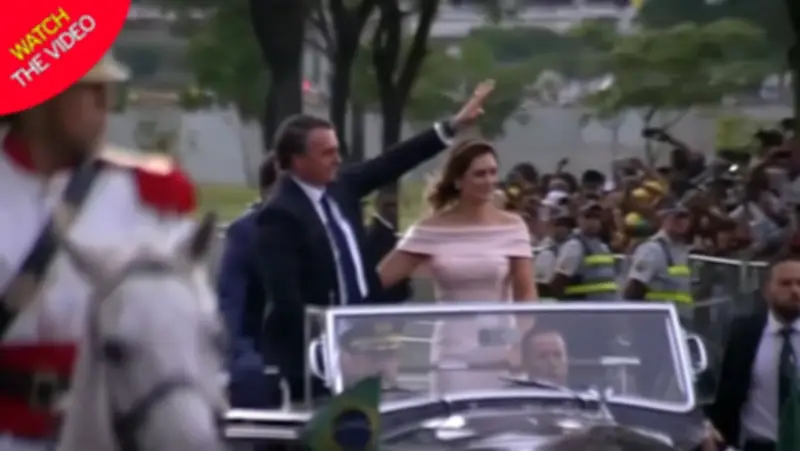
Brazil's President Luiz Inácio Lula da Silva defeated his right-wing rival Flávio Bolsonaro in a victory hailed as a 'left-wing victory for the world'. Lula secured 51.79% of the votes, compared with Bolsonaro's 48.21%, a stunning turnaround after losing the first round.
Lula secured a winning margin of 4.4 million votes against his Trump-backed opponent. It was the first time since 1988 - when the country returned to democracy - that a candidate who lost the first round has won the presidency. There was no immediate response from Washington to the result.
A historic comeback
Lula was in second place at 45% during the first round on 4 October, while Bolsonaro was ahead at 47%. He went from second place to first place between the two counts in 211 different municipalities. About 124 million people voted for Lula or Bolsonaro in the election.
In São Paulo, Lula thanked his supporters and said the result showed Brazil "will not accept being anyone's backyard". Bolsonaro refused to accept the result, called it "inexplicable" and demanded it be annulled. But Brazil's Supreme Court president confirmed the result. Experts said the chances of Bolsonaro's appeal being accepted were remote.
Legal challenge and campaign details
Voting was extended by two hours after a request from both campaigns. Lula's team alleged voter suppression due to a shortage of buses in several cities, and Bolsonaro's team raised concerns about poor weather conditions in the south of the country.
Fernando Neisser, an electoral law expert at the Institute of Lawyers of São Paulo (Iasp), said it would be "difficult from a legal standpoint" and would depend on the "narrative" his lawyers put forward. He added that since the margin of votes between the two candidates was relatively large - with Lula getting 4.4 million votes more than Bolsonaro - it seemed unlikely there would be an annulment.
Lula called on 'WhatsApp supporters' with one group known as "Lula's army" boasting almost 11 million followers. It was used in the build-up to the final vote to share information about his campaign, mobilise supporters to turn out, and share news and updates.
Serbia's student-led victory
In Serbia, long-standing leader Aleksandar Vučić admitted defeat to a student-led protest movement in another electoral victory for the left. The student movement grew after a railway station disaster two years ago was blamed on corruption and negligence. Celebrations erupted as crowds descended on the centre of Belgrade, Novi Sad and other cities.
Right-wing pro-Russian leader Vučić said: "It is clear we have lost these elections. I do not want unrest, I do not want killings, I do not want anything like that on the streets." He also blamed his defeat on a "revolution that was made up of support directly from different European countries and the deep American state, one against President Trump".
Lines snaked out of polling stations in cities across Serbia, as the country reported a voter turnout of 70%, the highest since the break-up of Yugoslavia in 1992. The students gained 2.2 million votes and his party 1.72 million. The students were on course to win 52.9% of the vote, according to a later projection by independent pollsters CeSID, with the highest turnout for years of 69.34%.
Impact and reactions
Vučić had spent two terms as president and could not seek a third term. So he was leading his Serbian Progressive Party (SNS) with the aim of returning to the post of prime minister, which he left in 2017. He called the snap elections after two years of protests triggered by the collapse of a canopy in front of Novi Sad station which killed 16 people.
The Student List's lead candidate Ilija Srdanović told BBC Serbian: "This will be a free state." He said the anti-corruption movement, which had attracted anti-government voters across Serbia, hoped to "free the country from tyranny". There were celebrations on the streets of the city, with people dancing and chanting "victory", cars honking, and fireworks set off. "Serbia is free," one student told the BBC. "It's a miracle."
With people dancing in the streets of Belgrade, Selena Lebovic said the result was "really fabulous". "We are all crying, and what to say. We couldn't believe that it would be so easy," she said. European Commissioner for Enlargement Marta Kos said: "A new chapter can begin for Serbia. The door to the EU is open, and we are ready to move forward together".
Long queues were seen outside polling stations in cities and towns across Serbia, as well as in countries with sizeable Serbian communities, including Slovenia's capital Ljubljana, Germany's Munich, and Los Angeles and Chicago in the US. In France, Serbian voters waited in line in heavy rain in Paris. Radomir Sajcic, a professor at Belgrade University speaking on behalf of the students at their headquarters, said: "Dear Serbia, the voice of the people is being heard. Tonight we celebrate victory, tomorrow we build the future."
The contest was called in September by Vučić, who resigned from his second term as president to run to be prime minister again. The victory of Students' List, led by cardiologist Srdanović, represents a big political shift in Serbia, reminiscent of the defeat of Hungary's prime minister Viktor Orban in April. Though the movement was shaped by university students, none actually appeared on the election list. Instead, its candidates were little-known experts, athletes, farmers and artists. The victory offers a blueprint for other student movements across Europe.