
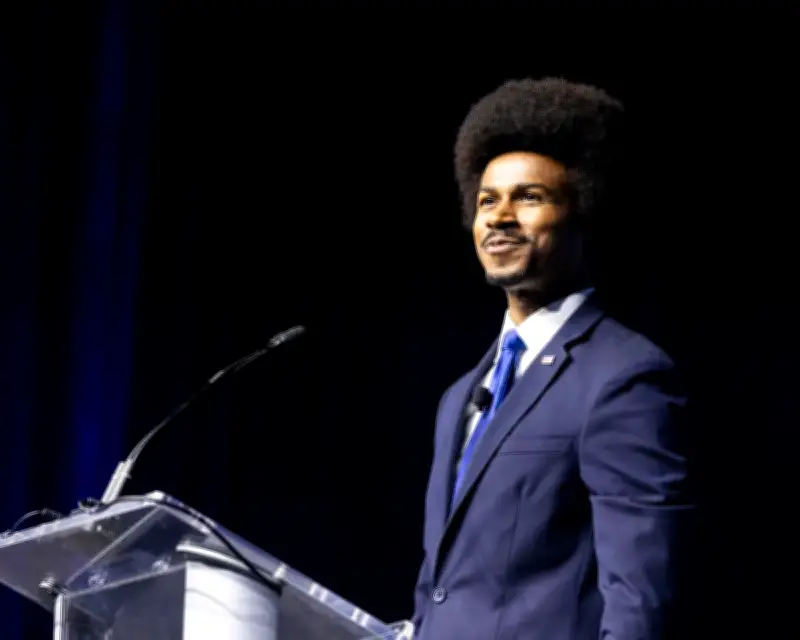
Justin Pearson, a Tennessee state representative known for his role in the "Tennessee Three" expulsions, has won a Democratic congressional primary after taking bold stances on voting rights, datacenters and the US war machine.
From the Tennessee Three to Congress
Pearson made national headlines as one of the "Tennessee Three" – state lawmakers expelled from the capitol for protesting gun control after a deadly school shooting. Three years later, he won the primary in Tennessee's ninth district, once the state's sole majority Black district, which was split into pieces after the supreme court's gutting of the Voting Rights Act's second provision. The redistricting was part of a larger Trump administration effort to retain control of Congress and dilute the Black vote, especially in the south.
At 31, Pearson has spent most of his life fighting for his community. In school, that meant fighting for new textbooks; then he launched a campaign to stop a crude oil pipeline from running through Black neighborhoods in his native Memphis. That was all before he was elected to represent the area in the state legislature – and then, a few months later, expelled over the protest.
Fighting datacenters and pollution
In the years since, Pearson has been at the forefront of a local movement against Elon Musk's xAI, which has built two datacenters powered by soot-producing turbines concentrated in a Black neighborhood in south Memphis already suffering from environmental damage. That pollution was exposed in part through Memphis Community Against Pollution, an organization Pearson co-founded with his brother. Though the NAACP and environmental advocacy groups have fought in court to halt the usage of the turbines, the justice department got in the way, arguing the datacenter was needed during Operation Epic Fury.
The effects of the Trump administration in Memphis continue to be acute: last September, Trump established a Memphis "taskforce" including 13 federal agencies and sent hundreds of federal agents into the city, with agents killing four Black men in the last 10 months. Trump claimed in his announcement that the city was "suffering from tremendous levels of violent crime" – but the week before, local police celebrated overall crime hitting a "historic" 25-year low. In July, over 1,000 people attended a rally for Pearson in response to the killings, where he was joined by congresswomen Alexandria Ocasio-Cortez, Summer Lee and Ayanna Pressley.
A progressive-populist wave
With his win, Pearson has joined the ranks of Michigan's Abdul El-Sayed and New York's Darializa Avila Chevalier and Claire Valdez as young progressive-populist upstarts sweeping primaries across the country. These candidates are running robust organizing-first campaigns in a model largely credited to Zohran Mamdani's 2025 win as New York mayor, built on small individual donations (Pearson's average donation was $31). The strategy echoes the 2016 Bernie Sanders presidential campaign and the rise of "the Squad" to Congress in 2018; unsurprisingly, Pearson was endorsed by both Sanders and Justice Democrats, the group that propelled Squad members Pressley, Ilhan Omar and Rashida Tlaib to office.
Pearson said the numbers he brings out – including 150 people at a rally in Pulaski, the birthplace of the Ku Klux Klan – and his longtime engagement with his local community could make the change he's calling for a reality. "It's concerning to me that our party would try and put a box around who can be a Democrat when we are literally living in a moment in time where people are trying to put a box around what it means to be an American, what it means to be a citizen," Pearson said. "It's the politicos in Washington DC thinking they know what's happening in the south or what's happening in our communities better than we do – and they're wrong."




