
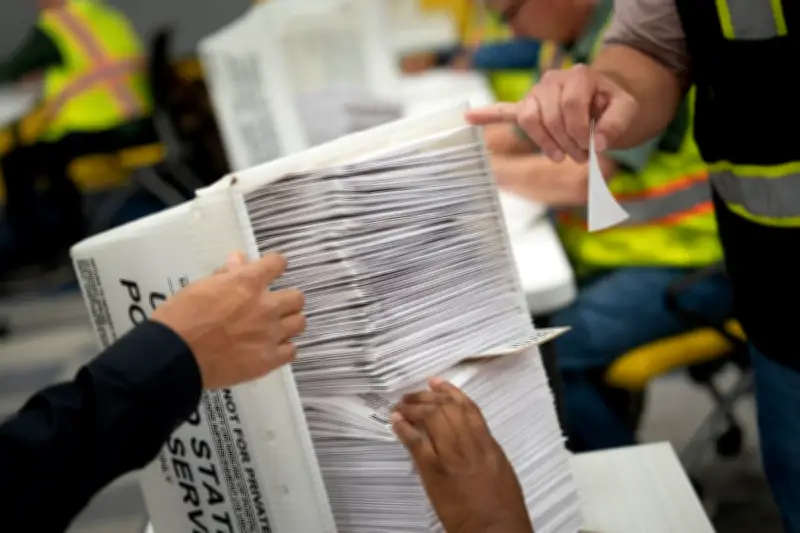
A federal judge in Boston blocked the Trump administration's attempt to restrict mail-in voting, ruling that an executive order requiring states to share voter rolls with federal officials or face denial of mail-in ballots was unconstitutional.
Ruling Details
U.S. District Judge Indira Talwani issued the injunction on Thursday, striking down provisions of an executive order signed by President Donald Trump on March 31. The order had directed the U.S. Postal Service to implement a barcode tracking system for ballot envelopes linked to U.S. Citizenship and Immigration Services data. Talwani ruled that the order exceeded presidential authority under the Constitution.
The ruling comes amid a broader push by the Trump administration to reshape voting rules ahead of the November midterm elections. Trump has been urging Congress to pass the Save America Act, which would impose new voter ID requirements and curtail mail-in voting.
Legal Challenge
Voting rights groups, along with 23 states and the District of Columbia, filed a lawsuit to stop the proposed rule. They argued that the Constitution grants no authority for the president to issue orders governing election administration. The injunction prevents the federal government from creating a new program to oversee state voter rolls or prosecuting states that do not comply.
During a Senate Homeland Security and Governmental Affairs Committee hearing on Wednesday, Democratic senators questioned Postmaster General David Steiner about the legality of the policy. Senator Gary Peters of Michigan, the ranking Democrat on the committee, stated, "It is clear there is nowhere in the constitution and no federal law that the postal service is authorized to create these types of voter databases, verification systems or mandatory standards. It simply does not exist." Steiner responded, "I would think that states would want the information to ensure that the ballots that they think they’re sending out are the ballots that are actually getting sent out."
Proposed Changes
On Wednesday, the USPS issued a public notice of rule-making outlining proposed changes. Under the plan, state election officials would have been required to submit a voter manifest containing names, addresses, and individual barcode identifiers to a new "USPS federal ballot mail portal" at least 30 days before an election. USPS would then physically verify outgoing mail-in ballots against this federal database. Ballots addressed to individuals not on the submitted lists, or envelopes lacking mandated federal serialization and barcode tracking, would be rejected and returned.
Impact of the Injunction
Talwani's injunction does not bar the federal government from providing assistance with verifying citizenship or voter eligibility if requested by a state and within Congress's framework. However, it blocks the administration from taking steps to create a new federal program to superintend state voter rolls or initiating investigations or prosecutions of plaintiff states, their officials, or local agents involved in federal election administration.




