

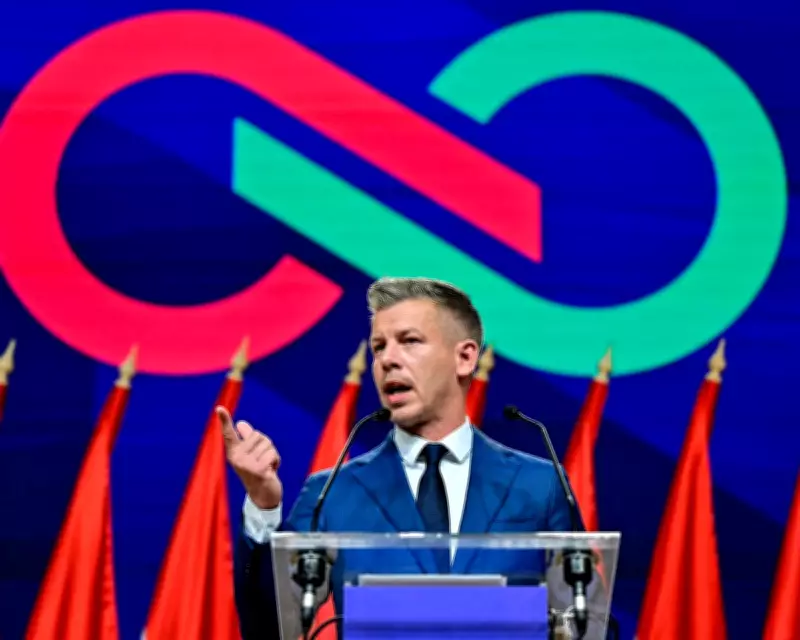
More than three-quarters of Hungarians who voted for Péter Magyar in last month’s election want his government to do more to address the climate crisis, and more than 70% want him to protect LGBTQ+ rights, a poll has found.
Magyar's Progressive Mandate
Magyar’s opposition Tisza party won a supermajority in the vote, ending Viktor Orbán’s 16 years in power. The new prime minister will be sworn in on Saturday, weeks after the results sparked celebrations in Budapest and Brussels.
Magyar, a former member of Orbán’s populist rightwing Fidesz party, has a conservative background and avoided pronouncements on progressive issues during the campaign, possibly to avoid fueling an estimated 80% of Hungary’s media controlled by Fidesz loyalists.

However, a poll conducted in the days after the election and published on Thursday indicates that Tisza’s voter base leans progressive, hinting at conflicting pressures facing the new government.
About 77% of Tisza voters polled supported an ambitious climate policy, while 71% supported the new government protecting LGBTQ+ rights, an area that saw dramatic rollbacks under Orbán.
Pawel Zerka of the European Council on Foreign Relations, which commissioned the polling, said: “That was my biggest surprise in this polling. There is a very clear mandate for the new government to have a more progressive stance. But it depends on whether Magyar looks at his own voters or the overall electorate, as the Hungarian public is much more divided on this.”
The actions Magyar and his government plan to take on climate and LGBTQ+ rights remain vague, despite more than two years of campaigning and a 240-page election manifesto.
Divisions on Ukraine and Energy
The poll also revealed other ways the government is likely to be pulled in several directions: although voters overwhelmingly sought change, they remained split on issues critical to the EU, such as support for Ukraine and curbing dependence on Russian energy.
While 64% of those polled expected the new government to improve relations with Kyiv, support for the Ukrainian war effort remains low, with 24% backing financial support and 12% backing military support. More than half of those surveyed (52%) opposed halting Russian energy imports.
“Péter Magyar’s landslide victory was a vote for domestic change, not for a geopolitical U-turn,” Zerka said. “While Hungarians are ready to turn the page on years of corruption and isolation, they have drawn clear red lines around energy independence and national security – realities that will need to be respected by leaders in Brussels.”
EU Relations and Domestic Challenges
The findings suggest that the EU’s efforts to reshape its relationship with Hungary – long strained by Orbán’s portrayal of Brussels as an enemy – will partly hinge on whether Magyar is allowed space to focus on domestic change, even as the bloc races to unlock billions in frozen EU funds.
Zerka said: “The dilemma is that Brussels would want to use the opportunity for a broader U-turn. But if they push too hard, they might divert the new administration and risk breaking the new prime minister by placing him in a position where he would be seen by the Hungarian electorate as somebody forced by Brussels to accept unpalatable compromises.”
He pointed to Poland as a cautionary tale, where Donald Tusk’s popularity has ebbed as political polarisation prevents him from carrying out desired changes.
This risk is moderated by the 79% of respondents who expected the new government to improve relations with the EU, with 73% confident that Hungary would gain access to frozen recovery funds.
However, Fidesz continues to hold 52 seats in Hungary’s 199-seat parliament, with its potential power leveraged by many party loyalists remaining in the state, media, and judiciary.
“Viktor Orbán still has ways to control the situation, at least partly through his people at various levels of state institutions,” Zerka said. “So while there are good reasons to celebrate today, there are also equally good reasons to be cautious about the coming months.”






