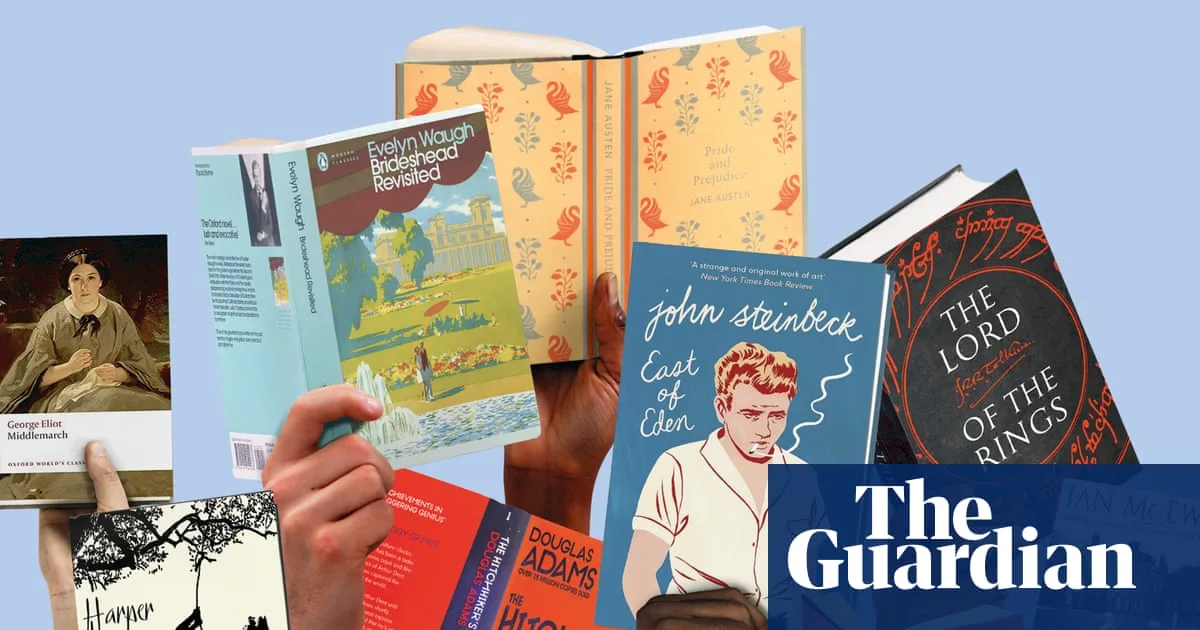
Guardian's 100 Best Novels List: Middlemarch Tops, Female Writers Surge
Guardian's Top 100 Novels: Middlemarch Wins, Women Rise

The Guardian has unveiled its definitive list of the 100 greatest novels of all time, a monumental undertaking that drew on the expertise of over 170 novelists, critics, and academics from around the world. The result is a rich, contentious, and deeply engaging catalogue of literary achievement, with George Eliot's Middlemarch claiming the top spot.

The Making of the List

As Stephen King, one of the many contributors, noted, compiling such a list is an impossible task. Each voter submitted their top 10 books in ranked order, and the Guardian tallied the results to produce the final 100. King lamented the absence of Dickens from his own list, while David Nicholls admitted his choices were skewed toward novels read at an impressionable age. Bernardine Evaristo, Salman Rushdie, Anne Enright, and many other literary luminaries also participated.

The list is part of a broader effort to reignite a passion for reading, which is in decline. Half of UK adults say they never read, and youth reading levels are at their lowest in 20 years. The National Year of Reading has been declared to address this crisis, and the list aims to guide readers toward the best works.

Wide Pickt banner — collaborative shopping lists app for Telegram, phone mockup with grocery list

Top 10 Highlights

George Eliot's Middlemarch took the No. 1 position, praised as a vast cathedral of a novel that encompasses love, faith, friendship, betrayal, science, politics, morality, and power. Virginia Woolf called it one of the few English novels written for grown-up people. At No. 2 is Toni Morrison's Beloved, a devastating novel that personalizes the experience of enslaved people. Woolf herself appears at No. 4 with To the Lighthouse, just after James Joyce's Ulysses at No. 3. Woolf is the most represented author with five novels on the list, surpassing even Jane Austen and Charles Dickens, who have four each. Other top 10 entries include Marcel Proust's In Search of Lost Time (No. 5), F. Scott Fitzgerald's The Great Gatsby (No. 11), and Leo Tolstoy's War and Peace.

Diversity and Representation

One of the most striking changes from previous Guardian lists is the increase in female writers: 36 out of 100, compared to 21 in 2015 and just 16 in 2003. Half of the contemporary writers are female. This shift signals a much-needed reset in the literary canon. The list also includes significant works of Black American literature, such as Ralph Ellison's Invisible Man, James Baldwin's Go Tell It on the Mountain, and Zora Neale Hurston's Their Eyes Were Watching God, alongside lesser-known gems like Edward P. Jones's The Known World.

Living authors are well represented: Salman Rushdie's Midnight's Children is the highest-ranking living author at No. 23, followed by Kazuo Ishiguro's The Remains of the Day. Han Kang, the first Korean Nobel laureate, appears with The Vegetarian. Other notable inclusions are Hilary Mantel's Wolf Hall, Margaret Atwood's The Handmaid's Tale, Elena Ferrante's My Brilliant Friend, and Chimamanda Ngozi Adichie's Half of a Yellow Sun.

Notable Absences

The list has sparked debate over its omissions. Big beasts of late-20th-century American literature like Norman Mailer, John Updike, and Philip Roth are absent, possibly reflecting a post-#MeToo discomfort with their treatment of women. However, Vladimir Nabokov's Lolita survives, despite its controversial subject matter. British authors like Martin Amis, Ian McEwan, and Angela Carter are missing, as are genre staples like J.R.R. Tolkien's The Lord of the Rings (the nation's favorite in the BBC's Big Read), C.S. Lewis, and Stephen King. No children's novels made the cut, excluding The Wind in the Willows, Charlotte's Web, and Harry Potter.

The comic novel, science fiction, and crime fiction are underrepresented, though Patricia Highsmith and Ursula K. Le Guin are included. John le Carré and Stephen King are notably absent.

Pickt after-article banner — collaborative shopping lists app with family illustration

Conclusion

The Guardian's list is not definitive but aims to be authoritative, ambitious, and far-reaching. As Margaret Atwood noted, lists procreate and give rise to other lists. The hope is that this list will inspire readers to discover or revisit these great works. Whether your favorites are included or not, the list is designed to enrage and inspire debate. As the article concludes, if you hate it, blame David Nicholls or Stephen King.




