
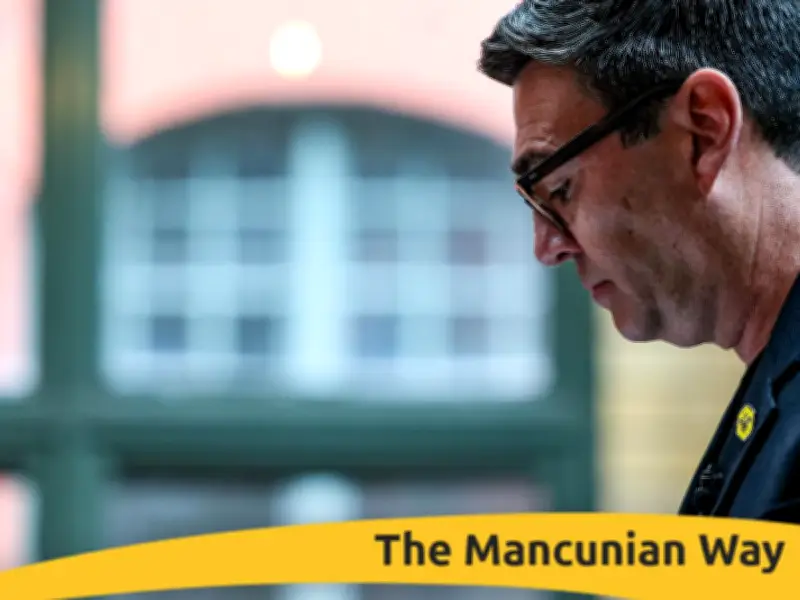
Andy Burnham, the newly elected MP for Makerfield and frontrunner for the Labour leadership, delivered a blockbuster speech at the People's History Museum in Manchester, outlining a radical 10-year plan to rewire the British state. The speech, which began with a joke about his DJing days and ended with a message of hope, included a commitment to the biggest council house building programme since the post-war period and a complete overhaul of technical education. However, the biggest standing ovation came when he promised to bring large parts of Westminster to Manchester with a 'Number 10 North'.
Diagnosis: A Country 'Stuck in a Rut'
Burnham diagnosed the country as being “stuck in a rut” and prescribed a complete re-wiring of the British state. He criticized Westminster as “broken” and said that his generation of politicians, including himself, must take responsibility. “We haven’t been good enough. But, instead of being honest about that, the parties have continued with politics-as-usual. Finger-pointing. Point-scoring,” he said. He argued that this is a “dangerous and destructive” way of doing politics that has eroded public trust.
Key Policy Announcements
Burnham committed to the biggest council house building programme since the post-war period if he becomes Prime Minister. He said his upbringing taught him that “a council home, a secure home” and “a good, technical education” were the foundation of working class aspiration in 1970s Britain, but they have been taken away. “Having this focus on council homes again and building in all parts of the country, will represent a decisive shift to a more preventative, productive state. If you don’t give people a good home, what chance have they got?” he said.
He also promised to set a “new direction” for the UK with an outpost of 10 Downing Street based in Manchester to drive his plans. Number 10 North would be the “nerve centre of a rewired Britain” allowing power to “flow” into regions. As well as housebuilding, it would support regions on reforming utilities, reindustrialization, and regeneration. “It will be given a mission to strive for equivalent living conditions in all parts of Britain - borrowing from the German Basic Law,” he said.
Reassuring Markets and Raising Living Standards
In an attempt to reassure the markets, Burnham promised his measures would be based on “the stability that comes from sound public finances” and “the discipline of our current fiscal rules.” He acknowledged that taxpayer-funded support would be needed to deal with cost-of-living pressures. “Ours is a 10-year mission to raise people’s living standards,” he said. “I know people can’t wait forever for change. People need to be able to look forward to a night out or a holiday with the kids. People need hope.”
He said Whitehall would be ordered to back British firms bidding for public contracts, even if this cost taxpayers more. In Westminster, Burnham said he would reach out to other parties to create a “greater sense of unity” in place of the “fragmented, disjointed” political environment he has found on his return to Parliament.
A Personal and Rousing Speech
The 30-minute speech felt like a deeply personal projection of everything Burnham has learnt in his 25 years as a politician, both in Westminster and Greater Manchester. He spoke with fondness about Greater Manchester, saying it was “such a wrench to leave” that he had to get special permission to wear “what people in Westminster call my Manchester clothes” - a black t-shirt and jacket. He joked about buying new running shorts to avoid changing decency laws.
His closing words were peppered with what colleague Rob Parsons described as “more than a touch of John Lennon.” “Imagine what it would feel like to live in a country wired to work for local people instead of against them,” Burnham said. “Imagine good growth in every postcode and hope in every heart. Well imagine no more. Let's make it happen.”
Reactions and Next Steps
Tory leader Kemi Badenoch accused Burnham of dodging scrutiny by declining to answer questions after the speech. But Deputy Labour Leader Lucy Powell told the World At One he likely wanted his “quite profound” speech to be judged on its own merit. Unless he faces a rival for the Labour leadership, Burnham looks set to become prime minister on July 20.
Greater Manchester Mayoral Election Candidates
Reform UK and the Conservatives have announced their candidates for the Greater Manchester mayoral election. Sian Astley, a businesswoman and property expert, is standing for Reform UK, while Trafford councillor and businessman Phil Eckersley is standing for the Tories. The mayoral candidates also include Richard Kilpatrick for the Liberal Democrats, Geraldine Coggins for the Greens, Marlon West for Restore Britain, and Bev Craig for Labour. Voters are due to go to the polls on Thursday July 30.




