
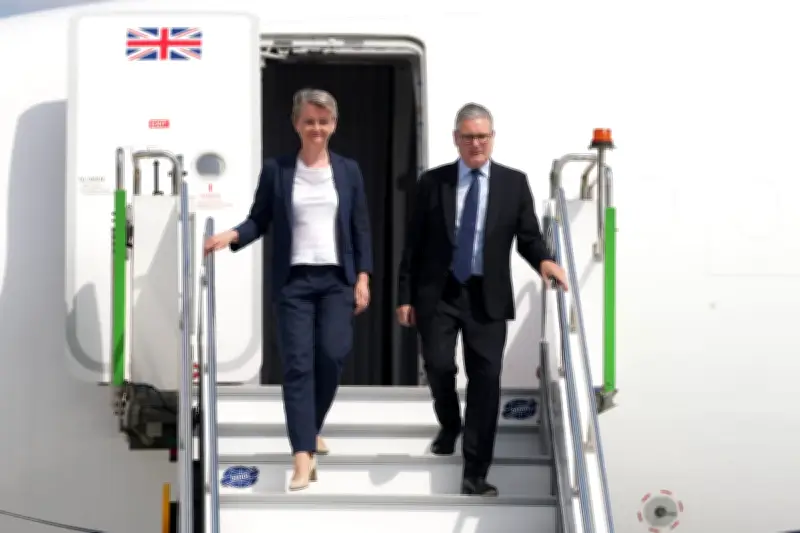
Sir Keir Starmer is set to announce a multi-billion-pound European initiative to develop the next generation of long-range missiles during the Nato summit in Ankara on Wednesday. The commitment, valued at 50 billion dollars (£37 billion), involves a dozen European allies and aims to produce weapons capable of striking targets up to 2,000 kilometres away with pinpoint accuracy.
Deep Precision Strike Missiles
So-called 'deep precision strike' missiles, including the British-made Storm Shadow, have proven crucial in the Ukraine war, enabling Ukrainian forces to hit targets far beyond the front line. The European commitment consolidates several projects, such as a joint UK-German effort to develop hypersonic long-range missiles and collaboration with Italy and France on the Stratus missile. Baltic nations are also expected to participate.
Defence Secretary Dan Jarvis said: 'We are building the weapons of the future to keep the UK and Nato secure for decades to come, backed by billions of pounds and working with our closest European allies. Our new suite of deep precision strike weapons will give our forces the ability to strike targets hundreds of kilometres away with great accuracy – strengthening Nato and deterring our adversaries.'
Strengthening European Defence
Last week's Defence Investment Plan saw the Government commit to spending £3 billion on deep precision strike weapons by 2030. Wednesday's announcement does not involve all nations working on a single weapon, but officials said the move would prevent duplication among allies, with nations focusing on different missile types. The emphasis on European action comes amid growing concern about US commitment to Nato under Donald Trump, who has continued to complain about perceived 'freeloading' on US defence spending and has withdrawn some American troops from Europe.
Sir Keir said the UK was already working with allies to develop high-end missiles, but added that Wednesday's commitment would 'allow us to step up our co-operation, bringing European allies together to ensure Nato remains safe and secure for years to come.'
UK Joins US-Australian Missile Programme
Separately, the Ministry of Defence announced on Tuesday that the UK would join the US-Australian Precision Strike Missile programme, providing the Army with a weapon capable of hitting targets up to 500km away. Backed by £190 million of funding from the Defence Investment Plan, the UK is expected to receive the first deliveries as early as next year. The announcement followed a meeting between Defence Secretary Dan Jarvis and his US counterpart, Pete Hegseth, at the Nato summit in Ankara.
Nato Summit Agenda
The Ankara summit is expected to see moves towards a more 'European' Nato, including plans for greater defence spending by allies on the continent. Nato secretary-general Mark Rutte has called for allies to attend the summit with 'credible' plans to meet the alliance's target of spending 5% of GDP on defence by 2035. The target, agreed at last year's Nato summit in The Hague under pressure from Mr Trump, includes spending 3.5% of GDP on 'core defence' and another 1.5% on resilience and infrastructure. However, Sir Keir has been accused of arriving at the summit 'empty-handed' after the Defence Investment Plan failed to set out a clear path to reaching that target. Ministers insist that further details will be set out at the next spending review.
Trump's Greenland Comments
Ahead of Wednesday's North Atlantic Council meeting, Mr Trump reopened the question of his support for the alliance over its opposition to his demand to annexe Greenland, a semi-autonomous territory of Nato member Denmark. Responding to questions on Tuesday, Mr Trump said the dispute over Greenland had 'hurt my relationship with Denmark' as he reiterated his belief that the island 'should be controlled by the United States.' UK Chancellor Rachel Reeves rejected his claims, telling reporters the island's future was 'up to the people of Greenland and of Denmark, and not up to the US president.'
Opportunity for European Leadership
Sharon Hudson-Dean of the Chatham House think tank suggested Ankara could present an opportunity to build a European security arrangement that 'better meets today's threats and is less dependent on American assets.' She said: 'As the US pulls back from Nato, leaving unhappy European publics in its wake, there is an important opening for key Europeans to begin filling the American leadership gap as they did when forming the 'coalition of the willing' in 2025 to support Ukraine. Past trailblazers have led the continent to a point of greater European co-operation than ever before – now is the moment for a new generation to take the next step.'
Bilateral Meetings and Agreements
While the main part of the summit takes place on Wednesday, Sir Keir spent Tuesday meeting fellow world leaders. After discussing support for Ukraine and a Middle East ceasefire with Norwegian prime minister Jonas Gahr Store, the two leaders donned football shirts ahead of their countries' World Cup quarter-final clash on Saturday. In the British ambassador's residence in Ankara, Sir Keir and his Dutch counterpart Rob Jettens signed a maritime partnership that will see the UK and the Netherlands co-operate on building amphibious transport ships. Confirmed in the Defence Investment Plan, the agreement will see each country operate four of the ships, carrying troops, vehicles and equipment including long-range drones. After Wednesday's main summit meeting, Sir Keir is also expected to meet Turkish President Recep Tayyip Erdogan to sign a defence co-operation agreement between the UK and Turkey.




