
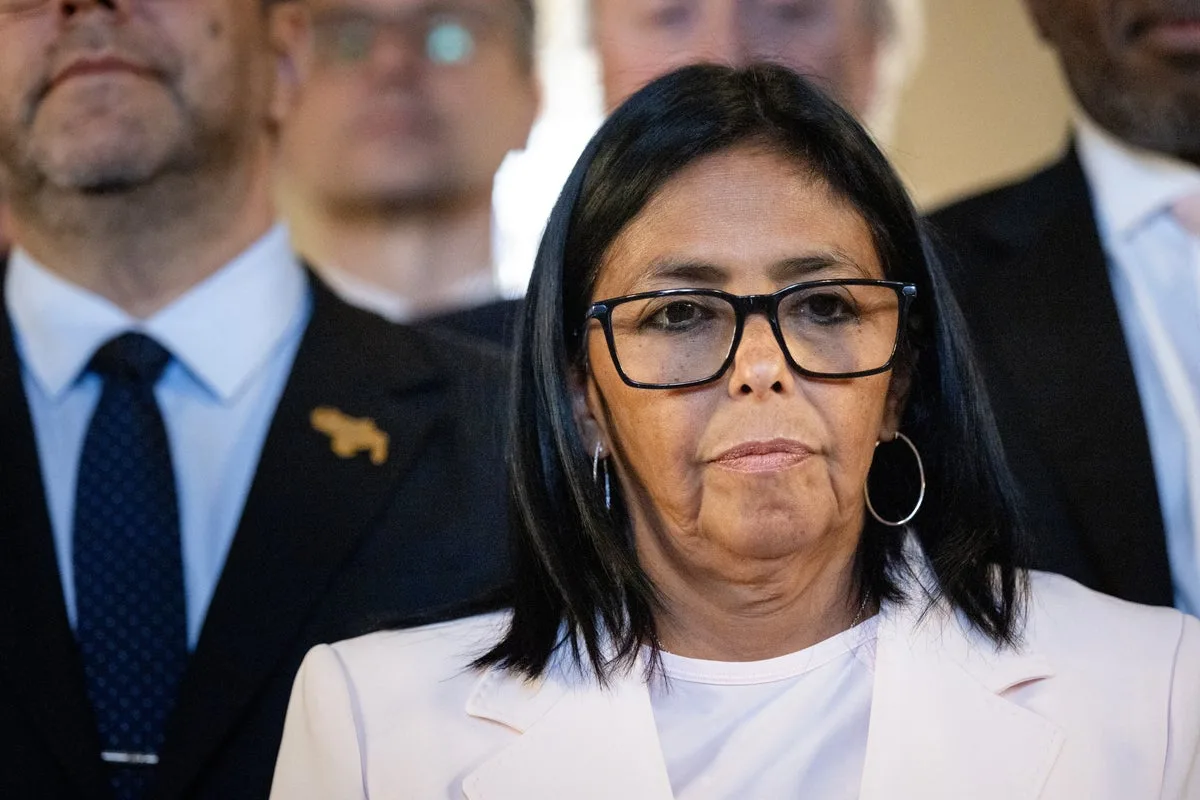
Venezuela's acting president, Delcy Rodríguez, has firmly rejected the notion of her country becoming the 51st US state, following remarks by Donald Trump that he was 'seriously considering' such a move.
Speaking at the International Court of Justice in The Hague, where she attended the final day of hearings in a territorial dispute with neighbouring Guyana over the Essequibo region, Rodríguez said: 'We will continue to defend our integrity, our sovereignty, our independence, our history.' She added emphatically that Venezuela is 'not a colony, but a free country.'
Rodríguez assumed power in January after a US military operation led to the ousting of then-president Nicolás Maduro. Trump made his comments in a Fox News interview earlier on Monday, according to a post by co-anchor John Roberts on social media. The White House did not immediately respond to a request for comment.
Before addressing Trump's remarks, Rodríguez defended her country's claim to Essequibo at the UN's highest court, arguing that political negotiations, not a judicial ruling, would resolve the century-old territorial dispute. The 62,000-square-mile territory, which makes up two-thirds of Guyana, is rich in gold, diamonds, timber and other natural resources, and sits near offshore oil deposits producing 900,000 barrels a day.
Guyana's foreign minister, Hugh Hilton Todd, told the judges last week that the dispute 'has been a blight on our existence as a sovereign state from the very beginning', noting that 70% of Guyana's territory is at stake. The court is likely to take months to issue a final and legally binding ruling.
Venezuela has warned that its participation in the hearings does not imply consent to, or recognition of, the court's jurisdiction. Rodríguez also accused Guyana's government of undermining the 1966 Geneva agreement with the 'opportunistic' decision to seek judicial resolution, coinciding with the 2015 discovery of a world-renowned oil field.




