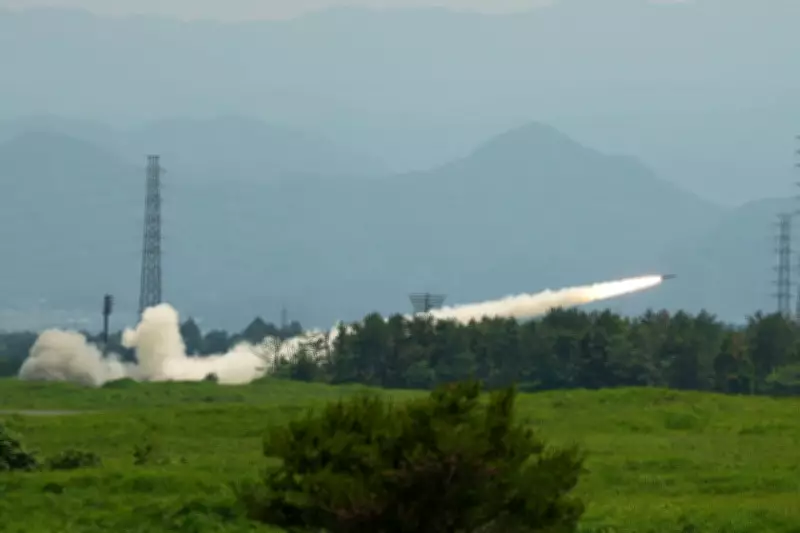
U.S. Marines test fired a dozen rockets from a High Mobility Artillery Rocket System (HIMARS) on Wednesday at a range in the foothills of Japan's iconic Mount Fuji, in an exercise designed to maintain proficiency with a weapon that is becoming an increasingly vital component of the American military's arsenal.
Rapid 'Shoot and Scoot' Tactics
The HIMARS is a launcher mounted on the back of a military truck that can be rapidly brought out from concealment, fire its rockets, then move quickly to a new location to avoid counter-battery fire. These so-called “shoot and scoot” tactics are growing in importance due to the proliferation of drones over the battlefield, which make static positions more vulnerable.
Historical and Strategic Context
The system has been used by U.S. forces in Iraq and Afghanistan, and most recently, U.S. Central Command stated it was employed in the opening attack on Iran, launching a new precision-guided rocket capable of reaching targets hundreds of miles away. This capability is particularly significant in the Pacific, where the United States aims to deter a possible Chinese invasion of Taiwan. China claims Taiwan as its own and has not ruled out taking the island by force.

HIMARS systems equipped with the latest missiles could easily reach targets in the Taiwan Strait if deployed on Japanese or other nearby islands. However, the HIMARS is generally fitted with shorter-range rockets, and the exercise at Camp Fuji—about a two-hour drive from Tokyo—involved only dummy projectiles.
Coordination with Japanese Forces
The exercise, only the second time the HIMARS was tested at Camp Fuji, was conducted in close coordination with Japanese military forces. As a precaution, a public road running between the firing point and the impact area was closed during the drill.