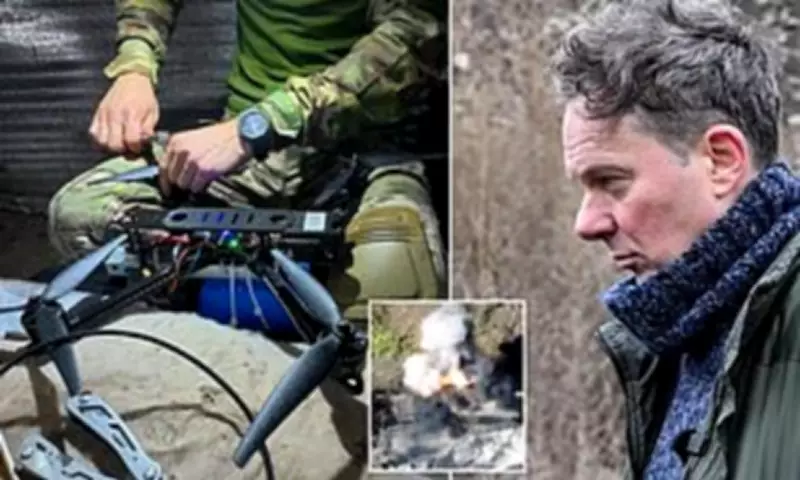
Award-winning foreign correspondent Richard Pendlebury has become the first reporter to witness Ukraine's fibre optic kamikaze drones in combat, joining the elite Charter Brigade in a gripping two-part series. These 'wonder weapons' are inflicting heavy casualties on Russian forces along the Kharkiv frontline, with a devastatingly simple advantage: they cannot be jammed.
Innovative Technology on the Battlefield
What sets these drones apart from conventional attack drones is their use of a gossamer-thin fibre optic cable running from the drone to its operator. This cabling makes the devices completely unaffected by enemy electronic warfare systems, a critical edge in modern combat. While the cable limits their range, specialist soldiers pilot the drones from dugouts deep underground, launching deadly strikes before vanishing back beneath the earth.
Pendlebury explained the innovation, stating, 'The Charter Brigade are at the forefront of the use of a so-called wonder weapon, the fibre optic kamikaze drone, which first appeared on the battlefield in the autumn of 2024.' He contrasted them with ordinary first-person kamikaze drones, which have dominated the Ukrainian battlefield for at least two years but are controlled by radio signals vulnerable to jamming.

Underground Operations with Elite Pilots
Pendlebury spent days underground with three drone pilots, known only by their military call signs: Puma, the team leader, Kush, and Umbrella. Their commanding officer highlighted the lethal effectiveness of the new weapons, describing a recent Russian push into Ukrainian territory. 'The last time we had Russian tanks here, it was on the 15th of May last year,' he said. 'Our side and their side were supposed to be negotiating. The next morning, the Russians launched a big assault in our direction. Six armoured vehicles, two cars and one cannon. All of it was destroyed by our drone units.'
One of the pilots, Puma, demonstrated how to construct a fibre optic drone, revealing another key strength: it can be assembled in as little as 30 minutes, with the fibre optic cabling adding only 10 minutes to the normal build time. This rapid assembly allows the unit to maintain a stockpile of drones, ready to replace any lost or destroyed in combat. 'We keep a stockpile,' Puma said via a translator. 'We just need to attach a shell, then it's ready for a mission.'
Strategic Implications and Future Use
The fibre optic kamikaze drones represent a significant advancement in drone warfare, offering Ukraine a reliable tool against Russian electronic countermeasures. Their ability to operate undetected and unjammed provides a tactical advantage in the ongoing conflict. As Pendlebury's report underscores, these weapons are not only innovative but also highly adaptable, with pilots able to deploy them quickly from hidden underground positions.
The full report from deep underground on the Kharkiv frontline offers an unprecedented look at these game-changing technologies, highlighting the resilience and ingenuity of Ukrainian forces in the face of adversity.