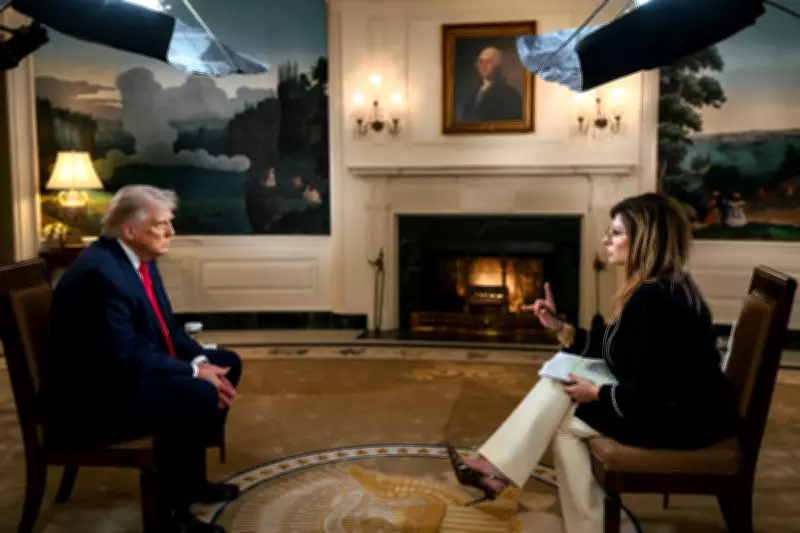
President Donald Trump has declared that the war with Iran is "very close to being over," even as recent marathon negotiations failed to produce a peace deal and a U.S. naval blockade threatens to escalate tensions. In an interview with Fox Business anchor Maria Bartiromo, set for full release on Wednesday morning, Trump reiterated his optimism about an imminent resolution.
Trump's Confident Assertions Amid Stalled Diplomacy
"I think it's close to over, yeah. I view it as very close to being over," Trump told Bartiromo. He added, "If I pulled up stakes right now, it would take them 20 years to rebuild that country. And we're not finished. We'll see what happens. I think they want to make a deal very badly." These remarks echo a prime-time address on April 1, where the president claimed U.S. strategic objectives were nearing completion.
However, this confidence contrasts sharply with the reality on the ground. Weekend talks in Pakistan, led by U.S. Vice President JD Vance, ended without a concrete agreement to end the conflict, which began in late February. The clock is ticking, with a two-week ceasefire set to expire on April 21, increasing pressure for a breakthrough.

Key Sticking Points in Negotiations
The negotiations deadlocked over Washington's demand that Tehran commit to not developing a nuclear weapon, a point Iran has long resisted by insisting its nuclear program is for civilian purposes. Vance emphasized this in a press conference, stating, "The simple question is, do we see a fundamental commitment of will for the Iranians not to develop a nuclear weapon, not just now, not just two years from now, but for the long term. We haven't seen that yet."
Additionally, Iran reportedly refused to allow the U.S. to retrieve its highly enriched uranium, further complicating the diplomatic efforts. Islamabad has proposed a second round of talks, and Trump hinted at imminent negotiations, telling The New York Post on Tuesday, "You should stay there [Islamabad], really, because something could be happening over the next two days, and we're more inclined to go there."
U.S. Naval Blockade Escalates Tensions
Complicating matters further, U.S. forces began blockading traffic in and out of Iranian ports on Monday, including the strategically vital Strait of Hormuz, a key global oil transit route. Admiral Brad Cooper, head of U.S. Central Command, announced, "A blockade of Iranian ports has been fully implemented as U.S. forces maintain maritime superiority in the Middle East. An estimated 90 percent of Iran's economy is fueled by international trade by sea. In less than 36 hours since the blockade was implemented, U.S. forces have completely halted economic trade going into and out of Iran by sea."
During the first 24 hours, no ships passed the U.S. line, and six merchant vessels turned back to Iranian ports in the Gulf of Oman. Iran has condemned the blockade as "piracy" and warned that military vessels approaching the Strait of Hormuz would violate the ceasefire. Despite this, multiple ships managed to leave Iranian ports around the blockade's start, according to maritime analytic firms, with over 10,000 U.S. service members and dozens of warships supporting the operation.
Economic and Political Ramifications
The International Monetary Fund has warned that extending the war could trigger a recession and an energy crisis, highlighting the blockade's economic risks. Politically, the conflict remains deeply unpopular with U.S. voters, and Trump's approval ratings have hovered near record lows as it persists. Democrats have pushed for impeachment or removal via the 25th Amendment, citing concerns over the president's mental fitness.
As the ceasefire deadline approaches, the juxtaposition of Trump's optimistic rhetoric with the stalled talks and military escalation underscores the fragile state of the Iran conflict, with significant implications for global stability and domestic politics.