
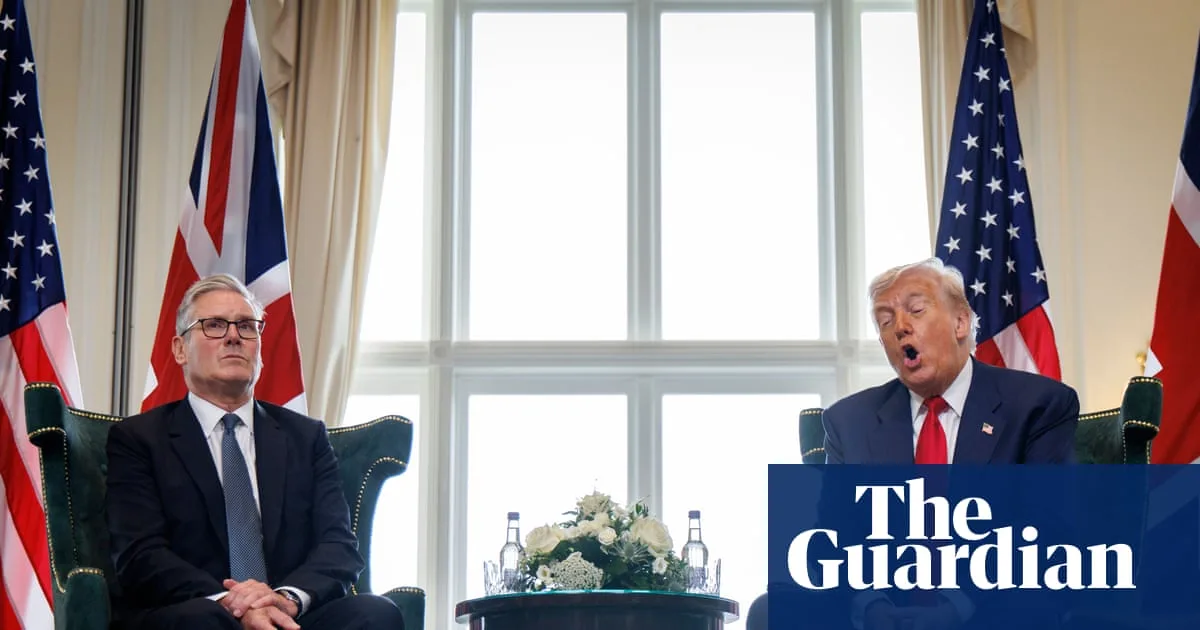
Donald Trump’s off-hand remark that he would not take a position on Palestinian statehood enabled Keir Starmer to announce a historic shift in UK policy, moving towards recognition of a Palestinian state by the end of September. The US president said in Scotland: “I’m not going to take a position. I don’t mind him taking a position. I’m looking for getting people [in Gaza] fed right now.” Within 36 hours, the prime minister convened an emergency cabinet meeting and set out a plan to revive the two-state solution.
Under the new policy, largely drafted by national security adviser Jonathan Powell, the UK will recognise Palestine unless Israel meets conditions including agreeing a ceasefire in Gaza and reviving the two-state prospect. Senior government figures acknowledge this commitment almost certainly leads to recognition. “The reality is unless the Netanyahu government falls in the next six to eight weeks or makes an 180 degree U-turn, the only outcome of this is the UK recognising the state of Palestine,” one source said.
Ministers stress recognition was a Labour manifesto commitment, but pressure mounted over the past fortnight due to global outrage at starvation in Gaza caused by Israel’s blockade. French President Emmanuel Macron had lobbied the UK and others for months, and on 22 July Macron announced France intended to recognise Palestine at the UN general assembly in September. In the UK, cabinet ministers including Wes Streeting, Shabana Mahmood, and Hilary Benn pushed for statehood, with an open letter signed by over 200 MPs.
Downing Street was concerned about the impact on US relations ahead of Starmer’s summit with Trump. But Trump’s indifference cleared the path. Foreign Secretary David Lammy told a UN conference: “Britain bears a special burden of responsibility.” The UK ruled Palestine under a mandate from 1922 to 1948.




