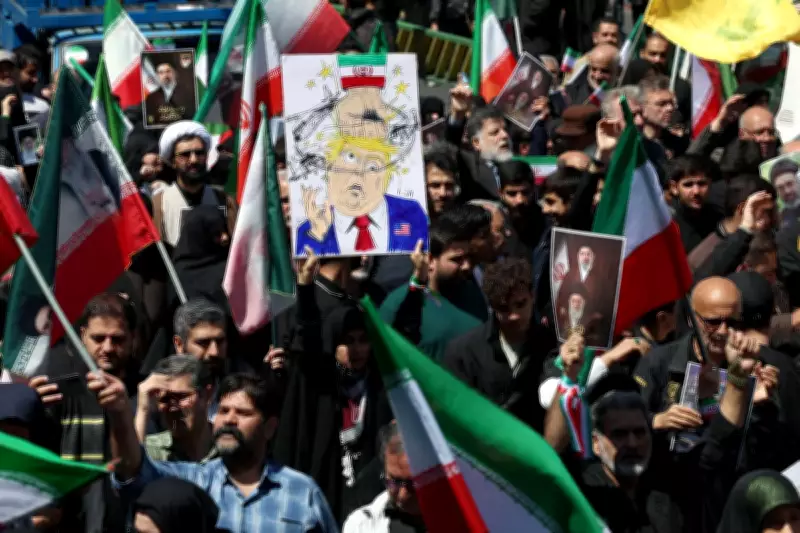
Former US Diplomat Outlines Three Scenarios for US-Iran Ceasefire Future
President Donald Trump announced a ceasefire between the United States and Iran on April 7, 2026, following more than a month of intense conflict. The war featured US and Israeli strikes targeting Iranian military leadership, Iranian retaliatory attacks on regional oil infrastructure, and a resulting global energy crisis that sent shockwaves through international markets.
According to former US diplomat Donald Heflin, warring parties typically arrive at ceasefires through three distinct pathways. Understanding these mechanisms provides crucial insight into what might happen next in this volatile situation.
The Three Pathways to Ceasefire
The first scenario occurs when one party grows weary of conflict and actively seeks peace. This approach, however, often reveals strategic weakness to the opposing side and therefore rarely succeeds. Heflin points to Hamas's attempts to secure a ceasefire with Israel in late 2023 and early 2024 as a prime example. Israel ultimately ignored these overtures and continued military operations in Gaza until October 2025.

The second pathway involves intervention by a powerful third country that insists warring parties cease hostilities due to risks to global peace and regional stability. Historically, the United States has played this role multiple times in the Middle East, leveraging influence over key players like Israel and Egypt. In the current US-Iran conflict, however, no nation currently occupies a strong enough position to effectively enforce such a ceasefire.
The third scenario, which best describes the current US-Iran situation, occurs when both combatants grow tired of mounting costs and escalating risks. They send signals indicating their readiness to de-escalate, and a willing intermediary steps forward to facilitate negotiations. In this instance, Pakistan deserves recognition for assuming the mediator role after detecting these signals from both Washington and Tehran.
Why Both Sides Sought Ceasefire
For the United States and Israel, the conflict failed to achieve primary objectives. There was no regime change in Iran, nor did the Iranian population rise up against their government. Meanwhile, Iran demonstrated continued military capability by closing the strategically vital Strait of Hormuz and maintaining its ability to shoot down warplanes while attacking neighboring nations including Israel, Saudi Arabia, the United Arab Emirates, and Kuwait.
Iran paid a heavy price for its military engagements, losing thousands of citizens and dozens of leaders while suffering significant infrastructure damage. The conflict had potential to escalate further with even more devastating consequences for the Iranian state and its people.
Three Possible Futures for the Ceasefire
Scenario one involves a fragile ceasefire that lasts only the initial two-week period, marked by continued instability as demonstrated by Israel's bombing of Lebanon after the ceasefire declaration. Under this outcome, full-scale war resumes with familiar consequences: severe impacts on the global economy and soaring financial costs for the US military.
Scenario two sees the ceasefire extended either formally or de facto, with minimal to zero US attacks or Iranian missile and drone launches. This represents a plausible middle ground where hostilities pause without formal resolution.
Scenario three offers the most optimistic outcome, where both parties use the initial two weeks plus potential extensions to negotiate key elements of a comprehensive peace agreement. This would require addressing core US-Israeli demands regarding Iran's nuclear weapons development and support for militant groups like Hamas and Hezbollah.

Potential Terms of a Lasting Agreement
The United States and Israel would likely insist that Iran abandon nuclear weapons development and cease backing Hamas and Hezbollah, the Shiite militia with extensive influence in Lebanon. From Iran's perspective, nuclear weapons may not represent their most effective deterrent. Their true strategic leverage lies in their ability to close the Strait of Hormuz, choking off approximately twenty percent of global energy supplies using relatively simple technology like drones and small speed boats.
Iran's support for Hezbollah has proven problematic, contributing to Lebanon's decline from prosperity and democracy since the militia launched military operations within the country in 1982. Meanwhile, Iran's missile attacks during the recent conflict demonstrated their capability to deliver nuclear weapons should they obtain them, while drone and missile strikes against Muslim neighbors including Qatar and Saudi Arabia have created new regional adversaries.
In return for concessions, Iran would likely demand an end to foreign attacks aimed at toppling their regime and permanent sanctions relief contingent upon ending support for terrorist groups and surrendering uranium stockpiles. Such an agreement, however, would offer little to pro-human rights groups within Iran.
The Trust Deficit Challenge
All parties must demonstrate genuine commitment to working through numerous complex details for any ceasefire to endure. Pakistan must maintain its role as honest broker without becoming discouraged, while involved governments must persuade their populations that negotiated terms are acceptable.
Historical precedents exist for resolving seemingly intractable conflicts, from Northern Ireland to Israel-Egypt relations. The crucial element involves both sides fearing war resumption more than they fear compromise. A significant obstacle remains the profound lack of trust between parties: the United States has witnessed Iran renege on previous promises, Israel remains traumatized by Hamas attacks in 2023, and Iran struggles to interpret the Trump administration's constantly shifting signals, particularly given US bombing campaigns during negotiations.
If the ceasefire holds and negotiations succeed, the world could witness an Iran that no longer threatens its neighbors, while Iran would gain readmission to the global economy it desperately needs. Should negotiations fail and hostilities resume, the world would return to a cycle of US and Israel deploying hard-to-replace munitions against Iran, with Iran retaliating through drone and missile attacks against multiple nations, further battering the already strained global economy.
About the author: Donald Heflin serves as Executive Director of the Edward R. Murrow Center and Senior Fellow of Diplomatic Practice at The Fletcher School at Tufts University.