The Double Life of Australia's Top Cold War Spy
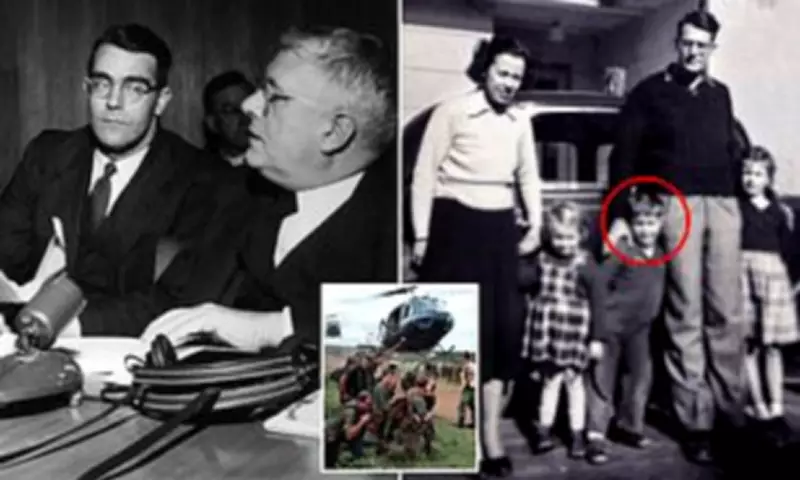
Growing up in Melbourne during the tense Cold War period, John Harry perceived his father Ralph as a somewhat distant but respected public servant. Ralph Harry worked diligently in what was then called the Department of the Exterior, maintaining hobbies like golf, chess, cryptic crosswords, and stamp collecting. To his son, he appeared reserved, rarely drank alcohol, and maintained a small circle of friends.
What John would not discover until the late 1980s was that his father had been serving as the director of the Australian Secret Intelligence Service (ASIS). In this pivotal role, Ralph Harry operated as Australia's foremost spy, leading a clandestine organization comparable to America's CIA and Britain's MI6.
A Distinguished Diplomatic Career Built on Intelligence Work
Ralph Harry's extensive experience managing ASIS provided a solid foundation for his subsequent diplomatic career. He served as ambassador to several significant nations, including Belgium, South Vietnam, Germany, and represented Australia at the United Nations. His expertise in international relations earned him prestigious honors: he was appointed as a Commander of the Order of the British Empire and a Companion of the Order of Australia.

Despite achieving the second-highest position within the Department of Foreign Affairs, Ralph never attained the top role, a disappointment that reportedly left him embittered. He passed away in 2002 at the age of 85.
Throughout his life, Ralph Harry never disclosed his true profession to his family. However, his son John firmly believes his father was engaged in 'black ops'—covert espionage missions conducted outside standard protocols and without official oversight.
Involvement in Controversial Operations
John Harry speculates that during his father's posting in Saigon in the late 1960s, he likely contributed to the CIA-led Phoenix Program. This controversial initiative aimed to dismantle the Viet Cong through methods that included assassination and torture. Additionally, Ralph played a crucial role in Australia's support of Indonesia's response to a failed Communist coup in 1965, an event that resulted in the deaths of over 500,000 people.
'Assessing the merit of his work in ethical or any other terms isn't possible,' John reflects. 'But that he led a double life and that his life was brutally contained by his secrecy commitments was beyond doubt.'
Early Life and Recruitment
Ralph Lindsay Harry was born in Geelong in 1917 into an accomplished family. His father Arthur taught classics at Geelong College, while his mother Ethel was the first woman to earn a Master of Arts from Adelaide University. His maternal grandfather, Sir Frederick Holder, served as a South Australian premier and became the first speaker of Australia's federal parliament.
After attending Launceston Grammar, Ralph achieved first-class honors in law from the University of Tasmania and was selected as Tasmania's Rhodes Scholar in 1938. At Oxford's Lincoln College, he completed a degree in politics, philosophy, and economics. It was during this period that intelligence recruiters may have first identified his potential.
Upon returning to Australia, Ralph joined the Department of External Affairs in 1940. He later enlisted in the army as an intelligence officer, serving in New Guinea during World War II before rejoining the department in 1943.
A Life of Secrecy and Family Distance
John, who spent parts of his childhood in Switzerland and Singapore, pursued a career in law, working for mining giant Rio Tinto and eventually becoming a partner at Allens law firm. He later reinvented himself as a winemaker and has now authored his first book.
His memoir, Talking of Michelangelo, delves into his complex relationship with his father, whose secret ASIS role John only uncovered in his forties. John describes Ralph as 'an imposing figure' who even applied spy techniques within the family.
'I realise now that these tricks were used on me routinely,' John writes. 'There was no place to hide, no document that would have been unread, no phone call unobserved, no lie undetected, no bluff unpenetrated.'

Ralph served as ASIS director from 1957 to 1960 while his family lived in Melbourne. John characterizes their relationship as 'distant and tentative,' noting his father was a 'serious, contained and reticent man' who maintained few friendships to protect his covert work.
Discovering the Truth and Seeking Answers
John only learned about his father's intelligence career through the 1989 publication of Oyster, an unofficial history of ASIS by Brian Toohey and William Pinwell. In his final years, Ralph destroyed personal and controversial documents, leaving behind sanitized papers for his son.
After his father's death, John met with some of Ralph's former intelligence colleagues, hoping to uncover more about his father's true activities. However, as might be expected from retired spies, he received only 'hints and pauses.'
'Whether the lies, compromises and brutalities of his trade were justified is something I'll never be sure of,' John concludes. 'I'll never know, despite the hard work, reticence and courage he needed, what he really achieved for the good of Australia.'
Talking of Michelangelo by John Harry is published by Hembury Books, offering a unique perspective on the personal costs of intelligence work during one of history's most tense geopolitical periods.