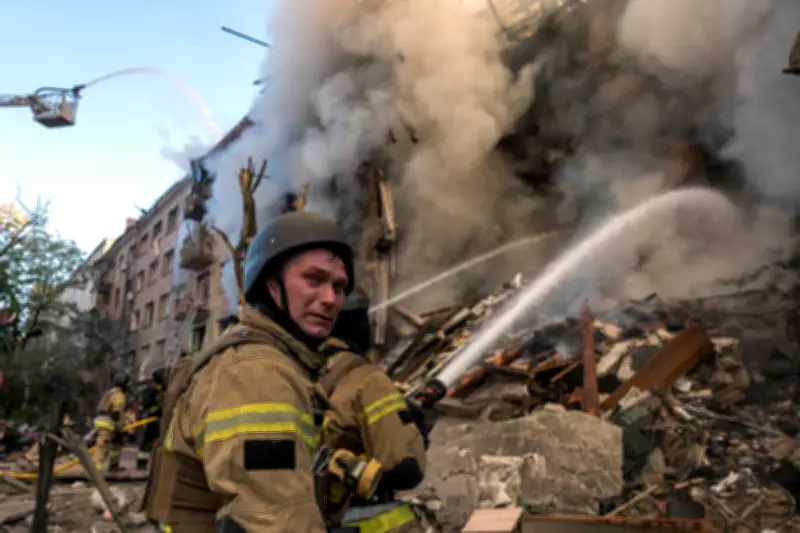
Western leaders have accused Russian President Vladimir Putin of engaging in reckless nuclear brinkmanship following a missile strike on Kyiv using the new Oreshnik missile system. The attack, which occurred on Monday, has heightened tensions and drawn widespread condemnation from the international community.
Escalation of Conflict
The Oreshnik missile, a recently developed weapon, was deployed in the strike on Ukraine's capital, resulting in significant damage and casualties. Ukrainian officials reported that the missile struck a residential area, killing at least 12 people and injuring dozens more. The use of this advanced weaponry marks a dangerous escalation in the ongoing conflict.
In response, NATO Secretary-General Jens Stoltenberg stated that Russia's actions demonstrate a blatant disregard for international norms and pose a direct threat to global security. He called for an emergency meeting of NATO allies to discuss the situation and potential countermeasures.

International Reactions
US President Joe Biden described Putin's move as a desperate act of aggression, warning that such behavior could lead to catastrophic consequences. British Prime Minister Keir Starmer echoed these sentiments, emphasizing the need for a united front against Russian aggression.
Ukrainian President Volodymyr Zelenskyy addressed the nation, vowing to retaliate and calling on Western partners to provide more advanced air defense systems to protect Ukrainian cities from further attacks.
Nuclear Concerns
The Oreshnik missile's capabilities have raised concerns about nuclear escalation. Analysts suggest that the missile could be fitted with a nuclear warhead, making its use a direct provocation. Putin's rhetoric has also intensified, with recent statements hinting at a lowered threshold for nuclear weapon use.
Experts warn that the situation is becoming increasingly volatile. Dr. Elena Petrova, a security analyst at the Royal United Services Institute, commented: 'Putin is testing the West's resolve. The deployment of the Oreshnik missile is a clear signal that he is willing to take greater risks, including nuclear ones, to achieve his objectives in Ukraine.'
Diplomatic Efforts
Diplomatic channels remain open, but progress has been limited. UN Secretary-General António Guterres called for an immediate de-escalation and urged both sides to return to negotiations. However, with both Russia and Ukraine digging in, a peaceful resolution seems distant.
Meanwhile, the European Union announced new sanctions against Russian entities involved in the development and deployment of the Oreshnik missile system. The measures target key military and industrial figures, aiming to constrain Russia's ability to continue its military campaign.
The international community watches with bated breath as the conflict enters a new and dangerous phase. The coming days will be critical in determining whether diplomacy can prevail or if the world will face a wider confrontation.