Netanyahu's 'Greater Israel' Ambition: More Than Just Territory
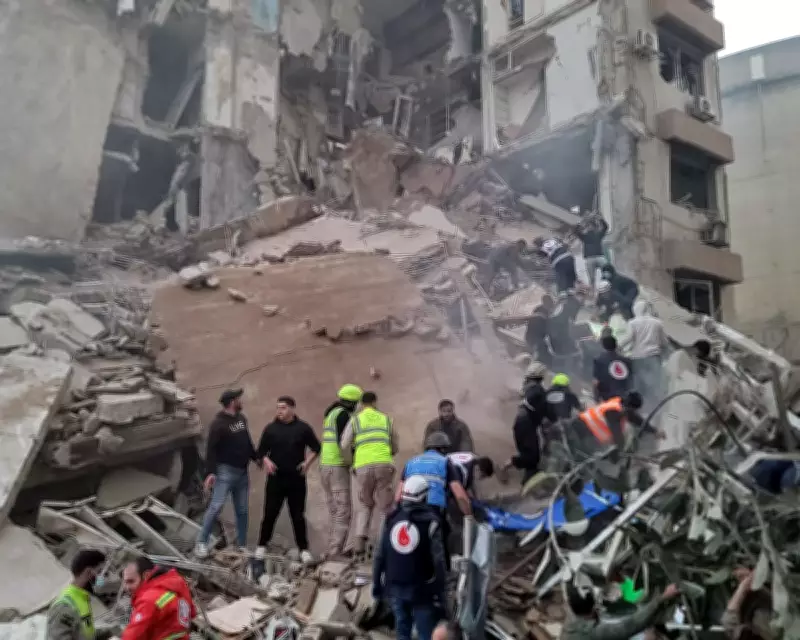
First responders and residents gathered at the site of an Israeli airstrike in Beirut's Tallet al-Khayyat neighbourhood on 8 April 2026, highlighting ongoing regional tensions. The concept of 'Greater Israel', often invoked by the Israeli right, is frequently perceived as a purely territorial ambition to expand Israel's claimed land. However, this view overlooks a deeper geopolitical strategy pursued by Prime Minister Benjamin Netanyahu.
Territorial Expansion and Displacement
Territorial acquisition is indeed a core element of 'Greater Israel'. Since its inception, Israel has engaged in expansionist policies, displacing and dispossessing Palestinians. In recent years, this process has accelerated dramatically. Over the past two-and-a-half years, Israel has flattened and reconquered Gaza, resulting in tens of thousands of casualties and devastating civilian infrastructure, confining the population to just 12% of the already small strip. In the West Bank, Israel continues an unprecedented campaign of destruction and displacement since the 1967 war, expanding settlements and control mechanisms.
Following the fall of President Bashar al-Assad in 2024, Israel seized territory in Syria beyond the illegally annexed Golan Heights and is establishing an occupation zone in southern Lebanon. Government ministers from factions like Religious Zionism and Jewish Power, along with Likud parliamentarians, openly advocate for Israeli sovereignty and settlement in Lebanon. Finance Minister Bezalel Smotrich has called for expansion to Damascus, and Netanyahu has expressed strong connection to this territorial vision.

Geopolitical Strategy and Regional Dominance
Yet, 'Greater Israel' should be understood as a geopolitical and strategic concept as much as a territorial one. Netanyahu is pursuing a project of dominion that involves new alliances and hard power dependency, aiming for Israel to become a regional superpower. After the 7 October attacks and Israel's harsh response in Gaza, regional normalisation efforts stalled. Netanyahu chose to double down on negating a Palestinian future, necessitating the removal of Iran as a regional power balancer, which required direct US military engagement.
Influential Israeli security figures noted that weakening Iran would establish Israel as the 'dominant regional power'. This strategy also involves making Gulf Cooperation Council states dependent on Israel for security and energy routes, with war spillovers seen as intentional design features. Netanyahu has promoted alternative energy routes through Israel's Mediterranean ports, bypassing chokepoints like the Strait of Hormuz.
Alliances and Global Aspirations
Netanyahu envisions a 'hexagon of alliances' including India, Arab nations, African nations, Greece, Cyprus, and Asian countries, with Israel as the central node. High-ranking IDF strategists argue for Israel achieving operational control in distant areas without occupation, establishing a 'queen of the jungle' status in the region. Netanyahu now refers to Israel as not just a regional but a 'global superpower', aiming to sustain influence even if US power wanes, targeting threats like Turkey.
This permanent war orientation in Israel's political and security circles carries risks of overreach and blowback, posing dangers for Israel and regional stability. Deterring this project of 'Greater Israel' dominion is a critical postwar challenge, as the region is unlikely to accept such dominance.