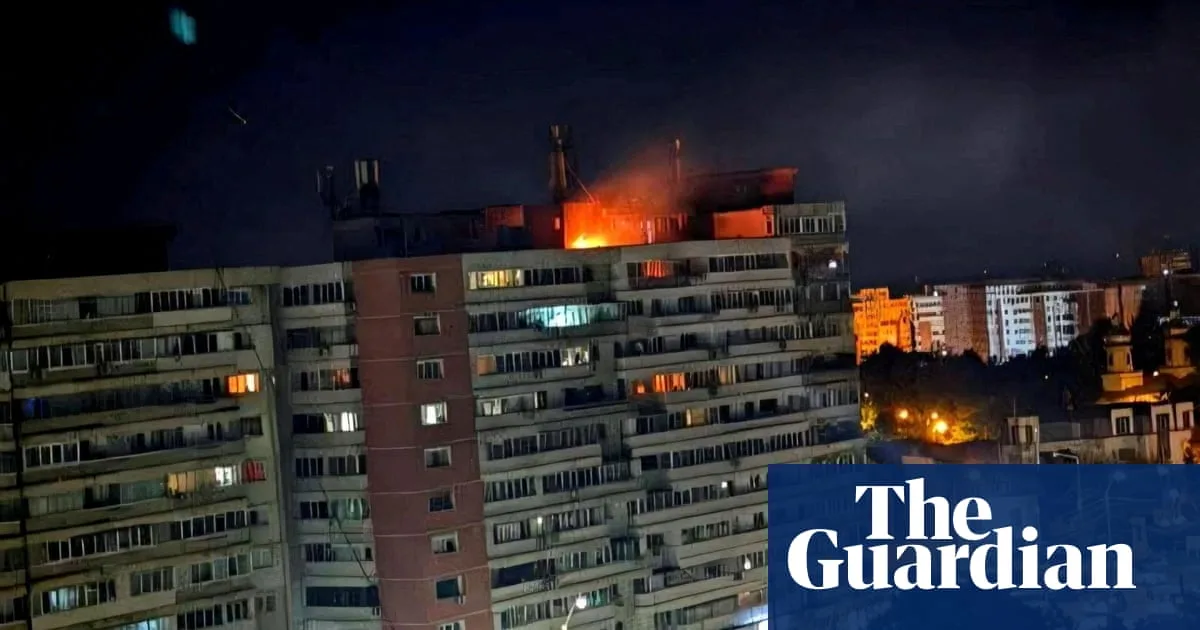
Nato Must Push Back Against Russian Aggression in Romania Drone Strike
Nato Must Push Back After Russia Drone Strike in Romania

The Independent View

Nato must be more willing to push back when the Kremlin goes too far

Editorial: It is unacceptable that Russia, in the conduct of its war in Ukraine, has yet again violated another nation’s sovereignty. After the drone strike on a residential tower block in Romania, the response must be more than the usual summoning of ambassadors.

That a Russian drone, probably fired from Crimea, crashed into a Romanian residential block and injured two people, is a gratuitous, unprovoked and serious act of aggression against an independent Nato state. It demands a suitable response. That the incident is hardly a surprise is no reason for complacency.

Wide Pickt banner — collaborative shopping lists app for Telegram, phone mockup with grocery list

It is true that in Romania, Poland and other states neighbouring Ukraine, Russian munitions and aircraft have been venturing into Nato airspace since before the full-scale Russian invasion in 2022. The danger was always that they’d stop landing harmlessly in a field. Not all were “accidents” – and there’s been too much activity more openly on the offensive. Indeed, the Russians have also been engaged for some time in a dizzying variety of assaults on the West: cyberattacks and disruption to civilian air traffic control, notably in the Baltic states; agents provocateurs conducting terror attacks in mosques and synagogues in France; bot factories fomenting political trouble in the UK; Russian shadow fleet surveillance of underground cables in the North Sea and Atlantic; assassinations; harassing RAF jets in the Black Sea; support for the Orban regime in Hungary; and interference in elections, most notably in Moldova, a buffer state sandwiched between Romania, Ukraine and Russian-controlled and occupied Transnistria.

The southeast Balkans are as much a potential powder keg for another European war as the Baltic republics, Finland, Poland, and any of the other territories now coveted by Vladimir Putin because they were once ruled by the Tsars and the Soviet Union. The precise reasons why this particular drone ended up where it did, just inside Romania near the border with Ukraine, are unclear. It could be that the Ukrainians jammed its signalling so that it strayed away from its intended target and into Nato territory – or it could have been simply that the Russians were, as Mark Rutte, secretary general of Nato says, reckless.

Incompetence or faulty equipment may have been a factor. Or the Russians may have decided, not for the first time, to see how far they can push things with a Nato member state, and to test both air defences and political resolve. In any case, it remains unacceptable that Russia should even contemplate conducting its war in Ukraine, itself illegal, in this way – not just by violating the sovereignty of yet another nation but displaying such callous disregard for human life. The probability is that the Russians will simply continue to push and probe until they meet strong resistance. So the question is what the response should be. It needs to be more than summoning ambassadors and expelling the local Russian consul in eastern Romania. The Kremlin understands very well that this sort of incident isn’t sufficient to trigger the Nato treaty’s Article 5 provision that an attack on one is an attack on all, and potentially to engulf the continent in nuclear war.

Article 5 requires a hostile attack to be “sustained”, and thus clearly intentional. One downed drone isn’t sufficient to justify all-out war. What it, and these many other harassments and infractions, call for is immediate strengthening of air defences.

The ideal could be the kind of anti-missile and anti-drone “Iron Dome” that protects Israel, and which President Trump plans for the US. That is plainly not practicable – but building far better air defences across Nato’s eastern flank is extremely doable, even without US assistance. Europe not only has the industrial capacity, it also has an ally, Ukraine, that leads the world in drone warfare and defence techniques. As it has for the Gulf states, Kyiv can help European Nato recover its ability to defend itself.

The F-16 fighters that the Romanian air force deployed against the drone were evidently unsuited to the task, and they had to be wary of shooting it down over a built-up area, which would have risked even greater loss of life.

Pickt after-article banner — collaborative shopping lists app with family illustration

Sending more troops to border zones, as the US has done in Poland, would be another gesture of resistance. But other measures in response to Russian low-level aggression are equally obvious – such as bolstering cyber defence against the increasingly brazen attacks, an urgent task that was highlighted only this week by Anne Keast-Butler, head of Britain’s intelligence, cyber and security agency, GCHQ.

Nato naval operations should now be stepped up, and Russian ships forcefully moved away from vital undersea communications and power infrastructure. The financial challenges of rebuilding European defences are formidable and, depressingly, the political will doesn’t always seem to be there, but there are still small but powerful actions that Nato can take to demonstrate its willingness to push back when the Kremlin goes too far, deliberately or otherwise.




