
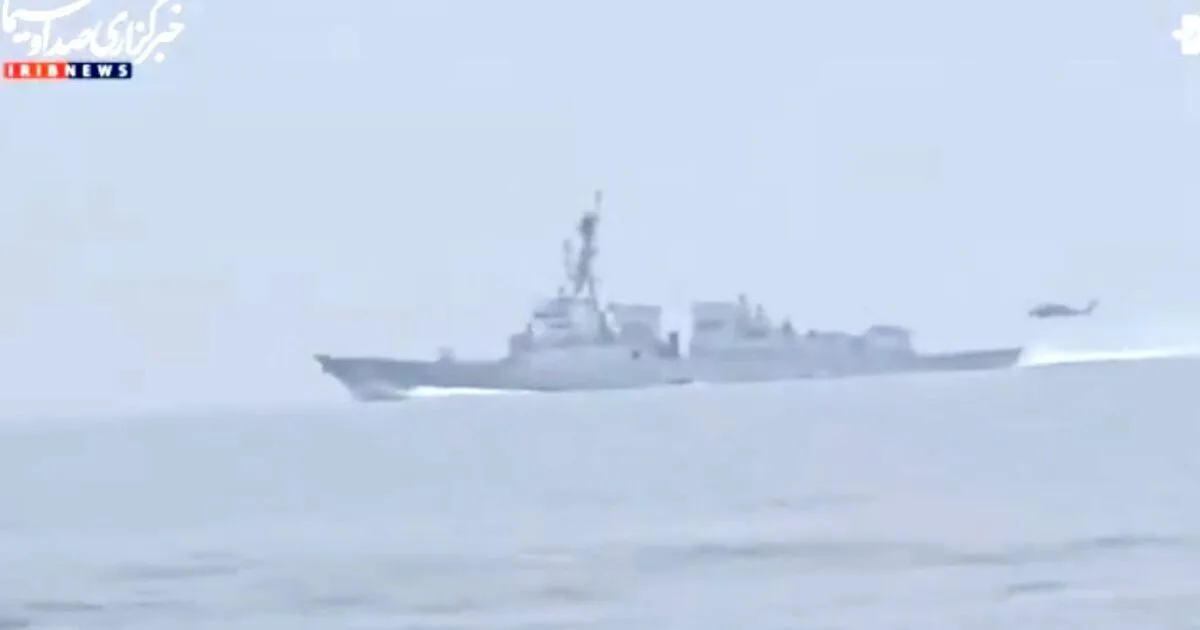
Iranian forces have issued a chilling “last warning” to an American warship, according to newly released audio aired on Iranian television. The recording, which Tehran claims captures an interaction between its military and a US vessel, was broadcast as the USS Frank E. Peterson and USS Michael Murphy, two guided-missile destroyers, entered the strategically vital Strait of Hormuz on Saturday to begin mine-clearing operations.
The development came after negotiations to end the US-Israel conflict with Iran, which had begun in Pakistan with Vice President JD Vance in attendance, collapsed. The strait has been closed and mined by Iran since the US and Israel launched strikes on the Islamic Republic on February 28, causing global market chaos due to the waterway’s role in handling 20% of the world’s oil and gas tanker shipping.
On the audio, a voice identifying itself as the Iranian Navy tells the USS Frank E. Peterson: “You must alter course and go back to the Indian Ocean immediately. If you don’t obey my order, you will be targeted. Out.” An American voice responds: “This is coalition warship 121 engaged in transit passage in accordance with international law. No challenge is intended to you.” The recording, which appears clipped, then captures the Iranian voice repeating “last warning” three times, before a separate broadcast warns all vessels in the Oman Sea to keep a distance of more than 10 miles from any warship, saying: “I am ready to open fire on them, without any warning.”
US Central Command (CENTCOM) Admiral Brad Cooper said on Saturday that the Navy had begun establishing a new passage through the strait and would share the safe pathway with the maritime industry “to encourage the free flow of commerce.” By evening, however, Iran’s Islamic Revolutionary Guard Corps (IRGC) Navy denied reports of any US passage, asserting that it “fully and authoritatively manages the intelligent control of the Strait of Hormuz” and that permission is granted solely to non-military vessels under specific regulations. The IRGC added on X: “Any erroneous maneuver will trap the enemy in deadly whirlpools in the Strait.”
President Donald Trump responded on social media by claiming it was the United States that was shutting down the waterway, writing: “Effective immediately, the United States Navy, the Finest in the World, will begin the process of BLOCKADING any and all Ships trying to enter, or leave, the Strait of Hormuz.” Meanwhile, UK Prime Minister Sir Keir Starmer called on both Iran and the US to “find a way through” following the failure of the Pakistan talks.




