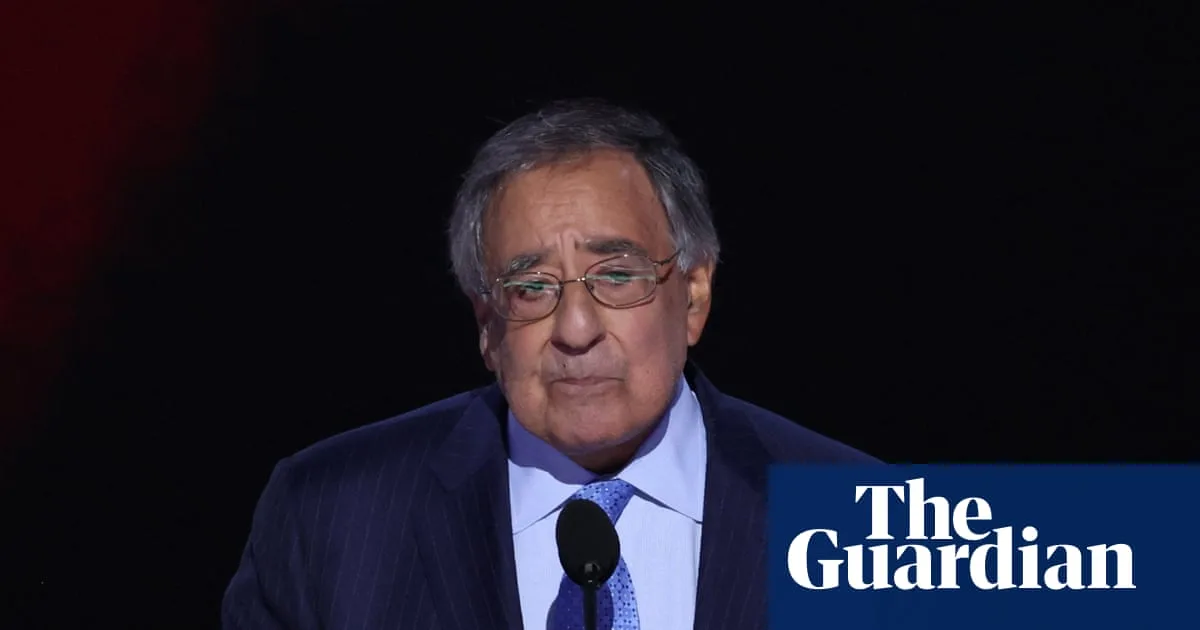
Former CIA director Leon Panetta has warned that Iran holds "a gun to our head" due to its control over the Strait of Hormuz, and cautioned that President Donald Trump may have underestimated the conflict's duration. Speaking to The Times, Panetta expressed concern that the war, initially expected to end within six to eight weeks, could persist for months.
Panetta's Assessment of the Conflict
"My sense is that it's very likely this war, which was supposed to end after six to eight weeks, is probably going to continue for a number of months," Panetta said. "This is because we have not found the key to how we achieve, not just a continuing ceasefire, but a resolution to some of the crucial issues which will then allow us to end the war. The president, frankly, has very few options."
Panetta, who led the CIA under Barack Obama from 2009 to 2011 and served as defense secretary until 2013, played a key role in the operation that killed Osama bin Laden. He questioned the value of renewed U.S. airstrikes against Iran, which Trump has threatened amid stalled peace talks.
Military Action Unlikely to Sway Iran
"I question whether additional military action is going to produce any real change in the regime," Panetta said. "They've been able to withstand a great deal, and from our own intelligence the indication is that they can continue to withstand that kind of impact. So I'm not sure military action provides a key to trying to apply leverage right now."
He added that Trump must decide whether to pursue a quick end to the war, which would require addressing the Strait of Hormuz and establishing a negotiating framework for the nuclear issue. "But that process is not there right now," he noted.
The Strait of Hormuz: A Strategic Chokepoint
Panetta argued that sending U.S. ground troops into Iran would only be justified to seize the Strait, a mission that would likely result in heavy casualties. "When I was secretary of defense, [we concluded] you've got to have enough troops to cover 50 miles on each side of the Strait of Hormuz and 100 miles further in to control that entire area," he said. "There will be casualties as a result of that kind of effort."
He suggested that the only realistic solution would be for both sides to agree to an allied coalition operating the passage, guaranteeing free movement of ships without fees. "But at this moment in time, Iran has a gun to our head with the closure of the Strait. Somehow, we've got to find a way to make sure that that gun is not there."
Economic Leverage and Missed Opportunities
Panetta noted that U.S. intelligence chiefs "always knew" Iran would respond to an attack by closing the Strait, blocking one-fifth of global oil shipments and driving up fuel prices. He accused the Trump administration of failing to plan ahead. "As long as the Strait remains closed, as long as they continue to put tremendous pressure on the US and the world economy, we're not going to get anywhere because they have the leverage."
Criticism of Trump's Negotiators
Panetta was dismissive of Trump's lead negotiators, Steve Witkoff and Jared Kushner, calling them "just two business guys from New York" with no diplomatic experience. He described the U.S.'s main leverage as its unwavering opposition to Iran's nuclear program, which ensures continued hostility from Washington.
"So, each side is in this situation where they're waiting for the other side to blink," Panetta said. "In many ways, they both consider the other side to be a paper tiger."
Trust Deficit and Long-Term Concerns
He highlighted a mutual trust problem, with the U.S. wary of Iran's "hardline regime" and Tehran uncertain "if they can trust Donald Trump as president, to stand by whatever agreement is made." Panetta warned that without a durable agreement, the U.S. and Israel could be at war again within four to five years, urging the administration not to alienate international allies.
The former official's comments came as Senate Republicans blocked Democrats' seventh attempt to end the war, though Alaska GOP Sen. Lisa Murkowski joined rebels Sen. Susan Collins and Sen. Rand Paul in opposing the conflict.






