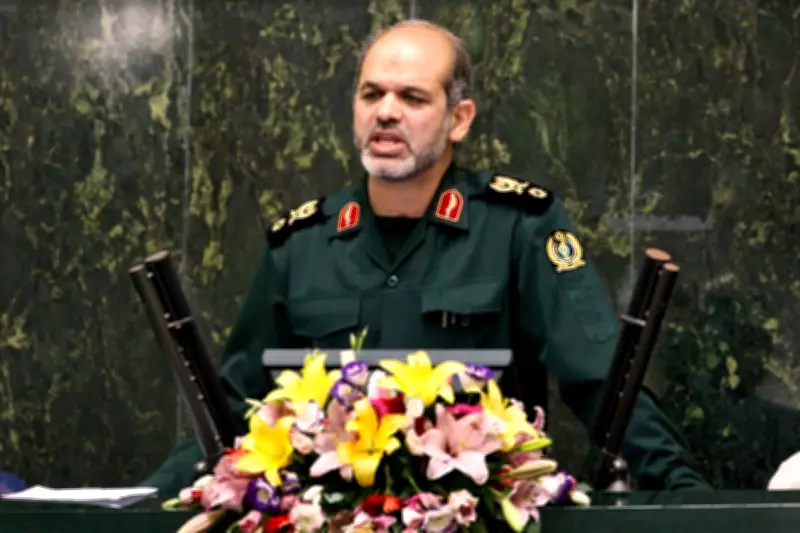
A hard-line Iranian general with a history of involvement in notorious attacks at home and abroad is believed to have secured a position near the center of power, as negotiations with the United States hang in the balance. Brig. Gen. Ahmad Vahidi, who commands Iran's paramilitary Revolutionary Guard, has become a major player in formulating Iran's uncompromising stance in talks aimed at ending the war with the US, experts say.
Rise to Power
Vahidi is thought to be part of a small clique in direct contact with Iran's Supreme Leader Ayatollah Mojtaba Khameini, who remains in hiding after being reportedly wounded in Israeli strikes on Feb. 28 that killed his father, Ayatollah Ali Khamenei. Since the war began, uncertainty over who ultimately controls decision-making has prevailed. Vahidi himself was not seen publicly for months after Feb. 8, weeks before the war started, until Thursday, when Iranian newspapers showed him meeting with Pakistan's interior minister in Tehran to discuss negotiations with the US.
Background and Influence
A veteran of the ruling system, Vahidi helped shape Iran's support for militant groups across the region. He is accused of playing a role in the 1994 bombing of a Jewish center in Argentina and, in 2022, led domestic security forces in a bloody crackdown on protesters. Elevated to Guard commander this year after his predecessor was killed early in the war, he now leads Iran's most powerful force, with its arsenal of ballistic missiles and small boats threatening Persian Gulf shipping.

According to the Washington-based Institute for the Study of War, “Vahidi and members of his inner circle have likely consolidated control over not only Iran’s military response in the conflict but also Iran’s negotiations policy.”
War Strategy and Negotiations
Iran's war strategy has focused on maintaining a stranglehold on the Strait of Hormuz, blocking oil and gas exports and causing a global energy crisis, while striking hard against oil facilities, hotels, and infrastructure in Gulf Arab nations. In negotiations, Iran has held out against US demands to surrender its stockpile of highly enriched uranium, betting it can outlast the US and that President Donald Trump will be reluctant to resume outright war that could damage America's Gulf allies.
This approach likely reflects Vahidi's confrontational style. “He comes from that mindset of unending revolution, unending resistance,” said Kenneth Katzman, a senior fellow at The Soufan Group. Vahidi believes “the U.S. needs to be challenged at every turn,” Katzman added. In January, Vahidi boasted that Iran's defense power makes it a “high risk for any military action by an enemy.”
Recent Developments
Pakistan hosted talks in April between an Iranian delegation led by parliament speaker Mohammad Bagher Qalibaf and an American one headed by US Vice President JD Vance, but no deal was reached. Qalibaf and Foreign Minister Abbas Araghchi faced criticism at home for being too willing to make concessions. Since then, Vahidi has become the main point of contact for those negotiating with Iran, said a regional official with direct knowledge of the mediation, speaking on condition of anonymity.
The extreme seclusion and unknown condition of the supreme leader have fueled speculation about jockeying among leaders for access to Khamenei and influence. In early May, President Masoud Pezeshkian, widely seen as sidelined by the Guard, emphasized that he “got to see our dear leader” and spoke with him for about two hours.
Holly Dagres, a senior fellow at the Washington Institute for Near East Policy, said it is likely the new supreme leader “is in lockstep with a more hard-line (Guard) — similar to his father, but in a more emboldened and uncompromising form.” Analyst Kamran Bokhari wrote that figures like Vahidi “are not just managing war — they are actively reshaping succession, consolidating authority around a weakened supreme leader, and effectively ‘capturing’ the state through crisis governance.”

Early Career and Controversies
Born Ahmad Shahcheraghi in Shiraz in 1958, Vahidi joined the Revolutionary Guard after the 1979 revolution and fought in the Iran-Iraq war. He entered the Guard's intelligence arm and oversaw operations outside Iran, gaining favor with powerful patrons like former President Akbar Hashemi Rafsanjani. Rafsanjani noted in his autobiography that Vahidi was involved in the 1980s Iran-Contra scandal, where the Reagan administration sold weapons to Tehran to free hostages. Rafsanjani later protected Vahidi when Supreme Leader Ayatollah Ruhollah Khomeini sought to prosecute Guard members for failing to stop an incursion by Iranian exile fighters.
Vahidi took over the Quds Force, which helped create a network of proxy militant groups. Prosecutors say the Quds Force under Vahidi masterminded the 1994 bombing of Argentina's largest Jewish community center, killing 85 and wounding 300. American investigators also believe Iran organized the 1996 Khobar Towers bombing in Saudi Arabia, killing 19 US service members. Tehran has denied involvement in both attacks.
Later Roles
Vahidi left the Quds Force in 1998. In 2010, as defense minister, the US imposed sanctions on him over alleged involvement in Iran's nuclear program. More recently, as interior minister, he oversaw police units in the bloody crackdown on protests following the 2022 death of Mahsa Amini. A classified document later showed his ministry ordered monitoring of women not wearing the hijab, which he had denied. Vahidi publicly called the hijab a barrier against “effete Western culture.”
Implications for Peace Talks
Vahidi's role makes reaching an accord with Iran more difficult for the US, as does the continued obscurity over Iran's leadership. President Trump wants a single interlocutor, but “the whole system has changed,” said Hamidreza Azizi, an Iran expert at the Middle East Institute. “It is not a one-man show. Vahidi is one alongside others. Some we know and some we don’t know.”