Iran Exploits Ceasefire to Recover Buried Missiles Amid US-Iran Tensions
Iran appears to be leveraging the two-week ceasefire to excavate missile launchers that were buried by the United States and Israel during intensive military operations. Following weeks of turmoil in the Middle East, the US and Iran agreed to a temporary ceasefire on April 8, with Pakistan acting as a mediator to discuss a potential end to the conflict. However, Iran does not seem to be idle during this period.
Satellite Evidence of Excavation Efforts
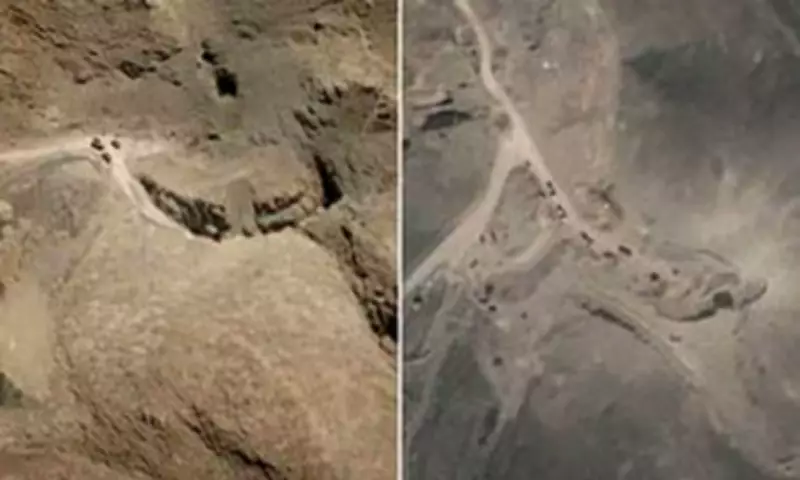
Satellite images captured after the ceasefire announcement show trucks removing rubble from military bases in Tabriz and Khomeyn. These images indicate a coordinated effort to clear entrances to these facilities, which were specifically targeted by Israel and the US to prevent Iran from accessing its missile arsenal. Earlier this week, Pentagon chief Pete Hegseth asserted that US military actions had 'functionally destroyed' Iran's missile program, rendering the nation 'combat ineffective for years to come.'
Despite this claim, US officials have cautioned the Wall Street Journal that Iran might be able to recover and repair a significant portion of its buried missile stockpile. This development occurs amid uncertainty over whether the US intends to extend the ceasefire with Iran. Initial reports suggested that Donald Trump was eager to push the deadline beyond next week, but White House press secretary Karoline Leavitt has denied these reports, stating they are 'not true at this moment.'

Confusion Over the Strait of Hormuz Blockade
Further confusion has arisen regarding the status of the Strait of Hormuz, following Trump's order to implement a naval blockade on behalf of the US. After peace talks with Iran collapsed over the weekend, the President initiated a blockade of this critical oil chokepoint, through which one-fifth of the world's oil supply flows. Trump imposed this measure to pressure Tehran back to negotiations, reportedly hesitant to resume the bombing campaign that has caused chaos in the region.
During the initial phase of Operation Epic Fury, Iran retaliated by disrupting traffic through the strait using explosive speedboats, drones, and naval mines. In a recent Truth Social post, Trump declared the waterway 'permanently open' after secret discussions with Chinese leader Xi Jinping, claiming that China had agreed to cease arming Iran. Trump wrote, 'China is very happy that I am permanently opening the Strait of Hormuz. I am doing it for them, also - And the World. This situation will never happen again.'
Contradictory Messages from US Authorities
Contrary to Trump's statement, the US military released audio footage of a radio message warning ships in the Strait of Hormuz to 'prepare to be boarded.' In the recording, a US military officer announces, 'The US has announced a formal blockade of Iranian ports in coastal areas. This is a legal action. All vessels are advised to immediately return to port if leaving, and discontinue transit to Iran if that is your next port of call, do not attempt to breach the blockade.'
The officer further warns that any vessels attempting to breach the blockade 'will be boarded for interdiction and seizure' and that 'we will use force.' A senior White House official informed the Daily Mail that, despite Trump's promise to reopen the strait, 'the blockade is fully in effect and working.' It remains unclear whether Trump was announcing an immediate reopening or signaling a long-term resolution as peace talks continue.
Adding to the complexity, Xi Jinping criticized Trump's decision to block the Strait of Hormuz as 'dangerous and irresponsible,' urging the international community not to 'revert to the law of the jungle.' This contradicts Trump's assertion that China supported the reopening, highlighting the ongoing diplomatic tensions and mixed signals in US-Iran relations.