Inside the Vatican Bubble: A Reporter's Account of Pope Leo's Africa Tour Amid Trump Feud
Covering Pope Leo XIV from within the Vatican's exclusive travelling press pool offers a profoundly isolated yet privileged experience. Escorted by police motorcades that effortlessly clear even the most congested traffic, journalists enjoy unparalleled access. However, during the Pope's monumental four-nation tour of Africa, being ensconced in this Vatican bubble has felt almost surreal. This is due to an unprecedented and very public exchange of barbs between the pontiff and former US President Donald Trump.
The Tense Transatlantic Dialogue
Each morning of the tour has begun with journalists waking to fresh developments from Washington, prompting urgent questions. Will Pope Leo respond directly? How will he address the latest criticisms while maintaining focus on his carefully planned African agenda? This tension was palpable on Wednesday as the Pope, his delegation, and approximately 70 accredited reporters boarded an ITA Airways charter flight from Algiers, Algeria, to Yaounde, Cameroon, marking the second leg of an eleven-day odyssey.
To the delight of the press corps, Pope Leo had initially confronted Trump's comments head-on. At the trip's outset, on April 13th, he gamely walked to the rear of the plane during the flight from Rome to Algiers. There, he fielded questions about a Truth Social post from Trump the previous day. The former president had accused the pontiff of being soft on crime, overly cozy with the political left, and suggested he owed his papacy to Trump himself.

Trump's outburst was a reaction to Pope Leo's calls for peace regarding the Iran conflict, where he labelled Trump's threat to annihilate Iranian civilisation as truly unacceptable. Moving from row to row, Pope Leo assured journalists he was merely preaching the Gospel in advocating for peace and criticising war, adding that he did not fear the Trump administration.
A Shift in Strategy and Subtle Signals
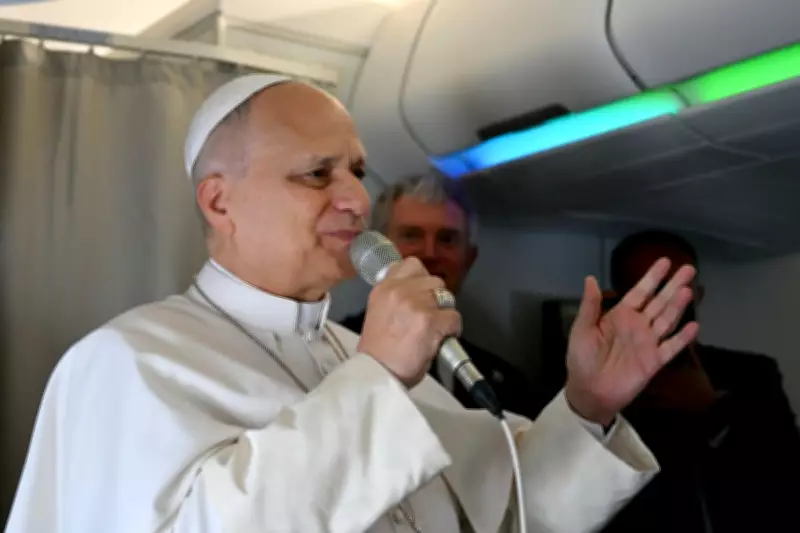
The dynamic shifted on Tuesday's short flight from Algiers to Annaba, the ancient city of Hippo. Pope Leo remained with the Vatican delegation at the front of the aircraft, disappointing reporters hoping for another explosive news cycle. However, excitement surged again on the subsequent five-hour journey to Cameroon when Vatican staff prepared a microphone at the rear of the plane.
Emerging from behind the curtain, Pope Leo did not take questions. Instead, his brief remarks, delivered exclusively in English—a potentially telling choice—focused on his concluded visit to Algeria. He honoured the legacy of St. Augustine of Hippo, his spiritual inspiration, and spoke of the goodness, generosity, and respect shown by the Algerian government.
While not explicitly mentioning war or Trump, his words seemed to acknowledge the ongoing criticism from Washington. He highlighted the military aerial escort provided for his plane and his visit to Algiers' Great Mosque as a symbol that people of different beliefs can live together in peace. He emphasised that St. Augustine's message of seeking truth and building unity is something which the world needs to hear today.
The Mechanics and Merits of the Papal Press Pool
Like other world leaders, the Pope travels with an internal media team and an external press pool. News organisations pay significant sums—often thousands of dollars per journalist—for a seat on the papal plane and special access to events. Outlets like The Associated Press routinely secure multiple spots.
Being inside this bubble presents distinct journalistic trade-offs. The advantages are substantial: prime access, seamless security under the Vatican's umbrella, pre-arranged visas, SIM cards, hotels, and transport. This allows reporters to concentrate solely on the news. They receive the Pope's speeches in advance and have real-time access to the Vatican spokesman and delegation members.
The primary reason for this costly investment is the airborne press conference. The only time a Pope traditionally holds such briefings is at 35,000 feet. Historic moments, like Pope Francis's 2013 Who am I to judge comment regarding a gay priest, originate here.

However, the disadvantage is the isolation from local reality. Reporters are removed from the on-the-ground context of nations like Algeria or Angola, with little time for independent, balanced reporting. Larger news organisations mitigate this by deploying separate ground teams or having pool journalists break away, blending official Vatican narratives with local colour.
A Jarring Disconnect and Unpredictable Path Ahead
When the central drama involving the Pope unfolds thousands of miles away, as with the Trump feud, the Vatican bubble creates a jarring disconnect. The news the world craves may not align with the pontiff's immediate agenda. Yet, on this historic first African tour by an American pope, the bubble's advantages were clear, providing a front-row seat to a unique geopolitical and religious moment. With the next stop in Angola, the question remains: What will Pope Leo have to say next?