
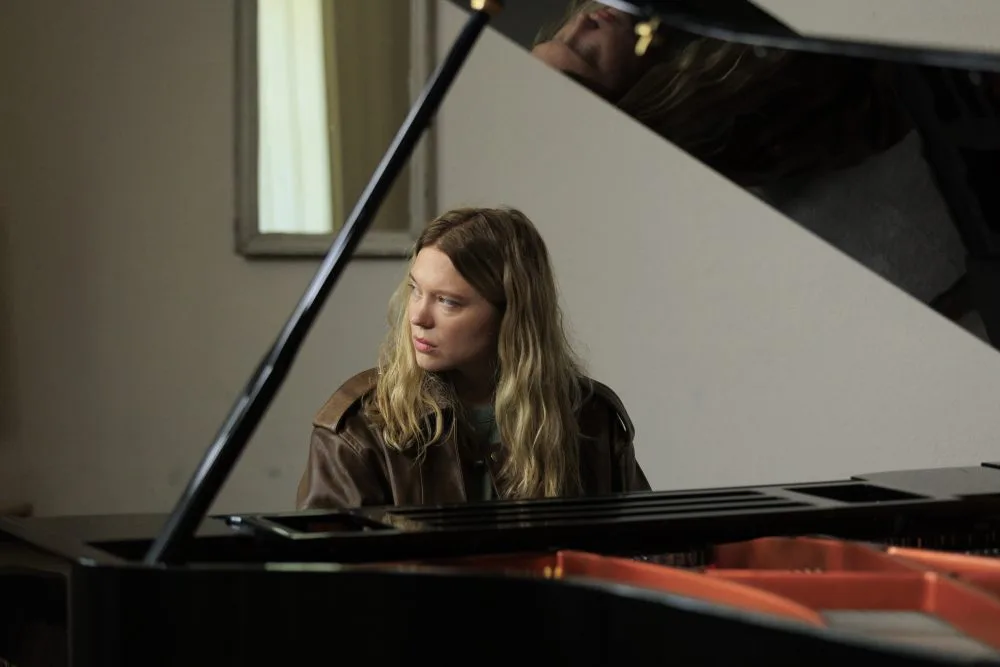
In Marie Kreutzer's 'Gentle Monster', Léa Seydoux delivers a powerful performance as a wife and mother grappling with the devastating revelation of her husband's involvement in a child pornography ring. The film, which premiered in competition at Cannes, follows Kreutzer's acclaimed 'Corsage' and maintains a grimly persuasive tone throughout.
The story centres on Lucy (Seydoux), a French avant-garde musician, her Austrian filmmaker husband Philip (Laurence Rupp), and their young son Johnny (Malo Blanchet). After Philip suffers a panic attack, the family moves to the German countryside seeking a fresh start. They assemble a trampoline for Johnny, and scenes of him bouncing joyfully contrast sharply with the film's downward spiral.
The family's fragile normalcy shatters when the Munich child sex crimes unit, led by Officer Else Kühn (Jella Haase), arrests Philip. Lucy is left in a state of bewilderment and dread, struggling to accept that her husband may have not only distributed child pornography but also abused their son. Seydoux captures Lucy's desperate attempts to rationalise the situation, including a moment of relief when Philip claims he did it for money—a claim that proves false.
A subplot involving Officer Kühn's aging father, who gropes his live-in carer Natalia (Patrycja Ziółkowska), mirrors the main narrative. Kühn dismisses her father's behaviour as senility, reflecting the same minimisation she condemns in her work. This parallel underscores the film's bleak view of male transgressions.
Kreutzer's direction, combined with Judith Kaufmann's muted cinematography and Camille's haunting musical arrangements, creates an unrelenting atmosphere. The film offers no easy answers, instead immersing viewers in Lucy's harrowing journey as she confronts an unbearable truth.




