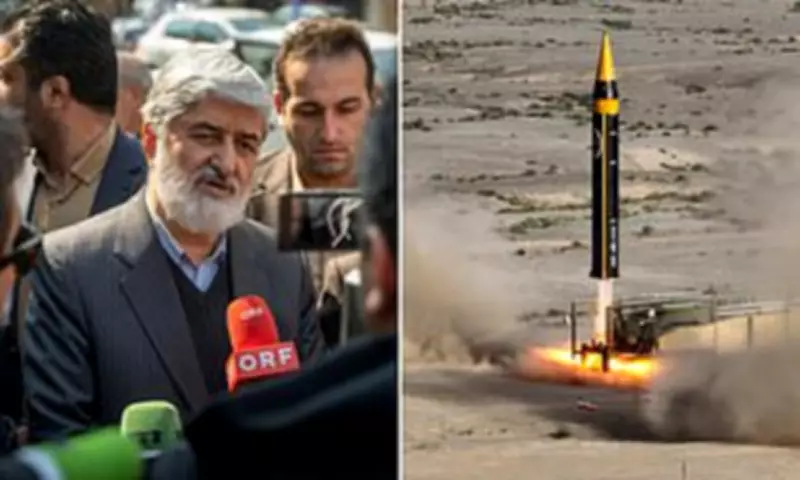
A resurfaced interview with a former senior Iranian official has ignited significant controversy after he openly admitted that Iran's nuclear program was originally intended to develop a nuclear bomb. Ali Motahari, who served as deputy speaker of Iran's parliament from 2016 to 2019, made these startling revelations during a 2022 appearance on the Iranian news outlet ISCA News.
Direct Admission of Nuclear Bomb Ambitions
In the interview, Motahari stated unequivocally: 'When we began our nuclear activity, our goal was indeed to build a bomb. There is no need to beat around the bush.' He clarified that the intention was not to detonate such a weapon but to use it as a deterrent, citing a Quranic verse about striking fear into the hearts of enemies. Motahari argued that possessing a nuclear bomb for deterrence 'would not have been a bad thing' and lamented that Iran should have proceeded to the nuclear threshold.
Contradiction of Official Iranian Position
These statements directly contradict Iran's long-standing official position that its nuclear program has always been purely for peaceful, civilian purposes. The interview has gained renewed attention amid ongoing US-Israeli military operations against Iran, with former US President Donald Trump repeatedly stating that preventing Iran from obtaining nuclear weapons is a primary objective of current attacks.

The Amad Plan and Secret Nuclear Weapons Development
Motahari explained that the nuclear bomb plan ultimately failed because Iran could not maintain secrecy, particularly after the People's Mojahedin Organization of Iran (PMOI) leaked confidential reports in 2003. This leak exposed the Amad Plan, a comprehensive nuclear weapons development program that included:
- Producing five 10,000-ton TNT warheads (equivalent to two-thirds the power of the Hiroshima bomb)
- Establishing a clandestine nuclear fuel cycle
- Preparing for underground nuclear tests by 2004
The project, led by Mohsen Fakhrizadeh, made substantial progress in just a few years, acquiring foreign weapon designs, conducting explosives testing, and studying warhead integration with Shahab-3 missiles. According to Motahari, this objective was pursued and supported by 'the whole regime, or at least, by the people who started this activity.'
Critical Missing Element and Continued Development
Despite this progress, Iran lacked the weapons-grade uranium or plutonium needed to fuel actual bombs. After the Amad Plan halted, Iranian leaders reportedly divided the nuclear program into overt and covert streams. According to the International Atomic Energy Agency (IAEA), scientists continued using computer simulations to test nuclear explosions until 2009, allowing weapons development to proceed without real-world testing.
Nuclear Infrastructure Expansion and Enrichment Milestones
By 2013, Iran had installed over 18,000 basic centrifuge machines and approximately 1,300 more advanced models at its nuclear facilities. Centrifuges are crucial for uranium enrichment, spinning uranium gas at extremely high speeds to separate lighter particles and increase concentrations of uranium-235, the isotope needed for both nuclear reactors and weapons.
Iran had accumulated substantial uranium stockpiles, including:
- Roughly 21,000 pounds enriched to 5% (sufficient for nuclear reactors)
- Approximately 815 pounds enriched to 20% (dramatically shortening the path to weapons-grade material)
Material enriched to 20% represents a significant milestone, as nuclear experts describe it as entering a 'danger zone' of enrichment capability. In 2016, US government experts estimated this material could potentially be turned into enough fuel for one nuclear weapon within two to three months with further processing.
International Agreements and Subsequent Violations
Following revelations of secret facilities in 2002, Iran faced international sanctions that led to the 2015 Joint Comprehensive Plan of Action (JCPOA). This agreement restricted Iran's nuclear activities in exchange for sanctions relief, capping uranium enrichment at 3.67% and limiting centrifuge operations while allowing international monitoring.

However, after the US abandoned the agreement in 2018, Iran gradually reduced compliance, eventually exceeding enrichment limits to reach 60% purity—close to weapons-grade levels. Uranium enriched to 60% is widely viewed by experts as a critical warning level, representing most of the work needed to achieve weapons-grade material.
Recent Developments and Current Conflict
On June 12, 2025, the IAEA formally declared Iran in breach of its non-proliferation obligations. The following day, Israel launched military operations targeting Iran's military and nuclear fuel cycle sites, causing substantial damage. In October 2025, Iran officially terminated the JCPOA, declaring all restrictions on its nuclear program void.
By 2026, Trump launched joint attacks with Israel against Iran, stating clear objectives that included ensuring 'the world's number one sponsor of terror can never obtain a nuclear weapon.' Motahari's interview adds historical context to these current conflicts, suggesting that Western suspicions about Iran's nuclear ambitions may have been justified all along.
Interestingly, toward the end of his 2022 interview, Motahari noted that Iran's Supreme Leader Ali Khamenei opposed building a bomb, deeming it 'forbidden.' This creates a complex picture of internal disagreements within the Iranian leadership regarding nuclear weapons development.