Coachella 2026 Highlights: Big Stars, Boisterous Energy and Millennial Nostalgia Power Windy Year
The festival might feel more corporate than ever, but enthusiasm remained sky high with Bieber fever, a Demon Hunters surprise, and a pop takeover. Even in the best of times, Coachella can be a heavy lift – a long drive, perhaps longer lines, and, if you do it right, extremely long days of careening between live music sets under the intense desert sun. Every year, North America’s largest music festival generates a round of buzz and scorn in near equal measure for good reason – the sky-high prices, the deluge of cringey social media boasts, and the overwhelming vibes of influencer culture.
Yet the faithful keep returning, and the agnostics keep tuning in online, forking over a minimum of $649 for a three-day pass or securing a brand deal to witness what continues to be the most expansive and comprehensive music slate in the country. This includes a genuinely exciting mix of up-and-comers gunning for a breakout set and you-had-to-be-there moments such as the return of Justin Bieber.
Bieberchella Dominates the Conversation
While Bieberchella dominated much of the conversation on the ground this year – his low-key but sufficient Saturday headliner set drew perhaps the biggest crowd in festival history – Coachella 2026 offered plenty of range for those not interested in the comeback of the millennial icon. Coachella may be the one thing in America currently safe from actual inflation – there was no rise in ticket prices this year, though over half of attendees are likely on payment plans. But the inflation mindset prevails.

Following its so-called flop era two years ago, when underwhelming headliner billing led to the slowest ticket sales in over a decade, the festival has returned to conversation-dominating form with a more-is-more approach. This includes more international artists catering to more potential attendees, more infrastructure such as a new underground movie theater called the Bunker, and more investment in an impressive livestream operation as the festival shifts from in-person experience to global event and brand.
Surprise Guests and Nostalgia Bait
Most importantly, for maintaining hype both online and off, there were more surprise guest spots baiting nostalgia or straight-up headlines. David Guetta, whose Saturday night set pushed the cavernous Sahara tent beyond capacity, brought out JLo for her song Save Me Tonight. A day earlier, Katseye drew an even larger crowd – the biggest ever seen in the south-east corner, according to some longtime attendees – that spilled beyond the reach of the speakers.
Their set drew mixed reviews even from the faithful but raves for its inclusion of Kpop Demon Hunters’ Huntr/x. Earlier that day, soul singer Teddy Swims catered to millennial nostalgia by bringing out Joe Jonas and Vanessa Carlton. Lizzo showed out for Sexyy Red, Camila Cabello turned up for a remix of Havana with Young Thug, and Major Lazer’s Diplo introduced MIA to audible gasps for a raucous rendition of Paper Planes, the 2008 smash they co-produced.
Corporate Influences and Logistical Challenges
More Instagram activations emerged as Coachella skews ever-more corporate – from the ever-popular Aperol Spritz tent to a long line for elf cosmetics and an Alaska Airlines pop-up. To attend Coachella is to traipse about an adult Disneyland that is at once an escapist fantasy and a model of the brutally hierarchical economy in miniature. Celebrities were certainly making waves, for better with Hailey Bieber beaming with pride, and for worse with whatever high school fantasy Katy Perry and Justin Trudeau were living out.
Even some significant logistical challenges – such as Italian DJ Anyma’s futuristic late Friday set cancelled due to high winds, a tight crowd bottleneck post-Bieber that left attendees stranded for nearly 30 minutes, and a speaker that fell on a woman, closing Do LaB for Friday night – didn’t dent the feeling that Coachella is a well-oiled machine powering full steam ahead.

Politics and Performance Art
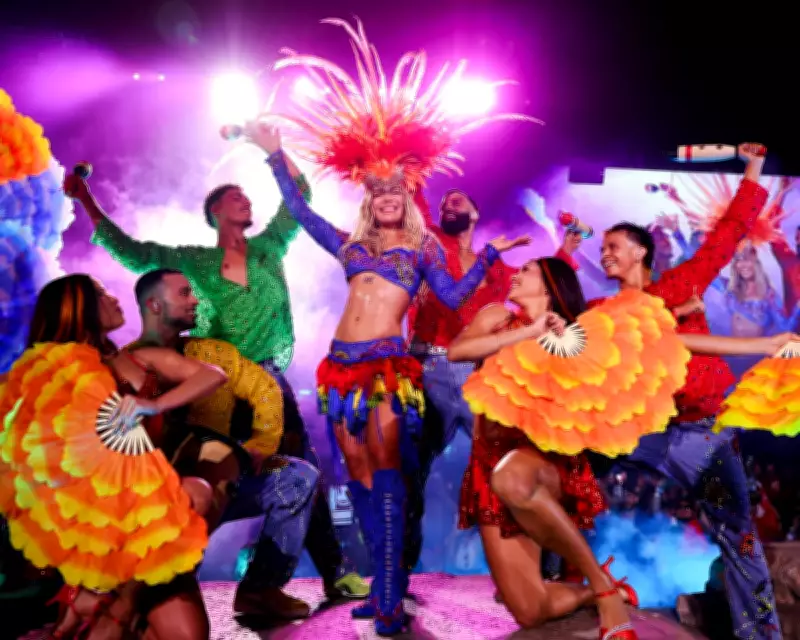
Coachella’s reputation as an escape is such that politics largely go unmentioned, beyond platitudes to peace and unity and some chaotic comedy from the Strokes frontman Julian Casablancas. Sunday headliner Karol G, the festival’s first Latina headliner in its 27 years, offered an implicitly political celebration of Latina pride and pan-American unity that nodded to the current US immigration crackdown.
However, other than a few noted rebukes – such as indie band Wednesday’s Karly Hartzman declaring “Fuck ICE and free Palestine” at the end of their set, and David Byrne projecting images of anti-ICE protests to his song Life During Wartime – Coachella stayed an oddly sanitized zone. This is, after all, a festival quietly run by Anschutz Entertainment Group, whose owner, rightwing billionaire Philip Anschutz, funnels money to various Republican political organizations.
Range of Entertainment and Emotional Moments
Still, the necessary side-eyeing aside, the festival once again delivered a mind-boggling range of top-quality entertainment and joy. From artists intent on bringing their A-game to a festival that can turbocharge a career, like Chappell Roan, to breakout artist Slayyyter’s pop-screamo set that kicked the festival off on a raucous note. Attendees accessed another dimension with Nine Inch Noize’s subterranean bass in their first-ever full set and nearly hit the ceiling when Jack White played Seven Nation Army to a thrashing crowd.
While hip-hop seemed de-emphasized in this year’s bookings, the festival continued to expand beyond its base of electronic and rock music toward pop, broadly construed. This included the cotton candy synths of Addison Rae, the mesmeric Runescape music of French electronic artist Oklou, and the tight choreo of Bini, the first all-Filipino group to perform at the festival. But it has not lost its touch with its rock roots, thanks to buzzy current acts like punk crossover Turnstile and Gen Z breakout Geese.
Once again, Coachella booked an excellent stable of veteran artists: Iggy Pop, shirtless and vital at 78 years old, who convened an all-ages mosh pit on Sunday night; electronic pioneer Moby, who led an extremely hype crowd through a “rave anthem” he played at the very first Coachella in 1999; and Fatboy Slim, whose sticky Sunday night DJ set at Quasar prompted a college kid to ask incredulously, “Who is this artist?!”
Genuine emotional moments can be hard to come by at a festival that can feel increasingly soulless and gamified, but Coachella wouldn’t carry on without its distinct magic. Many found this late Sunday night, as Karol G signed off with every whizzbang the main stage would allow, to screams of delight from so many Spanish speakers who knew every word to her groundbreaking set. Fireworks, pyrotechnics, and confetti were an appropriate cap on three 12-hour days and too many glorious beat drops to count. Recession indicators may abound, but Coachella keeps betting on more.