British Citizens Trapped in Dubai Amid Iranian Missile Attacks and Airport Chaos
Britons Stranded in Dubai as Iranian Missiles Strike and Flights Cancel

Panic has engulfed airports in Dubai as terrified British citizens attempt to escape the city amid ongoing Iranian missile and drone attacks. With approximately 14,000 UK nationals alone having registered their desire to leave the desert metropolis and other Middle Eastern locations, a palpable sense of desperation now prevails across the region.

Widespread Disruption and Stranded Tourists

Iran is believed to have launched nearly as many drones and missiles at Dubai and the United Arab Emirates as it has targeted Israel, transforming the Gulf's dominant trade and tourism hub into what many describe as a warzone. The iconic Palm Jumeirah hotel was set ablaze during the attacks, symbolizing the severity of the situation.

The Daily Mail spoke with numerous stranded tourists and expatriates desperately trying to secure flights back to Britain. Among them was Paul Hart, who explained how he and his wife have been trapped in Dubai since the fighting began and were unable to travel to Oman for the British Government's repatriation flight.

Wide Pickt banner — collaborative shopping lists app for Telegram, phone mockup with grocery list

Medical Complications and Travel Nightmares

"If you travel to Oman you have to go to the border and then get another taxi to take you from the border to the airport," Hart said. "My wife suffers from Crohn's disease and also has occipital neuralgia, therefore she needs close proximity to toilets and things, so it's not an option to travel to Oman."

Hart described being aboard a plane scheduled to depart on February 28 when the airspace suddenly closed. "It was all boarded, and then it came over the airways that 'Sorry, the airspace is closed'. So after four hours, we were able to depart the plane. Fortunately, we were able to get a taxi, and fortunately, we were able to return to our original hotel, because the alternative they provided was booked up within seconds."

He has since rebooked his hotel stay multiple times while anticipating further flight cancellations. "I'm fully expecting when my flight, which is due to leave on Monday, it will be cancelled on Saturday, and we will go around the loop again, with the prospect of another flight, but BA has got no intention flying people out of Dubai."

Personal Accounts of Fear and Uncertainty

Retiree Sue King, 66, from Newquay, Cornwall, had been visiting her daughter and family in Dubai when the first wave of Iranian missiles and drones struck. "It was very frightening," she recalled. "We heard the bangs and saw some flashes from interceptions, but luckily my grandchildren are very young, so they didn't pick up on what was going on."

King was originally supposed to fly home on Sunday, but that became impossible after the conflict began on Saturday. She then attempted to board a British Airways repatriation flight from Dubai Airport, only to discover it had been cancelled. "I'm now on standby for two different Emirates flights to Heathrow, one at 2pm and another at 2am, so I'm just crossing my fingers that I can get on one of them."

Interestingly, despite Dubai airport's live departures board showing King's "cancelled" British Airways flight, a BA spokesman clarified that the flight was never actually scheduled. "We aren't operating from Dubai at the moment," the spokesman confirmed.

Daily Reality of Missile Alarms

The barrage of deadly drone fire has become an unavoidable daily and nightly reality for those remaining in Dubai. Wailing sirens warning of missile alerts have been blaring across the metropolis at all hours for six consecutive days, as the UAE has become the worst-hit of the ten Gulf states targeted so far.

Several British passengers were disembarked from the stranded cruise ship MSC Euribia at Dubai's Port Rashid. A fleet of buses waited to transfer them overland on a 12-hour journey to Riyadh, Saudi Arabia, for connecting flights to Europe.

Screen printer Mark Killgariff, 54, from Stoke-on-Trent, told the Mail: "The first night was a bit hairy. We could see things in the distance, and the next day there were about six explosions, which was a little scary, but we soon realised that the missiles and drones were being intercepted. Family and friends have been emailing and texting, but we've reassured them."

Pickt after-article banner — collaborative shopping lists app with family illustration

Killgariff hopes they have worked out a way to get home, saying: "We'll now fly to Rome with Emirates and we'll have to try and find our way back to Manchester from there. We should have been going home tomorrow by a different flight, of course. But we have been well looked after."

Airport Struggles and Regional Impact

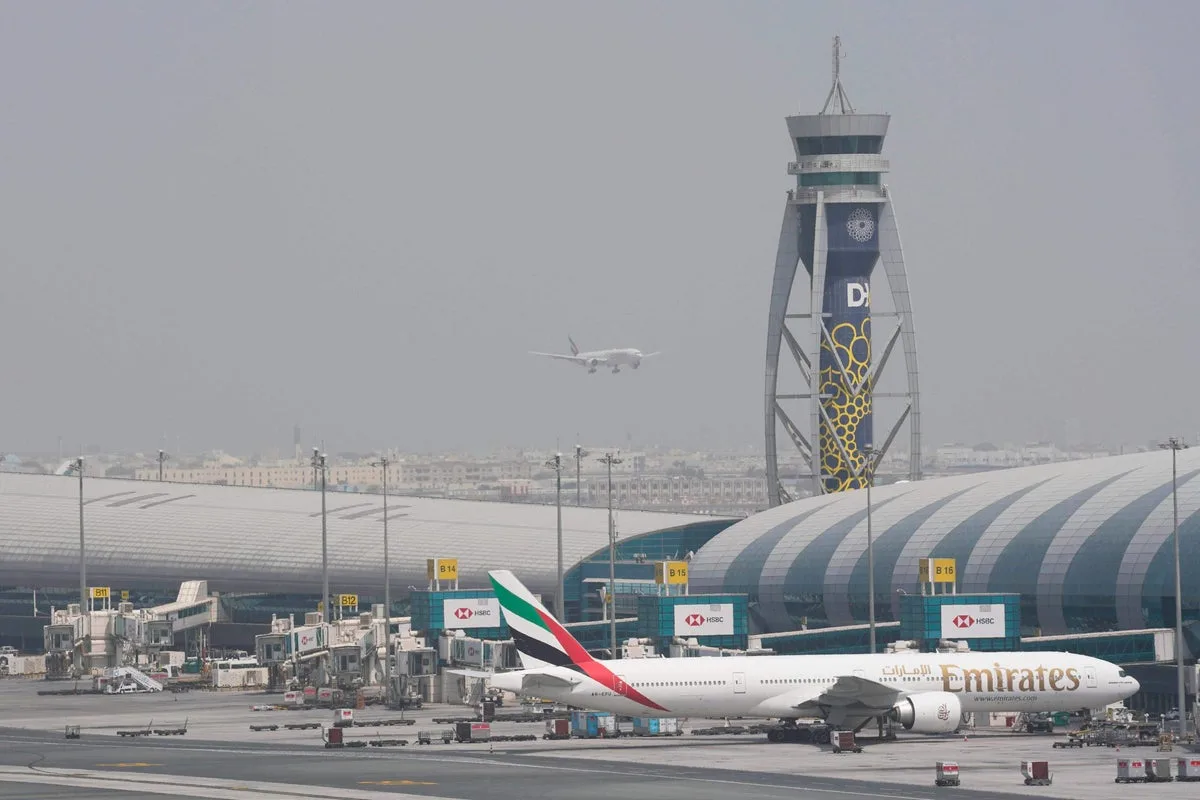
The attacks forced Dubai airport to close completely, leaving 20,000 travellers stranded in the UAE with all flights suspended. Airports across the region were initially closed following the Iranian missile and drone attacks but have now begun to reopen with heavily restricted air traffic.

Even though Dubai airport has now reopened, it's struggling to cope with the knock-on effects. Approximately half a million passengers ordinarily travel through it and sister airports in Doha or Abu Dhabi daily, all vital hubs between Europe and Asia.

Residents Putting on a Brave Face

Many permanent residents continue to put a brave face on the situation while attempting to leave. Dubai residents Eoin Campbell, 32, and Kate O'Neill, originally from Northern Ireland, said they were travelling back on a scheduled break to see their families.

Although they had experienced three cancelled flights so far, they were now trying to get to Edinburgh, from where they would continue with a short hop home. "I don't feel unsafe," said construction manager Mr. Campbell. "You can see that the air defence capability is up to scratch from the small numbers getting through, so the chances are very small of being injured. We'll come back here without any qualms."

Also displaying remarkable calm were an older couple from Ireland, despite having been staying at the Palm Jumeirah when it went up in flames. Pat O'Reilly, 81, and his wife Bernadette, 76, from Ardfield, near Clonakilty in County Cork, were staying in the Fairmont Hotel on the Palm Jumeirah when it received a direct hit on Saturday night. Fortunately, they were visiting their son and his family when the fire started.

"We weren't that far away, and we heard the bang," said former insurance agent Mr. O'Reilly. "Then the phones all sounded with the emergency alert and we realised what had happened. Our 11-year-old granddaughter was frightened out of her life."

The couple phoned the hotel and were told everyone had been evacuated, so they stayed at their son's house longer and returned later when the fire was out. They were uncertain about finding a flight to Dublin and left their luggage at their son's house to be sent on later.

They shrugged off the drama of their extended stay, except for one particular disappointment. "Our local pub the Mountain House in Ardfield has been closed for two years and their grand reopening is tonight and we're going to miss it," explained Mrs. O'Reilly.

Mr. O'Reilly added with characteristic Irish humor: "The war? No problem. Missing the opening of the pub, that's bad."




