Northern Ireland Leaders United Against Violence Despite Separate Appearances
Northern Ireland's First Minister Michelle O'Neill and deputy First Minister Emma Little-Pengelly have firmly insisted they are working "shoulder to shoulder" to address violence against women and girls, despite making separate media appearances on the issue. The political leaders spoke out following several high-profile cases that have shocked communities across the region.
Recent Tragedies Prompt Strong Statements
The ministers' comments come in the wake of multiple devastating incidents. Stephen McCullagh was recently convicted at Belfast Crown Court for the murder of his pregnant partner Natalie McNally. Additionally, two other women were murdered this month, with investigations ongoing following the death of Amy Doherty in Londonderry over the weekend, and a man appearing in court charged with the murder of Ellie Flanagan in Fermanagh earlier this month.
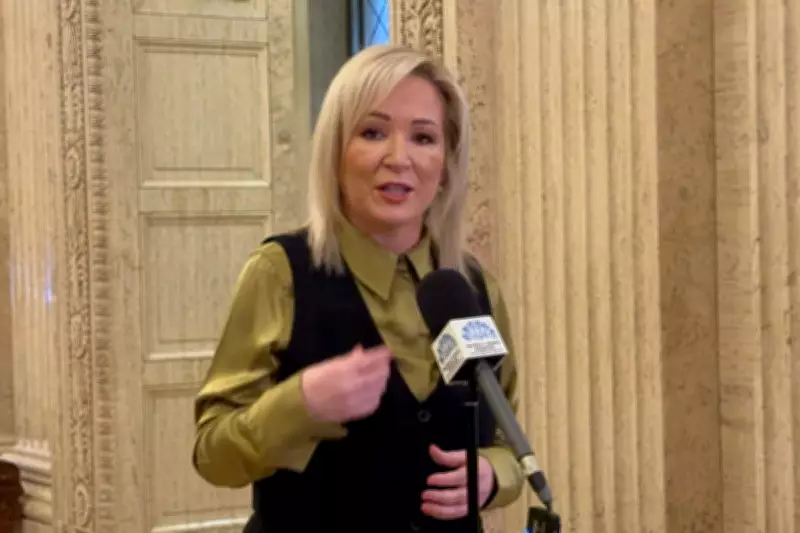
Speaking to reporters at Stormont, Ms O'Neill delivered a powerful message: "enough is enough." She emphasized that ending violence against women and girls represents a central focus of a major government strategy, while acknowledging the deep-rooted nature of the problem.

Addressing a Generational Challenge
"We knew that two years of a strategy isn't going to turn around the problems," Ms O'Neill stated, referencing what she described as "an ingrained problem in our society." She pointed to Northern Ireland's historical treatment of women, mentioning specifically the Magdalen laundries as a recent example of systemic issues.
The First Minister explained that ongoing work includes engagement with young people and reforms across the justice system. "We're trying to turn around a generational problem, and unfortunately I don't think we're going to do that in two years," she acknowledged, revealing that "in the next number of weeks we're bringing the next stage of our plan to the Executive."
Ms O'Neill stressed the collective responsibility: "We have a job, all of us collectively as a society, in terms of ending violence against women and girls. It needs to be an ongoing conversation, we need to challenge the misogyny we see every day."
Separate Appearances, United Purpose
When questioned by media about why she was not standing beside Ms Little-Pengelly for her comments, Ms O'Neill clarified that the two would later speak together at an event with 600 young people, insisting that "all of our shoulders are to the wheel." Pressed further on the separate appearances, she responded firmly: "There is no issue to see here."
She explained her appearance was primarily to offer condolences to the McNally family following the court case outcome, while noting that both ministers were preparing to attend different events. "There is nothing to see here, we're all committed to tackling this work and I think that is what we should all keep focusing on," Ms O'Neill concluded.
Deputy First Minister Echoes Commitment
Speaking separately at Parliament Buildings, Ms Little-Pengelly welcomed McCullagh's conviction while paying tribute to the McNally family. "It has been a very long journey, very upsetting journey," she said of the case. "Natalie was a young woman with her entire life in front of her and the terrible murder of her and her unborn child was absolutely appalling."
Ms Little-Pengelly praised the family's bravery in campaigning to prevent similar tragedies: "They've been incredibly brave and stepped forward to try and ensure that this should not happen to another woman or girl."
When asked about not making a joint appearance with Ms O'Neill, the deputy First Minister emphasized their unity on the issue: "We have stood shoulder to shoulder at absolutely every opportunity in terms of this strategy." She expressed anger at each new report of violence against women in Northern Ireland, stating: "The level of violence against women and girls in Northern Ireland is just completely unacceptable."
Justice Minister Highlights Systemic Issues
Earlier, Justice Minister Naomi Long described violence against women and girls as a "particularly difficult" problem in Northern Ireland. Ms Long characterized the region as remaining a "patriarchal society" where there persists "a lot of sexism, chauvinism and misogyny."

The minister paid tribute to Ms McNally's parents Bernie and Noel, who attended every day of the trial, describing them as "so dignified throughout this whole ordeal." She noted the unimaginable pain experienced by the family and expressed relief that they had received justice.
Ms Long highlighted alarming statistics: "Sitting here with 30 women killed in six years, we have to say that pain that the McNallys have gone through is a pain that many families are going through, too many families."
The Justice Minister outlined legislative and policy measures being implemented, including new laws in the last mandate and further legislation planned for the current mandate. However, she emphasized that solutions extend beyond the justice system: "It is about how we change the conversation in society, how we change the dial in terms of the vulnerability of women and girls to this kind of predatory behavior."
A Northern Ireland-Specific Challenge
While acknowledging that violence against women is not exclusively a Northern Ireland problem, Ms Long identified specific factors making it "a particularly difficult issue" in the region. She pointed to Northern Ireland's status as "a very patriarchal society" where "abuse of women generally is still accepted."
The minister also noted the impact of Northern Ireland's post-conflict context: "We also have, coming out of a post-conflict society, a higher tolerance for violence, higher levels of PTSD and other risk factors which could allow people to become perpetrators."
Ms Long highlighted research connecting domestic abuse with concentrated paramilitarism in communities, explaining that this exacerbates harms as victims may be "afraid to report what is happening to them, afraid of being seen to be engaging with the PSNI where that is frowned upon."
Despite the challenges, all three ministers expressed determination to address what Ms O'Neill described as "a fixable problem" requiring collective effort from society. Their separate appearances underscored not division but rather a multifaceted approach to confronting a crisis affecting communities across Northern Ireland.