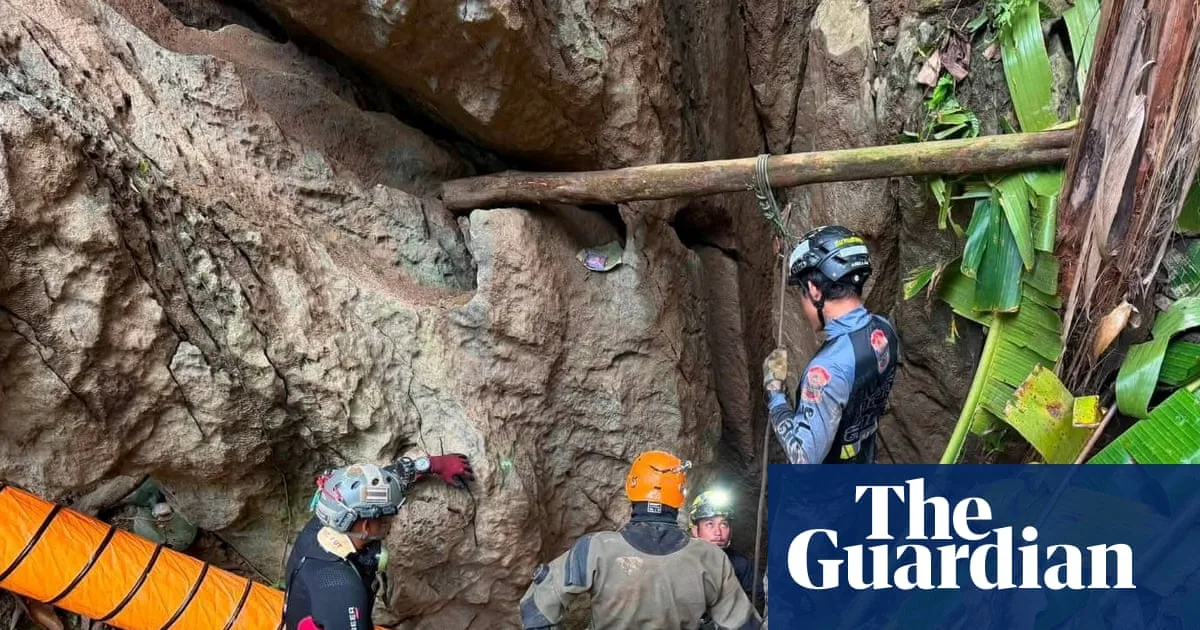
Footage has emerged showing the moment rescuers found five villagers trapped in a flooded cave in Laos, with one man visibly emotional and placing his head in his hands in gratitude after a week of uncertainty in the dark chamber. The mission to locate them was fraught with danger, but the extraction phase poses equally significant threats.
Discovery and Immediate Challenges
The five individuals were found in a terminal chamber after days of effort by rescue teams. Reaching the chamber required crawling for hundreds of metres through long stretches of dark, flooded areas, some with tunnels just 60 centimetres wide. The chamber is approximately 300 metres from the cave entrance, as noted by Mikko Paasi, a Finnish diver involved in the rescue.
Paasi described the environment as "extremely remote and hostile," involving a four-kilometre jungle track to the site and navigating hundreds of metres of constant restrictions, flood waters, collapse hazards, and contaminated air quality. The rescue is not yet complete; the next step is to mobilise the five people out of the cave, a task that remains highly complex.
Conditions Inside the Cave
Video footage depicts dark, narrow passageways, many nearly fully submerged by muddy waters. Grant Pearce, national director of the Cave Divers Association of Australia, compared the rescuers' efforts to finding one's way through an unfamiliar house with all lights off, trying not to stub toes. Cave divers are specially trained to navigate "sumps" (water-filled passages), manage varying tunnel sizes, and operate in low visibility. They use multiple bright torches, though these can be ineffective in muddy conditions, leaving divers working in zero visibility.
To mitigate this, divers run a fixed line from the surface through the cave, serving as a tactile reference—like breadcrumbs—to guide them to the trapped individuals and back out.
Factors Complicating Extraction
Several factors make extraction difficult: low oxygen supplies, anticipated rain, and the lack of diving experience among the trapped villagers. Kengkard Bongkawong, head of operations for Metta Tham Rescue, has appealed for oxygen tanks, stating that at least 30 are needed for both rescuers and the stranded men. He helped in the 2018 Thai cave rescue and is among international divers assisting in Laos.
Outside rescue missions, cave divers follow the "thirds rule": one third of air for the journey in, one third for the return, and one third reserved for emergencies. Unlike open-water diving, direct ascent is not possible in caves. The trapped individuals likely lack diving skills, so they must be attached to rescuers. Their physical and mental state is a concern; if anxious, they risk panicking, endangering both themselves and the rescuer.
Lessons from Previous Rescues
The 2018 rescue of a Thai football team involved sedating the boys, equipping them with full-face scuba masks, and towing them underwater while tethered to divers. However, Pearce emphasises that each rescue is unique, and the same approach may not be applicable due to differing cave conditions and the individuals involved.