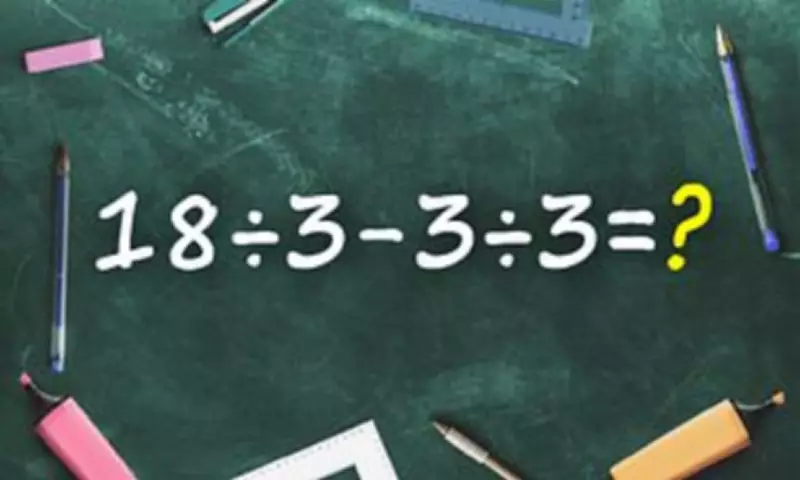
A seemingly straightforward arithmetic problem has ignited a fierce debate across social media platforms, challenging users to dust off long-forgotten school mathematics knowledge. The equation 18 ÷ 3 - 3 ÷ 3 has left thousands scratching their heads, with answers ranging wildly from 1 to 14.
The Viral Puzzle That Divided the Internet
The mathematical conundrum was originally posted by the popular X account BreaktheSilos, which regularly shares viral puzzles designed to test logical thinking and problem-solving abilities. This particular equation quickly gained traction, accumulating hundreds of comments as users attempted to demonstrate their arithmetic prowess.
"Can you solve it in 30 seconds? Ready. Set. Go!" challenged the original post, setting off a timer in the minds of participants across the globe.

The Great Answer Debate
Social media users presented a surprising array of solutions to what appears to be a simple calculation. Many confidently declared the answer to be 5, while a significant contingent argued for 1. More creative responses included claims of 7 and even 14, demonstrating just how divisive this elementary equation has become.
The confusion stems from differing approaches to mathematical order of operations - a fundamental concept taught in middle school that many adults have allowed to fade from memory.
The PEMDAS Principle Explained
For those struggling with the problem, the solution lies in recalling the acronym PEMDAS, which stands for Parentheses, Exponents, Multiplication, Division, Addition, and Subtraction. This hierarchy dictates the sequence in which mathematical operations must be performed to achieve the correct result.
Since the given equation contains no parentheses or exponents, we immediately proceed to division operations. The first division encountered is 18 ÷ 3, which equals 6. This transforms our equation to 6 - 3 ÷ 3.
Here lies the crucial point of confusion: despite the subtraction appearing first when reading left to right, division takes precedence over subtraction according to PEMDAS rules. Therefore, we must next calculate 3 ÷ 3, which equals 1.
The final operation becomes 6 - 1, yielding the correct answer of 5.
Where Most People Go Wrong
Those who arrived at the answer 1 typically made the understandable error of solving the equation strictly from left to right. Following this approach, one would calculate 18 ÷ 3 = 6, then subtract 3 to get 3, then divide by 3 to reach 1.
This incorrect method ignores the fundamental mathematical principle that division and multiplication must be completed before addition and subtraction, regardless of their position in the equation.
Testing Your Mathematical Mettle
Did you manage to solve the puzzle within the 30-second time limit? If so, congratulations - your arithmetic skills remain sharp, and your middle school mathematics teachers would undoubtedly be proud of your retention of core mathematical principles.
For those who struggled or arrived at an incorrect answer, take comfort in knowing you're in good company. Thousands of social media users similarly stumbled over this deceptively simple equation, proving that even basic mathematical concepts can become rusty without regular practice.
The viral puzzle serves as a reminder that mathematical literacy extends beyond classroom walls and continues to challenge us throughout our lives.
If you enjoyed this mathematical challenge and wish to test your skills further, numerous similar puzzles circulate online, each designed to probe different aspects of logical thinking and mathematical understanding. The next time you encounter such a problem, remember PEMDAS - it might just save you from mathematical embarrassment.