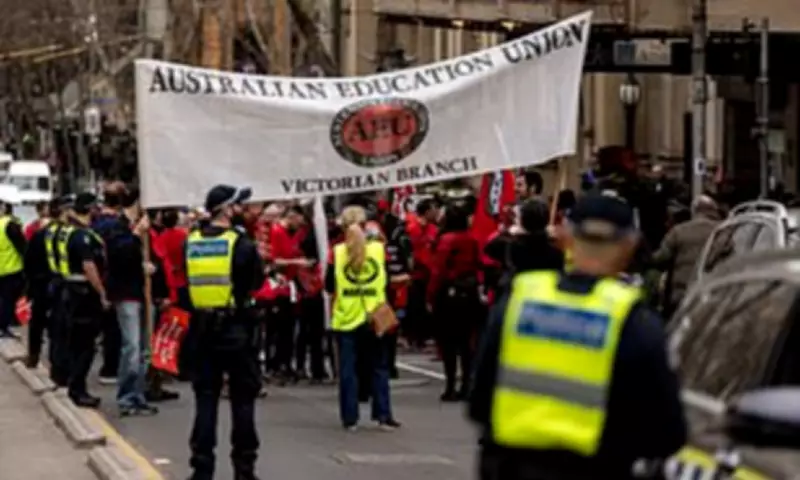
Tens of thousands of teachers, principals, and education support staff across Victoria and Tasmania are set to down tools in a major industrial action after last-minute pleas to avert school strike chaos were ignored. The strikes, driven by an unresolved pay dispute, will see Victorian public school staff walk off the job on Tuesday, while Tasmanian teachers will stage a three-day rolling strike, rejecting offers that fall far short of union demands.
Pay Offers Rejected Amid Union Demands
In Victoria, teachers have turned down a proposed 17 per cent overall pay rise over three years, with education support staff offered 13 per cent over the same period. This figure is a significant departure from the union's demand for a 35 per cent increase over four years. Currently, Victorian teacher salaries range from $78,021 to $126,992, while principals can earn up to $236,313. The union argues that these offers fail to address underpayment and undervaluation of educators, prompting the first statewide teachers strike in Victoria in more than 13 years.
School Disruptions and Parental Guidance
Schools across Victoria will remain open, but many will operate at reduced capacity, with classes cancelled and parents advised to keep children home if possible. For instance, a school in Melbourne's outer east has recommended alternative arrangements, and only four of 34 classes are scheduled to run at a nearby primary school. The Department of Education has confirmed it is working to limit disruption, stating that while all schools are expected to be open, many will only provide supervision for a limited number of students. Approximately a third of the 30,000-strong unionised workforce are expected to march from Victorian Trades Hall to state parliament for a rally.

Political and Economic Context
The strike occurs eight months before the state election, with Premier Jacinta Allan urging the Victorian branch of the Australian Education Union to cancel the action and return to negotiations. However, the union has refused, with Victorian branch president Justin Mullaly emphasising that students and families deserve properly compensated staff. The union has also threatened to escalate the industrial campaign if necessary. Meanwhile, a Victorian parliamentary inquiry is investigating the government's decision to delay increasing school funding to 75 per cent of the Schooling Resource Standard until 2031, which the union claims equates to a $2.4 billion cut in previously committed funding.
Deputy Liberal leader David Southwick has criticised the state government for prioritising other union demands over teachers' needs. Victoria's budget faces strain from mounting debt, and underlying economic assumptions could be tested by global inflation shocks linked to conflicts in the Middle East.
Tasmanian Strike Action
In Tasmania, public schools will close over three days as teachers strike for improved pay and conditions. Stop-work action will begin in the northwest on Tuesday, followed by the north on Wednesday and the south, including Hobart, on Thursday. Tasmania and Queensland have offered teachers an eight per cent pay rise, below the 13 per cent offer made to those in the Catholic system, further fuelling the dispute.
This coordinated strike action highlights growing tensions in the education sector, with unions pushing for better remuneration and funding amid economic pressures and political scrutiny.