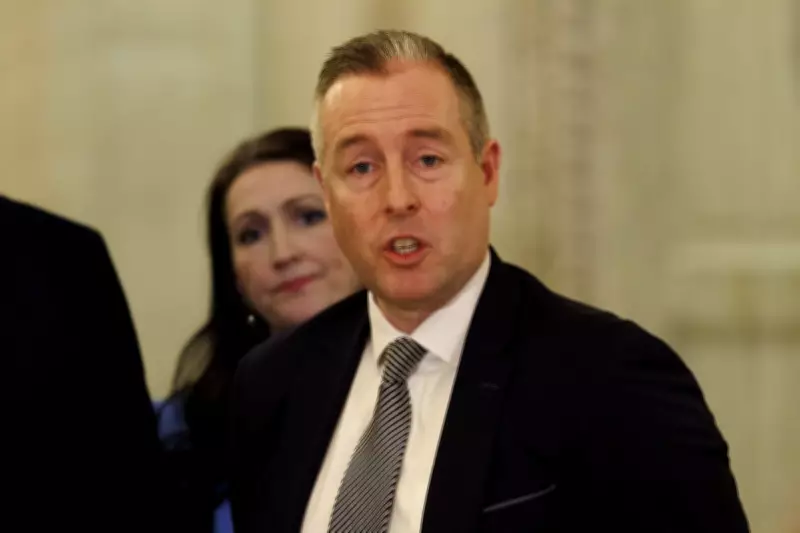
Education Minister Paul Givan has called for a fundamental transformation in how budgets are allocated to Stormont departments, describing the current process as flawed and unsustainable. Speaking amid severe financial pressures facing the Northern Ireland Executive, particularly in delivering public services, Givan emphasized that public sector pay commitments should be the starting point for departmental funding allocations.
Flawed Budget Process and Staff Cost Pressures
During an interview on the BBC's Sunday Politics programme, Givan highlighted the disproportionate impact of staff costs across departments. "My department is 82% staff pay, while in other departments that only accounts for around 30%," he explained. "Fundamentally, how we approach the budget is a flawed process, and we need to now start a new way of allocating funds to each department."
Givan argued against the traditional incremental budgeting approach, stating, "It can't just be, last year department x spent the following, this year we'll top it up by another 5%." Instead, he proposed basing allocations on "contractual inescapable pressures," with pay being a primary example. This shift, he believes, would ensure that departments with higher staff cost burdens, like education, receive appropriate funding to meet their obligations.

Engagement with Treasury and Long-Term Solutions
The Education Minister also stressed the need for closer engagement with the Treasury to address financial challenges. He referenced an additional £400 million made available to Stormont to support public services, which is in the form of a reserve claim to be repaid over three years. "I fully accept that collectively as an Executive, we're all facing difficulties within our departments," Givan said. "That's why opening our books up to the Treasury, allowing that detailed examination, and we need to get a longer-term arrangement with the Treasury to enable us to have that transformation."
Givan has published a sustainability budget plan with clear proposals, calling for Treasury support to implement it. This engagement, he argued, is crucial for achieving financial stability and enabling the Executive to make necessary reforms without compromising public services.
Unsustainable Education System and Proposed Reforms
Beyond budget allocation, Givan warned that the current approach to the education system is unsustainable both financially and in terms of outcomes for pupils. Last month, he published a five-year budget strategy that includes controversial proposals, such as reducing the number of schools in the region and reshaping special educational needs (SEN) support in mainstream schools.
"There are difficult decisions for this Executive to take," Givan acknowledged. "We do need to ensure that every pound is being effectively spent, and I couldn't say honestly that every single pound is being effectively spent in education. But there are wider pressures; we do need more funding, but it is my job to make sure that what we do have is spent effectively."
He pointed to demographic challenges, noting a declining birth rate that is expected to reduce school enrollments by 13% over the next decade. "It's not sustainable for a school where there are already small numbers of pupils, for them to remain open," Givan added, underscoring the need for structural changes to align with population trends.
Broader Implications for Public Services
Givan's comments come at a time when the Northern Ireland Executive is grappling with significant financial constraints across all departments. His call for a revised budget allocation process reflects broader concerns about the efficiency and fairness of current funding mechanisms. By prioritizing inescapable pressures like staff costs, he aims to create a more equitable system that better reflects the real-world demands on public services.
The proposed changes could have far-reaching implications, not only for education but for all Stormont departments. As the Executive considers these reforms, the focus will be on balancing fiscal responsibility with the need to maintain and improve public service delivery in Northern Ireland.