
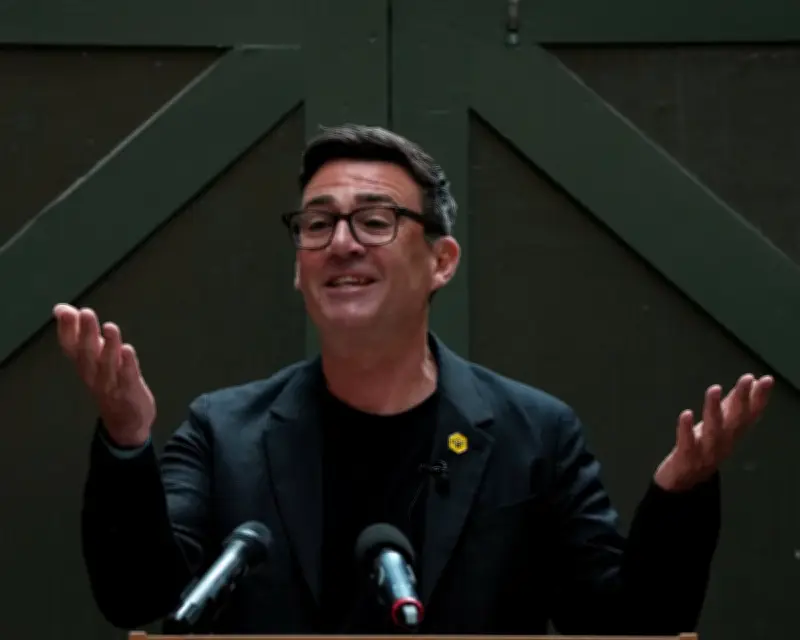
England's mayors should be granted sweeping new powers over a wide range of public services, including social care, childcare and skills, according to a paper by JP Spencer, the head of devolution policy at the thinktank ThinkLabour. Spencer is part of a small team of policy experts feeding ideas to Andy Burnham as the Makerfield MP hones his policy platform with a view to becoming prime minister later this month.
Burnham's Vision for Devolution
Earlier this week, Burnham unveiled plans to move parts of the Downing Street operation to Manchester, declaring: 'The days of Whitehall fighting the devolution of power into the regions and nations are over, for good.' England has some of the worst regional inequality in the western world, with seven of the 10 poorest regions in northern Europe, a disparity many experts attribute to the country's highly centralised politics.
Spencer argued: 'National command and control systems have proved insufficient to tackling our more complex problems.' His paper calls for 'a radical reshaping of the state around local democratic boundaries at local or strategic authority level supported by a central state that encourages rather than controls.'
Proposed Powers for Mayors
Under Spencer's plans, mayors would appoint health and education commissioners to oversee local schools, GPs and childcare providers, similar to the role of police and crime commissioners. Mayors should also gain direct control of sixth-form colleges and the government's skills agenda, potentially receiving more than £4bn from the growth and skills levy to fund these responsibilities. Health commissioners, appointed directly by mayors, would oversee public health and primary care.
On policing, Spencer endorses Shabana Mahmood's plans to reduce the number of police forces, recommending alignment with mayoral areas and allowing mayors to become police and crime commissioners, as some already have. Burnham is reportedly sceptical about Mahmood's proposals, which would merge 43 forces in England and Wales into between 12 and 20 larger regional constabularies. However, aligning them with mayoral areas could address concerns about accountability.
Political Reactions and Concerns
Spencer's ideas were previously considered by the current housing and local government secretary, Steve Reed, though ministers decided not to go beyond the existing devolution bill, which allows mayors to request new powers. Reed told the Guardian: 'This country is being pulled apart by regional economic inequality. The answer to that is to go further on devolution.'
Angela Rayner, Reed's predecessor at the Ministry of Housing, Communities and Local Government, will give a speech on Wednesday night reaffirming her commitment to further devolution. Rayner has been mentioned as a possible successor to Reed under a Burnham government.
However, some in Labour are concerned about the rush to push power out of Whitehall. Some MPs in Kent, for instance, are worried about the prospect of a mayor for their county, who would almost certainly represent Nigel Farage's Reform UK. Darren Jones, chief secretary to Keir Starmer, warned on Wednesday that devolution must be coupled with cuts to Whitehall. 'In the past, we’ve gone down the path of replicating checks both in the regions and in Westminster, creating more state rather than more power in those regions,' he told Restate’s Remaking the State conference. 'So for this to truly work, Westminster must trust local leaders to make the right decisions.'




