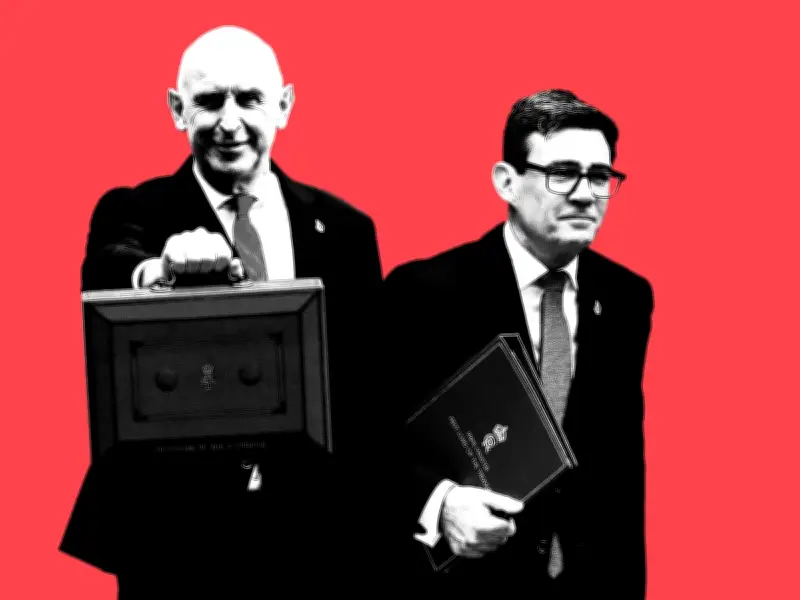
Greater Manchester is set to gain significant new fiscal powers, including a share of business rates and income tax receipts, as part of the government's devolution roadmap. However, questions remain over whether these reforms will spread prosperity beyond the thriving city centre to towns like Rochdale and Oldham.
New Funding Streams for Mayors
During the Makerfield by-election hustings, a recurring complaint was that Manchester city centre was thriving, but the prosperity had yet to reach the outer boroughs. The city was attracting investment, while towns like Rochdale and Oldham were still waiting to feel the benefits.
In his victory speech, Andy Burnham said: "A Makerfield test at the heart of British politics will make sure that the places Westminster has neglected will now get fairness."
Hailing the most 'radical act of decentralisation in a generation', John Healey unveiled the roadmap for fiscal devolution in the Commons. The chancellor said mayors will retain 20% of business rates from April 2027, with a share of income tax receipts to follow from 2028. The longer-term ambition is for all business rates to be retained locally by the end of the decade.
Mr Healey also mentioned the new 'tourist tax' – the overnight visitor levy – which will be introduced in 2028. "Taken together, these are long-term funding streams they can use to back investment into big local infrastructure," he said.
Historic Transfer of Power
The intention is to give local leaders a more direct financial stake in the success of their economies, allowing them to invest more of the proceeds of growth in the places that generate it. The Treasury's 'fiscal devolution roadmap', now published online, sets out the changes. There will also be a pledge to provide a further £1.5 billion worth of devolved loans for mayoral authorities across England.
It is indeed a historic transfer of power, and potentially a significant one. For too long, decisions about regional economies have been made in Whitehall, by those with little knowledge of those areas. Greater control over local revenue could potentially give Greater Manchester even greater freedom to shape its own destiny, backed by a financial incentive to attract investment, create jobs, and raise wages.
However, the Government is not simply handing mayors an entirely new pot of money. The income tax arrangements are intended to replace existing central government grants, while the new business rates arrangements are being introduced alongside changes to existing funding streams.
Risk of Widening Disparities
The central proposition is that local leaders should have more control over how existing resources are used, and a greater opportunity to benefit when their economies grow. Few would, in theory, argue against that.
But that raises an uncomfortable question: what happens when some parts of a region don't see huge levels of growth? Manchester city centre has already demonstrated its ability to attract investment. A model that rewards areas for generating additional business rates and expanding their tax base could reinforce that success.
More development could mean more revenue, which could fund further investment and attract even more development. In the right circumstances, that could benefit the wider region. Yet there's no denying that it could deepen existing economic disparities if growth continues to concentrate in the places that are already prospering.
Will Manchester city centre continue to grow at a disproportionate rate, leaving weaker ones like Rochdale, Oldham and others struggling to catch up? Furthermore, what mechanisms will ensure that the rewards of growth are shared across Greater Manchester, rather than simply accumulating where it's already concentrated?
Accountability and Limits
These aren't arguments against devolution. Rather, they're arguments for taking its promises seriously. If the objective is to ensure that no area is left behind, as Mr Burnham promised in June, success must also be measured by where the investment goes, who gets the jobs it creates, whether wages rise and if living standards improve in the communities that have waited longest for change.
There is also a limit to what devolution can achieve on its own. Local leaders can indeed make decisions about transport, skills, housing and investment that better reflect the needs of their communities. But what happens if the national economy is not doing well, or if a global crisis drives up energy costs (such as the one we're seeing right now)? If the cake is hardly growing, giving mayors more control over how it's divided won't, by itself, make everyone better off.
Greater local control means greater responsibility. Mayors must be able to explain not just what they've spent, but why particular projects were prioritised and who stands to benefit.
The questions surrounding Manchester City's Abu Dhabi-backed owners offer a pertinent lesson in transparency. A £55m loan connected to the Manchester Life housing project, involving the club's UAE owner while Mr Burnham was mayor, is now the subject of intense national scrutiny. The episode serves as a reminder that attracting wealthy investors may bring economic benefits, but those benefits don't remove the need for robust scrutiny and clear public accountability.
Long-Term Test
The more power and resources mayors acquire, the more important it becomes for residents to understand how those powers are exercised. Devolution should, therefore, bring decisions closer to the people affected by them.
Ultimately, this was a budget concerned with economic stability. The government has sought to provide 'breathing space' for households and businesses, avoid broad tax rises and set out a longer-term programme for growth. Fiscal devolution is part of that programme, but its effects will take years to emerge. The question is whether the government can turn a set of reforms into tangible improvements in people's lives before it runs out of political time.
With an election potentially on the horizon next year, the government will want to demonstrate that its economic approach is working. But announcements about fiscal devolution are not the same as actual results. Those will be judged in the places – like ours – that have heard promises of regeneration before.
For Greater Manchester, the opportunity is real. More control over resources could allow the region to make decisions that are better suited to its needs and give local leaders a stronger incentive to create prosperity. But devolution is a means, not an end. Its ultimate test won't be how much power has been transferred from Westminster, but whether that power helps narrow the gap between Manchester's prosperous centre and the communities beyond it.
In Makerfield, Mr Burnham promised not to leave any area behind. The budget gives areas like Greater Manchester the tools with which to pursue that ambition. Let us hope that these tools are enough, and are used to spread the growth and prosperity, rather than simply accelerating them where they already exist.