
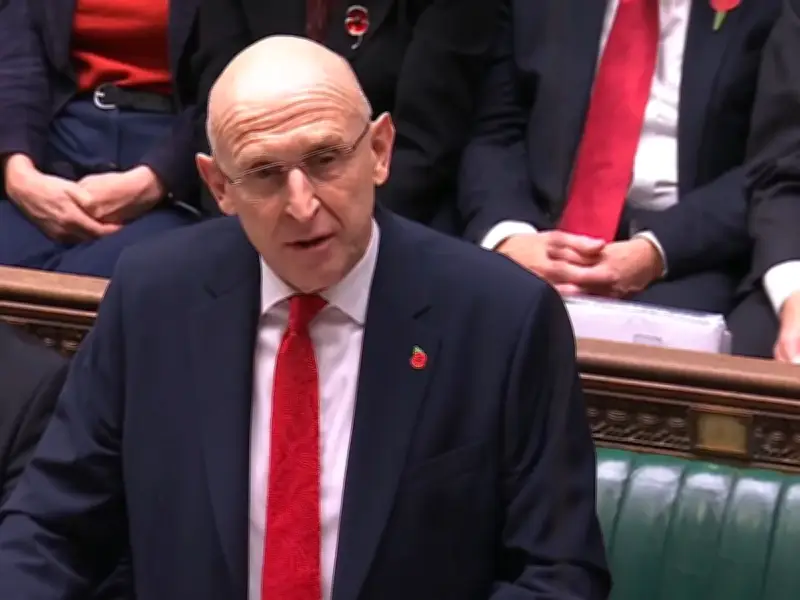
Chancellor John Healey has announced £1.5bn of devolved loans for mayoral authorities, alongside giving mayors a greater share of locally raised tax revenues, in a move designed to reduce reliance on central government grants and give regional leaders more control over investment decisions.
Delivering his budget on Wednesday, Mr Healey said: “For the first time I’m making the commitment that 100 pc of business rates will be retained locally by the end of the decade, so if local leaders help businesses start and grow, more of the rates they pay stay in that area. From next year, 20 pc of business rates revenue will go to Mayors, and from 2028, a share of income tax receipts will go to Mayors as well.”
Biggest wave of devolution in a generation
The Government also revealed it was in the final stages of agreeing 10 new devolution agreements, including a mayoral strategic authority for Lancashire. Mr Healey described the changes as “the biggest wave of devolution in a generation, driving good growth in every postcode delivered to the British people by this Labour government.”
“Taken together, these are long-term funding streams. They can be used to back investment into big local infrastructure, so that more of the money that is raised locally can be invested and spent locally,” the chancellor said. He added: “If local leaders help businesses to start and grow, more of the rates they pay will stay in that area.”
The reforms are intended to give regions more predictable, long-term funding to invest in major infrastructure, transport and regeneration projects.
Greater Manchester's ambitions
Bev Craig, mayor of Greater Manchester, said the region was “on the right path to build the best decade our region has ever seen.” She added: “Today’s budget backs our ambitions for Greater Manchester, investing in new jobs and supporting the local independent businesses that are the life blood of our high streets with over 3,500 local businesses will save thousands of pounds every year. It also set out a devolution plan where we can get more money and power to fulfil our ambitions like expanding the tram network, building genuinely affordable homes and investing in our roads. We have long known that we are the best people to set our own path. Now we are ready to take control and supercharge Greater Manchester’s success story.”
Henri Murison, chief executive of the Northern Powerhouse Partnership, said the changes could be significant for Greater Manchester's ambitions, including proposals for an underground transport system at Manchester Piccadilly. The idea is separate from demands from city leaders for an underground railway station at Manchester Piccadilly, which would play a part in boosting railway travel supporting the £45bn Northern Powerhouse Rail project.
“Something like that would be impossible to do without these new powers. In order to build an underground system, they’ve re-designed the British tax system,” said Murison. He said major infrastructure projects would require more than government funding alone, with local authorities needing to bring private sector investment into the mix.
Accountability and private finance
Murison also argued that greater financial autonomy would bring more accountability for regional leaders, whose future budgets would increasingly depend on the economic success of their areas. “An underground is more expensive, and something that can’t be done solely through government funding. It will require local authorities to get the private sector involved – as they have done in Greater Manchester,” he said.
Murison said the new powers would “insert a level of discipline” on regional mayors, as their future budgets will depend on how they spend. He said: “There will be limits set in due course on authorities borrowing, which is why we must consider private finance as well as funding so that major projects like Northern Powerhouse Rail can be effectively supported through local contributions, as well as the £45bn national funding envelope committed by the previous Chancellor earlier this year. Investment in infrastructure will generate jobs immediately as well as raise long term productivity, with Bakerloo line trains to run on the new extension in London mentioned by the Chancellor able to be built in Goole on the Humber.”
The Treasury’s fiscal devolution roadmap sets out a shift away from a system in which mayoral authorities rely heavily on ringfenced grants allocated by Whitehall for specific purposes.
“Success is not simply a line on a spreadsheet at the Treasury or in a local finance department. It is the new tram stop that puts a good job within reach, the derelict site that becomes homes young families can afford, the empty shop that opens its doors again,” the document states. “Local leaders will now have the certainty to drive that kind of change, from Leeds South Bank in West Yorkshire Combined Authority to Atom Valley in Greater Manchester Combined Authority and St James Quarter in the North East Combined Authority. The investment decisions and strategic approaches taken by local leaders will help give confidence to private sector partners, supporting businesses of all sizes, across the nation, to succeed.”
Reaction to the reforms
Government grants will, in turn, only be given on an “exceptional basis,” according to the Treasury document. Mr Healey said the announcement was “not sentimentality, but supply-side economics.”
Although many in the city region have welcomed fiscal devolution, they said success will ultimately depend on whether these resources are effectively utilised to create better local opportunities and drive regional growth. Professor Ken McPhail, head of Alliance Manchester Business School, said: “The real test now is whether these resources are now deployed properly, as the success of devolution must be judged by whether people can access better opportunities and places can become more productive, rather than simply the creation of new structures away from Whitehall.”
Sam Booth, CEO of pro-Manchester, a growth network, said changes now need to translate into meaningful investment and opportunities across the region. “Today’s announcements offer encouraging recognition of the role that regional leadership, entrepreneurship and investment can play in the UK’s economic future,” she said. “The focus must now turn to delivery: ensuring that new funding and powers create tangible benefits for businesses across Greater Manchester, supporting those ready to scale while helping smaller businesses manage costs, protect jobs and remain viable. Ultimately, success should be measured by the opportunities they create for businesses and people across our region.”




