US Military Demonstrates Rapid Nuclear Deployment with Reactor Airlift
The Pentagon and the US Department of Energy have executed a landmark airlift operation, transporting a small nuclear reactor from California to Utah. This demonstration flight underscores a concerted push by the Trump administration to accelerate the deployment of nuclear power for both military applications and civilian energy needs.
Historic Flight Marks New Nuclear Era
In a significant move last weekend, a C-17 military aircraft carried a 5-megawatt microreactor on a nearly 700-mile journey from March Air Reserve Base in California to Hill Air Force Base in Utah. While the reactor was transported without nuclear fuel, officials hailed the mission as a breakthrough for fast-tracking commercial licensing and showcasing portable nuclear technology.
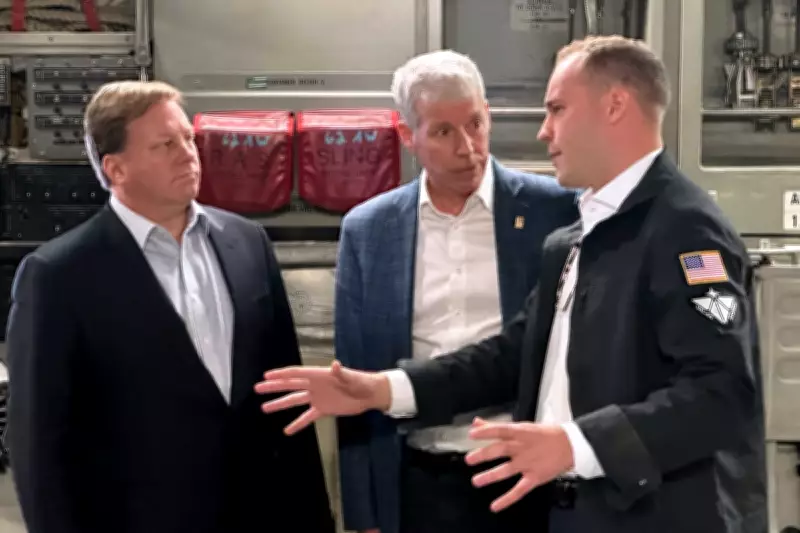
Energy Secretary Chris Wright and Undersecretary of Defense Michael Duffey, who accompanied the reactor on its February 15 flight, emphasized this as a pivotal step in reshaping America's energy landscape. "Today is history. A multi-megawatt, next-generation nuclear power plant is loaded in the C-17 behind us," Wright declared before the two-hour flight.

Trump's Nuclear Push Amid Energy Demands
President Donald Trump has championed nuclear power as a reliable, carbon-free electricity source, even as his administration has shown hostility toward renewable energy and prioritized coal and fossil fuels. This airlift highlights the administration's drive to meet skyrocketing power demands from artificial intelligence, data centers, and military operations.
Last year, Trump signed executive orders granting Wright authority to approve advanced reactor designs, bypassing the independent safety agency that has regulated the nuclear industry for five decades. Wright touted this as enabling rapid progress, stating that at least three reactors will achieve "criticality" by July 4, as promised by Trump. "That's speed, that's innovation, that's the start of a nuclear renaissance," he said.
Microreactors for Military and Civilian Use
Currently, 94 operable nuclear reactors in the US generate about 19% of the country's electricity, down from 104 in 2013. Recognizing delays in full-scale reactor deployment, the industry and government have focused on efficient designs like small modular reactors and microreactors.
Duffey explained that portable microreactors can "accelerate the delivery of resilient power to where it's needed," potentially providing energy security on military bases independent of the civilian grid. The reactor airlifted to Utah, produced by California startup Valar Atomics, can generate up to 5 megawatts—enough to power 5,000 homes. CEO Isaiah Taylor said the company aims to sell power on a test basis next year and become fully commercial by 2028.
Safety Concerns and Skepticism
Despite the enthusiasm, skeptics warn of risks. Edwin Lyman, director of nuclear power safety at the Union of Concerned Scientists, dismissed the transport flight as "a dog-and-pony show" that merely demonstrated the Pentagon's ability to ship heavy equipment. He argued it doesn't address feasibility, economics, or safety for the military and public.
Lyman noted the Trump administration hasn't made a safety case for transporting fueled microreactors to data centers or military bases, nor resolved nuclear waste disposal. Wright said the Energy Department is in talks with Utah and other states for reprocessing or permanent disposal sites. The microreactor will undergo testing at the Utah San Rafael Energy Lab, with fuel provided by the Nevada National Security site.
Wright concluded, "The answer to energy is always more. After four years of restrictions under the Biden administration, now we're trying to set everything free. And nuclear will be flying soon." This airlift marks a bold step in America's nuclear ambitions, blending military logistics with civilian energy strategy under political pressure for rapid deployment.