US Forces Intercept Iranian Missile Barrage After Joint US-Israel Strike
American military forces have engaged in intense defensive operations against a significant barrage of Iranian missiles targeting multiple US bases across the Middle East. This escalation follows a coordinated military attack launched by the United States and Israel against Iran on Saturday morning, marking a dangerous new phase in regional tensions.
Widespread Attacks Across Strategic Bases
According to officials speaking to the Wall Street Journal, American military installations successfully intercepted multiple incoming missiles during the early hours of Saturday. The Qatari Ministry of Defense confirmed it had 'successfully thwarted the third wave of attacks' targeting Al Udeid Air Base, which serves as the largest US military facility in the region.
The retaliatory strikes extended beyond Qatar, with a US Navy base in Bahrain also coming under fire. The New York Times reported that Bahraini authorities confirmed the US Fifth Fleet headquarters sustained a missile impact. Iranian sources, including the Tehran Times newspaper, identified five key US bases targeted in the operation: facilities in Qatar and Bahrain, along with Al-Salmiya base in Kuwait, Al-Zafra airbase in the United Arab Emirates, and King Hussein Air Base in Jordan.

Regional Defensive Responses and Escalation
Air raid sirens activated across multiple nations including Israel, the UAE, Bahrain, and Kuwait as the conflict intensified. Jordanian authorities reported shooting down two ballistic missiles, while the Pentagon confirmed it had bolstered regional air defenses by deploying advanced systems including Terminal High Altitude Area Defense (THAAD) and Patriot missile defense batteries.
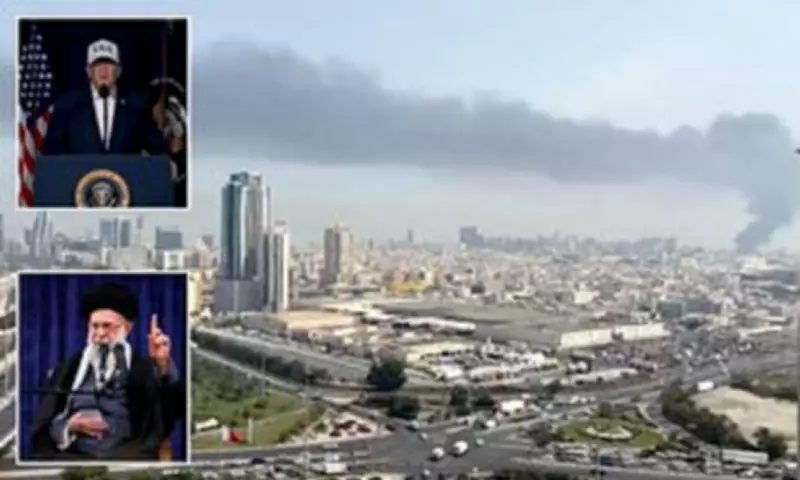
Eyewitnesses reported smoke rising from the vicinity of Al Udeid Air Base in Qatar and the US Fifth Fleet headquarters in Bahrain, visually confirming the intensity of the attacks. These defensive preparations had been underway for several weeks as the United States enhanced its military presence across the Middle East.
Political Context and Presidential Announcement
The military confrontation follows failed diplomatic negotiations between the US and Iran regarding Tehran's nuclear program, with the most recent talks occurring in Switzerland on Thursday. President Donald Trump announced the initial US strike at 2:30 AM from his Mar-a-Lago estate in Florida, warning that American troops faced potential casualties in what he termed 'Operation Epic Fury.'
'Our objective is to defend the American people by eliminating imminent threats from the Iranian regime, a vicious group of very hard, terrible people,' President Trump declared. 'Its menacing activities directly endanger the United States, our troops, our bases overseas, and our allies throughout the world.'
The President referenced historical grievances including the 1979 takeover of the US embassy in Tehran and hostage crisis, while emphasizing continued attacks against American forces and vessels in recent years. 'It's been mass terror, and we're not gonna put up with it any longer,' he stated, threatening to 'raze their missile industry to the ground' if Iran continued hostilities.
Congressional Backlash and Legal Challenges
President Trump's decision to launch military action without seeking prior congressional approval has sparked significant political controversy in Washington. Numerous lawmakers have characterized the strike as 'illegal' under constitutional provisions requiring congressional authorization for acts of war.
While Secretary of State Marco Rubio reportedly briefed bipartisan congressional intelligence leaders shortly before the operation, opposition has mobilized quickly. Republican Congressman Thomas Massie of Kentucky and Democratic Congressman Ro Khanna of California plan to force a vote next week on an Iran War Powers resolution that would block further military action without congressional approval.

Democratic Senator Ruben Gallego of Arizona criticized the President's warning about potential troop casualties, stating: 'We can support the democracy movement and the Iranian people without sending our troops to die.' Similarly, Democratic Senator Andy Kim of New Jersey emphasized: 'Americans don't want to go to war with Iran. Trump once again started a cycle of violence that has already escalated and could spiral out of control. This is unacceptable.'
Military Buildup and Regional Deployment
The United States has significantly enhanced its military posture in the Middle East in recent weeks, including repositioning the aircraft carrier USS Gerald R. Ford from the Caribbean to the Mediterranean Sea. The destroyer was recently observed near Crete, Greece, while an Israeli submarine was also detected in Mediterranean waters on Saturday.
Despite domestic political criticism, the Trump administration maintains its focus on confronting Iran, with the President delivering an ultimatum for Tehran to 'lay down their arms or face certain death.' The situation remains volatile as Iranian state television broadcast images of devastation from the initial US-Israeli attack, with Tehran vowing continued retaliation.