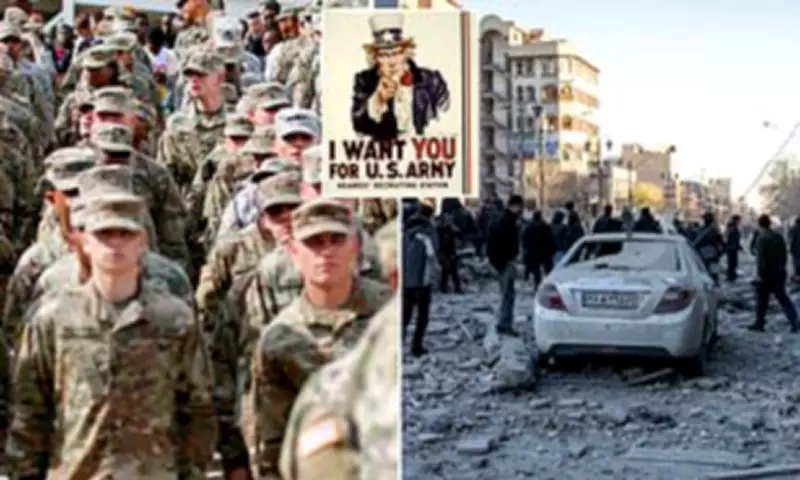
Social Media Erupts with Barron Trump Draft Jokes Following Iran Strikes
Within hours of the initial American military strikes against Iran on Saturday, social media platforms became inundated with satirical quips targeting Barron Trump. The jokes suggested the 19-year-old New York University student would urgently seek a medical diagnosis for bone spurs to avoid any potential military conscription. This narrative directly references his father, former President Donald Trump, who received a medical deferment for bone spurs during the Vietnam War era.
White House Refusal Fuels Conscription Anxiety
The humorous commentary online coincided with growing public apprehension about Operation Epic Fury and its potential escalation into a broader global conflict. These fears intensified significantly when White House Press Secretary Karoline Leavitt appeared on Fox News with host Maria Bartiromo. During the interview, Leavitt pointedly declined to rule out the possibility of reinstating the military draft.
'It has been, and it will continue to be,' Leavitt stated when questioned about the draft's potential revival. 'President Trump wisely does not remove options off of the table.' This ambiguous response from the administration's chief spokesperson triggered immediate political backlash and widespread public concern.

Expert Analysis: Draft Return Remains Highly Unlikely
Despite the escalating tensions in the Middle East, defense policy experts maintain that the United States is extremely unlikely to reinstate mandatory military service. Katherine Kuzminski, a senior analyst at the Center for a New American Security, a Washington, DC-based think tank specializing in national security, provided clear reassurance.
'No one needs to worry about getting drafted,' Kuzminski emphasized. She explained that the current US campaign against Iran has relied exclusively on air and naval power, avoiding large-scale ground troop deployments that would necessitate a personnel surge.
Political Taboo and Public Opposition
The foremost obstacle to draft reinstatement, according to Kuzminski and other political analysts, remains raw politics. For over half a century, the prospect of reviving conscription has represented a taboo subject among politicians from both major parties. They are acutely aware that such a move would prove deeply unpopular with voters across the political spectrum.
Former Representative Marjorie Taylor Greene exemplified this immediate political backlash following Leavitt's comments. 'Not my son, over my dead body,' Greene declared emphatically on social media platform X. 'By the way a bunch of psycho Republicans want to not only draft your sons but your daughters too!!!!!'
Historical polling data consistently shows strong American opposition to military conscription, shaped largely by the traumatic legacy of the Vietnam War and a prevailing preference for an all-volunteer, professional defense force.
Operational Realities and Systemic Challenges
From an operational perspective, Pentagon sources indicate that any potential ground conflict escalation would likely involve elite special operations teams rather than inexperienced draftees. Kuzminski notes that the United States would probably only require a massive expansion of ground forces in the highly remote scenario of a direct invasion on American soil.
Even in that improbable event, the country remains woefully unprepared to implement conscription effectively. The Selective Service System, which registers men aged 18 through 25 for potential draft activation, operates as a 'standby agency' that hasn't been functionally tested in over 52 years.
'My assessment is that they're not prepared at all,' said Kuzminski, who co-authored a 2024 national report reaching this identical conclusion. The system faces significant logistical challenges, including outdated communication infrastructure and enforcement mechanisms.

Legal Hurdles and Constitutional Challenges
Should draft legislation somehow advance, experts anticipate substantial legal obstacles that would delay implementation. Men's rights organizations have repeatedly challenged the constitutionality of requiring only men to register with the Selective Service System. While courts have upheld the registration requirement as a minimal burden, actual conscription would provide far stronger legal standing for constitutional challenges.
'It could sow a lot of confusion among men getting draft notices about whether they needed to follow them or not,' Kuzminski warned, noting that numerous lawsuits and appeals would likely impede rapid mobilization.
Alternative Personnel Strategies
The Defense Department maintains a strong preference for working with highly trained volunteers rather than conscripted novices. 'None of our current war plans involve draftees. It's not, with all due respect, how we want to operate,' one Pentagon source revealed anonymously.
The federal government possesses several alternative mechanisms for boosting military personnel without resorting to compulsory service:
- Recalling former active-duty personnel from the reserves
- Implementing 'stop-loss' orders to extend service commitments
- Increasing deployment durations for existing forces
- Mobilizing additional National Guard units beyond those already deployed from Wisconsin, Vermont, and Virginia
As one Pentagon source succinctly reassured: 'Fear not, college kids of America. We've got our bases covered.' The combination of political impracticality, operational preferences, systemic unpreparedness, and legal vulnerabilities makes draft reinstatement an extremely remote possibility despite heightened public anxiety.