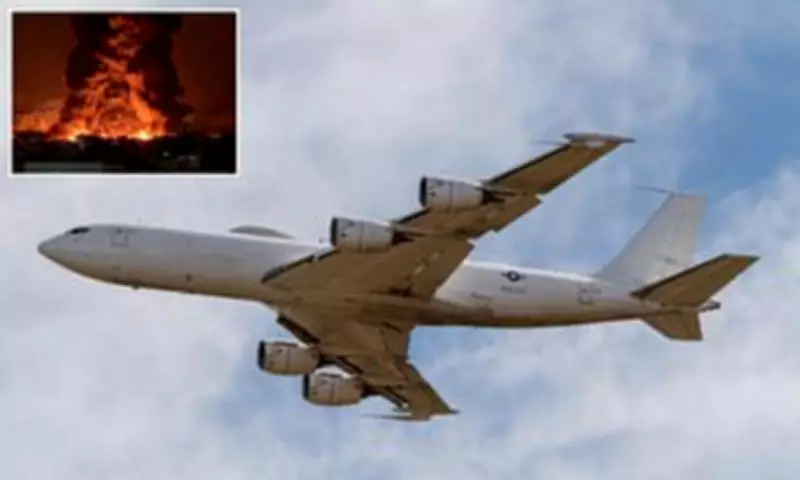
US 'Doomsday Planes' Take Flight as Iran Conflict Sparks Nuclear War Concerns
The United States military has activated its formidable fleet of 'Doomsday planes' as escalating tensions in the Middle East heighten fears of a potential nuclear confrontation. Flight-tracking data has documented multiple launches of the Navy's E-6B Mercury strategic airborne command aircraft since the outbreak of war in Iran on February 28.
Survivable Command Centres in the Sky
These colossal aircraft, constructed using the airframes of the Boeing 707, are specifically engineered to withstand the catastrophic effects of a nuclear war. Their primary function is to coordinate America's military response from the air, ensuring continuity of command even in the most dire circumstances.
The E-6B Mercury serves as a flying radio station and command centre for the president and the Secretary of Defense. It is equipped with specialised antennas capable of communicating with nuclear-armed submarines lurking in the ocean depths, as well as satellites, land-based military installations, and underground missile facilities.

In the event of a full-scale nuclear attack on the United States, the Mercury fleet possesses the capability to control and execute a nuclear retaliatory strike, making it a critical component of the nation's strategic defence posture.
Recent Flight Activity and Operational Secrecy
On March 2, two distinct E-6B Mercury flights were observed over US airspace. One aircraft travelled from the Gulf Coast before landing at Naval Air Station Patuxent River in Maryland, while another took off and subsequently returned to Offutt Air Force Base in Nebraska.
Subsequent reports from military news outlets indicate further E-6B launches, with aircraft reportedly heading across the Atlantic Ocean towards the Persian Gulf region. The Pentagon has declined to comment on these specific flight operations, citing standard operational security protocols.
The Ominous 'Take Charge and Move Out' Mission
The core mission of these aircraft is encapsulated in the chilling directive known as 'Take Charge and Move Out,' or TACAMO. This protocol enables the E-6B to transmit critical orders from the president or senior military leaders to Navy nuclear submarines and other nuclear missile sites, even if conventional communication networks are destroyed or compromised.
During a crisis, the planes are deployed to predetermined areas, where they remain airborne or positioned near key locations. This strategy maintains vital communication links should ground-based command centres be attacked, disabled, or subjected to electronic jamming.
Escalating Threats and International Tensions
The first week of the Iran conflict has seen US military bases, embassies, and civilian targets in the Middle East come under attack from Iranian missile barrages. While the military often launches E-6B aircraft for routine readiness drills, training exercises, or demonstrations of capability, the current geopolitical climate lends a more urgent context to these deployments.
The threat of nuclear escalation has intensified following the initial US and Israeli strikes on Tehran. Iran's allies, including nuclear-armed Russia and China, have issued warnings that the situation could spiral out of control, potentially triggering a broader, large-scale war.
Alarming reports suggest that Russia has begun providing intelligence assistance to Iran, sharing information on the positions of US forces in the Middle East. Such actions are viewed by analysts as a potential catalyst that could ignite a wider global conflict.
A Proven, Enduring Capability
Despite being introduced into service four decades ago, the E-6B Mercury remains regarded as America's most survivable aircraft for executing its apocalyptic mission. Its ability to communicate with all branches of the US military—from submarines to underground missile installations—ensures it can perform this world-altering task with unwavering reliability.
The continued deployment of these 'Doomsday planes' underscores the grave seriousness with which US military planners view the current crisis, as the spectre of nuclear war looms larger on the global horizon.