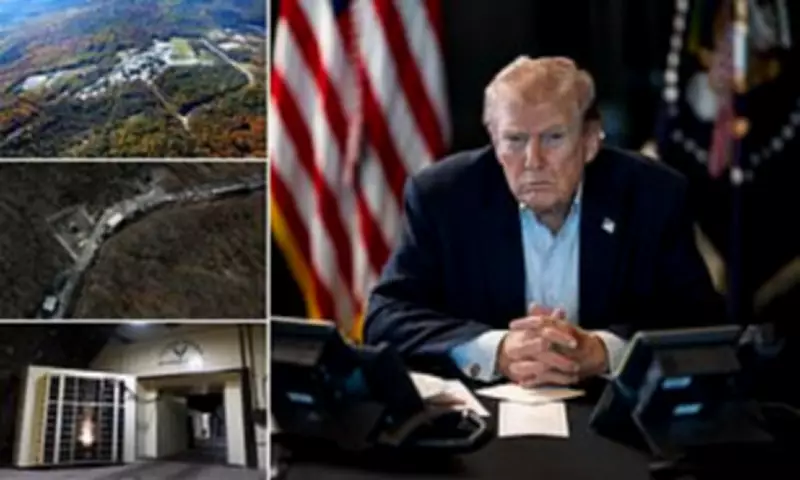
US Government's Secret Nuclear War Escape Plan Revealed
In the event of a global nuclear war, President Donald Trump or any future US leader could be forced to evacuate to one of the government's top secret fortified bases scattered across the United States, according to declassified doomsday planning documents. As tensions with Iran threaten to escalate into a worldwide nuclear confrontation, the United States government maintains a comprehensive playbook known as the Continuity of Operations Plan (COOP) to ensure the survival of federal leadership and critical functions.
Continuity of Operations Plan: Ensuring Government Survival
The COOP is designed to guarantee that essential government operations—including national defense, economic stability, and public safety—continue uninterrupted even if multiple major American cities are destroyed by weapons of mass destruction. From heavily fortified underground bunkers in Colorado, Pennsylvania, and Virginia, the presidential administration could continue governing the nation despite the catastrophic outbreak of World War III.
Three primary facilities have been publicly acknowledged as integral components of the COOP since the Cold War era: the Mount Weather Emergency Operations Center, the Raven Rock Mountain Complex, and the Cheyenne Mountain Complex. Each site has been equipped with advanced communication technology to maintain contact with both the military and the civilian population during a national crisis.

Modernized Cold War Bunkers
Despite their origins in the Cold War, these facilities are far from obsolete relics. They receive active funding, are staffed by personnel, and are regularly referenced in annual federal budgets. The bunkers were even prepared for activation during the terrorist attacks of September 11, 2001. Each complex is constructed deep within defensible mountain ranges to provide maximum protection against direct nuclear strikes.
Over the past year, speculation about potential COOP implementation has alarmed many Americans, particularly after the president's emergency command aircraft was observed conducting unusual flights over various US regions on multiple occasions.
Mount Weather Emergency Operations Center
The Federal Emergency Management Agency (FEMA) has managed the Mount Weather Emergency Operations Center (MWEOC) in Virginia since 1979. This base reportedly contains a specialized bunker designed for civilian leadership and is packed with communications equipment to enable multiple government agencies to maintain contact with the public during emergencies.
Originally operated by the US Army since 1959, MWEOC remains a crucial element of America's emergency preparedness framework, with FEMA conducting regular updates every few years. The US Department of Homeland Security has emphasized that MWEOC not only provides reliable support and resilient capabilities for the president but also functions as a command center for classified government programs.
Raven Rock Mountain Complex
During a major global conflict, the Raven Rock Mountain Complex (RRMC) in Pennsylvania would likely serve as the primary military command hub for the Department of Defense throughout the national emergency. A 2025 report on the facility stated: 'The RRMC supports COOP operational readiness by providing a safe and secure environment for DoD essential functions.'
These functions include providing an alternate headquarters for the Secretary of Defense, the Joint Chiefs of Staff, and other senior military leaders. The Trump Administration has allocated millions of dollars in funding this year specifically for maintaining RRMC's operational readiness.
Cheyenne Mountain Complex
The Cheyenne Mountain Complex in Colorado is an extensive underground facility that formerly housed the North American Aerospace Defense Command (NORAD), the military organization responsible for defending US and Canadian airspace. Although no longer NORAD's primary headquarters, it remains an alternate command center for the agency and serves as a backup COOP site due to its nuclear-resistant design and comprehensive communication systems.

The massive complex reportedly contains over a dozen buildings constructed approximately 2,000 feet underground, built atop large steel springs for shock absorption. Raven Rock Mountain Complex features similar construction, with these springs providing additional protection against violent shaking or sudden forces generated by nuclear explosions or earthquakes.
Additional Doomsday Facilities
Numerous other emergency sites remain operational across the United States, including a bunker located directly beneath the East Wing of the White House. According to a 2004 government report, former Vice President Dick Cheney and other officials utilized this shelter during the 9/11 terrorist attack on the Pentagon.
Federal government reports have also identified Peters Mountain in Virginia and Offutt Air Force Base in Nebraska as facilities that could accommodate the president and cabinet members as part of COOP implementation.
Current Global Tensions
Following recent US and Israeli military strikes against Iran, nuclear-armed nations China and Russia have warned that the conflict could spread throughout the Middle East and potentially trigger nuclear exchanges between world superpowers. While such escalation would endanger tens of millions of American citizens, the COOP primarily focuses on ensuring leadership survival to guide the nation through crisis rather than protecting the general population.
COOP Framework and Implementation
The secretive government plan was established as a framework for relocating key personnel, securing communication networks, and protecting vital records if America's most secure locations come under attack. In a World War III scenario involving nuclear weapons, COOP would guarantee that the president, military leaders, and other essential officials could operate from protected sites, preventing a leadership vacuum that could lead to nationwide disorder.
The plan includes clearly defined lines of succession, ensuring that if the president, vice president, or other top officials are killed, designated successors are prepared to assume command immediately. This is crucial for maintaining military coordination and emergency response capabilities during global conflict.
According to FEMA documentation, COOP ensures 'the capability exists to continue essential agency functions across a wide range of potential emergencies.' The plan addresses not only World War III scenarios but also crises including major natural disasters, pandemics, and terrorist attacks.
Historical Origins and Evolution
COOP traces its origins to the Cold War era, when nuclear conflict with the Soviet Union represented a daily concern for years. President Dwight Eisenhower established the foundation in the 1950s through executive orders directing government agencies to prepare for post-attack governance.
The Federation of American Scientists (FAS) noted that Eisenhower's initiatives prompted the development of secure facilities and communication systems designed to withstand nuclear detonations. Subsequent presidents expanded these plans through directives like Presidential Decision Directive 67 in the 1990s, which formalized COOP programs.
Today, continuity planning is guided by the National Continuity Policy Directive (FCD-1), ensuring adaptability to contemporary threats including cyberattacks that could cause national blackouts or nuclear escalation scenarios.
Security and Documentation
While COOP is documented in government and scholarly sources, specific operational details remain classified for national security reasons. FEMA's official website outlines continuity programs and emphasizes their role in national preparedness. Even agencies like the Internal Revenue Service (IRS) have publicly detailed their own COOP implementation measures.
A 2002 Congressional Research Service (CRS) report confirmed COOP activation following the 9/11 attacks, with between 75 and 150 government officials relocated to secure sites, demonstrating the plan's practical application in real-world emergencies.