US Military Builds Up Largest Force in Middle East in Decades
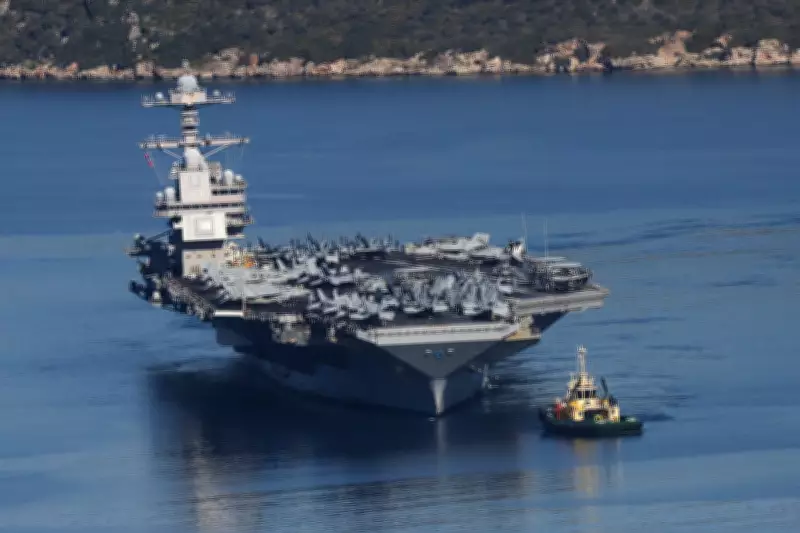
The Pentagon is currently assembling the largest concentration of American warships and aircraft in the Middle East in decades. This significant military buildup includes two formidable aircraft carrier strike groups and a massive influx of fighter jets, as President Donald Trump issues stark warnings regarding potential military action against Iran should nuclear negotiations collapse.
Trump's Warning and Military Options
"It’s proven to be, over the years, not easy to make a meaningful deal with Iran, and we have to make a meaningful deal," President Trump stated. "Otherwise bad things happen." Experts suggest that if diplomacy fails, Trump will have a range of military options at his disposal. These could include precise, surgical strikes targeting Iran's air defense systems or even operations focused on Supreme Leader Ayatollah Ali Khamenei.
However, analysts warn that Iran's potential retaliation could be far more severe than its response to previous attacks by the United States or Israel. This escalation risks American lives and could ignite a broader regional conflict. "It will be very hard for the Trump administration to do a one-and-done kind of attack in Iran this time around," said Ali Vaez, an Iran expert at the International Crisis Group. "Because the Iranians would respond in a way that would make all-out conflict inevitable."

Aircraft Carriers Bolster Naval Presence
The naval component of this buildup is substantial. The aircraft carrier USS Abraham Lincoln, accompanied by three guided-missile destroyers, has been stationed in the Arabian Sea since late January after being redirected from the South China Sea. This strike group added approximately 5,700 service members to the region, reinforcing a smaller existing force.
In a further escalation two weeks later, President Trump ordered the world's largest aircraft carrier, the USS Gerald R. Ford, to deploy to the area along with three more destroyers and over 5,000 additional personnel. This deployment will bring the total US Navy presence in the Middle East to at least 16 ships, significantly surpassing the 11-ship fleet recently stationed in the Caribbean Sea.
Massive Influx of Aircraft
The air power complementing this naval force is equally impressive. More than 100 fighter jets, including advanced models like the F-35, F-22, F-15, and F-16, have been tracked departing from bases in the United States and Europe, heading towards the Middle East. This tracking was conducted by the Military Air Tracking Alliance (MATA), a team of open-source analysts.
MATA also reported monitoring over 100 fuel tankers and more than 200 cargo planes moving into the region and European bases in mid-February. In a particularly notable move, the United States has deployed 12 F-22 stealth fighter jets to a base in Israel, according to an anonymous US official detailing sensitive operations.
Satellite imagery analyzed by The Associated Press from Muwaffaq Salti Air Base in Jordan showed more than 50 aircraft, nearly all believed to be part of this American military surge, with potentially more housed in hangars. Steffan Watkins, a Canadian researcher with MATA, noted the tracking of key support aircraft, such as six E-3 early-warning planes, heading to a base in Saudi Arabia. These aircraft are crucial for coordinating large-scale aerial operations.
Context and Expectations of Retaliation
This activity mirrors preparations seen last year when the US moved air defense systems, like Patriot missiles, into the region ahead of an expected Iranian counterattack following strikes on nuclear sites. Iran did launch missiles at Al Udeid Air Base in Qatar shortly after.
Defence experts contextualise the current buildup. Seth Jones of the Center for Strategic and International Studies notes the US is not deploying a major ground force, unlike the hundreds of thousands of troops sent during Operation Desert Storm or the 2003 Iraq invasion. "So there are substantial limits to the force package," he remarked.

Michael O’Hanlon, a defence analyst at the Brookings Institution, stated this is technically the largest regional buildup since the 2003 Iraq invasion, though the resources for that war were far greater. He suggested the forces now in place are configured not just for striking remaining nuclear targets—which could be done with long-range bombers—but for attacking a broader range of Iranian targets and defending against retaliation.
Many anticipate Iran may respond with drone and missile attacks on Israeli and American bases. However, experts warn the response could be more severe. Ali Vaez argues that Iran is unlikely to limit its retaliation as it did previously. "They have now come to the conclusion that the only way that they can stop this cycle is to draw blood and to inflict significant harm on the US and Israel, even if that comes at a very high price for themselves," Vaez said.
Behnam Ben Taleblu of the Foundation for Defense of Democracies added that Iran's ballistic missile arsenal remains a key factor. "The Islamic Republic may think that would be a deterrent to Trump, whereas in reality, that might be an inducement to move the president from a limited operation to a larger one," he said.