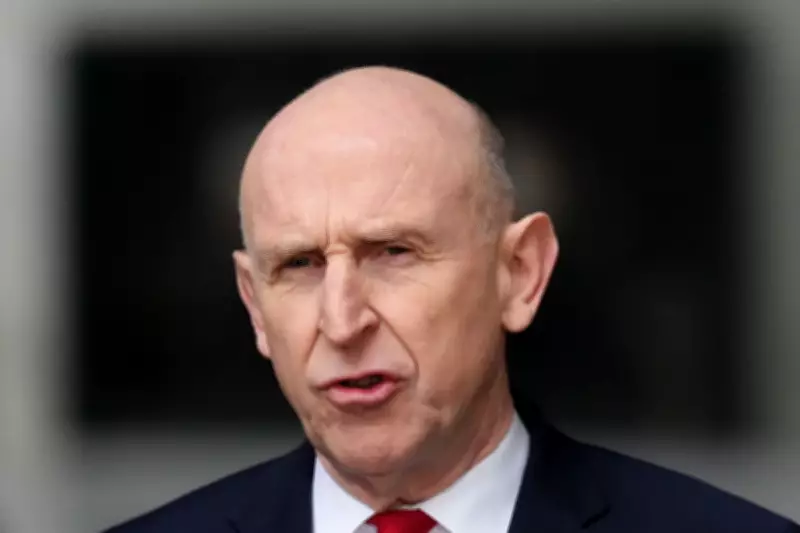
Defence Secretary John Healey has explicitly declined to rule out the possibility of British aircraft participating in future offensive strikes against Iran. During a visit to Cyprus, Healey was pressed on whether he would categorically exclude UK involvement in such operations.
Adapting to Changing Circumstances
In an interview with Sky News, Healey stated, "As circumstances in any conflict change, you've got to be willing to adapt the action you take." He emphasized that all current UK actions are defensive, legal, and coordinated with allies, but left the door open for potential escalation.
Military Reinforcements to Cyprus
The Defence Secretary detailed immediate military reinforcements being deployed to British bases in Cyprus. This includes anti-drone helicopters arriving overnight, with a Type 45 air defence destroyer scheduled to arrive within weeks. More than 400 additional air defence personnel have already been dispatched to the region.

Two Wildcat helicopters armed with drone-busting missiles will arrive in Cyprus on Friday, while HMS Dragon, a Type 45 warship, is being deployed but isn't expected to reach the Mediterranean until next week.
Response to Drone Attacks
The military build-up comes in response to recent drone attacks on RAF Akrotiri in Cyprus. Overnight on Monday, a hangar at the base was struck by an Iranian-made Shahed drone launched from Beirut, Lebanon. Two additional drones detected that same day were successfully shot down by British warplanes operating from Akrotiri.
Healey revealed he had been moving extra jets, air defence systems, radars, and drone teams to Cyprus "weeks before" the conflict began on Saturday, though the government has faced criticism for not establishing a larger military presence in the Middle East earlier.
International Coordination
The Defence Secretary highlighted the importance of international cooperation, noting that bringing defence planners to Cyprus will help coordinate contributions from multiple nations. He mentioned German and Greek naval assets now operating in the area, along with long-standing partnerships with Qatar, Jordan, and Cyprus itself.
Cyprus's high commissioner to the UK, Kyriacos Kouros, had previously stated that a British military presence to defend the island was "the least we expect," particularly as other European nations had already dispatched naval assets to the region.
Political Context and Criticism
Prime Minister Sir Keir Starmer announced the deployment of four additional British Typhoon fighter jets to Qatar, while defending the government against criticism from former US President Donald Trump. Trump claimed the UK had been "very disappointing" and that Starmer should support the US "without question or hesitation."
The Prime Minister insisted the special relationship between the US and UK remains intact, telling reporters, "Look, the special relationship is in operation right now. We're sharing intelligence on a 24/7 basis in the usual way. That is the special relationship."
Timeline of US-UK Discussions
Starmer provided a detailed timeline of discussions with the United States regarding potential military cooperation. He explained that no specific request from the US arrived until Saturday afternoon, meaning "on Friday there was no concrete decision to be made."
The Prime Minister stated, "A decision had to be made when we had the request, that came in on Saturday during the course of the afternoon – we were already taking measures in relation to our own capability – that came in on Saturday afternoon, late in the afternoon. We then, as you would have expected, went through the details with the US over the next day, and ultimately reached a decision on Sunday."
This clarification came in response to a report by The Spectator magazine suggesting Starmer had been open to allowing the US to use British military bases for initial strikes on Iran, with Cabinet ministers including Energy Secretary Ed Miliband reportedly urging against such cooperation. The story represents a potential leak of highly sensitive information from the Government's National Security Committee.