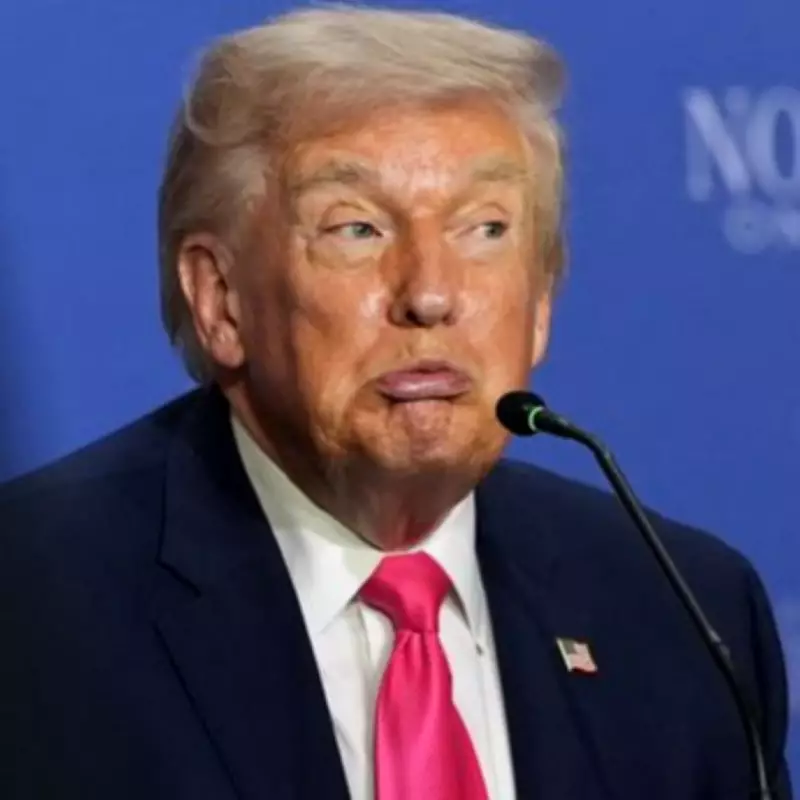
Every President is briefed on the nuclear football before they come into office. You may have noticed a suspicious black leather briefcase follows Donald Trump everywhere. It isn't full of mundane papers or family photos; it is actually the 'nuclear football', the mobile hub that grants the US President the authority to launch a nuclear strike from anywhere on Earth.
Can the President Be Stopped?
With so many gripped by reports of bizarre behaviour by the Commander-in-Chief, there is a question on people's minds: can the President be stopped from pushing the button? This follows unverified claims that Trump was recently blocked from accessing the nuclear codes after an argument in the White House.
According to retired CIA analyst Larry Johnson, speaking on the Judging Freedom YouTube channel, the incident occurred during an emergency meeting following a critical Iran rescue operation. Advisors were concerned about his furious temperament and volatility.

He claimed Trump was barred from the Situation Room during a discussion with senior officials including War Secretary Pete Hegseth and the Chairman of the Joint Chiefs of Staff, General Dan Caine, on 18 April.
Johnson told listeners: "One report coming out of that meeting at the White House is that Trump wanted to... use the nuclear codes and General Dan Caine stood up and said 'No'. He invoked his privilege as the head of the military, so to speak. It was apparently quite a blow-up... There are some very bizarre things going on in DC."
It has been reported by US outlets that several top officials, including Vice President JD Vance, Secretary of State Marco Rubio, Defence Secretary Pete Hegseth, CIA Director John Ratcliffe, and Joint Chiefs Chairman Dan Caine, were all at the White House that night. However, the claim that Trump was blocked from accessing the codes has not been confirmed, and a White House spokesperson has said it is untrue.
The Nuclear Football
Despite the name, the 'football' is a 20kg metal Zero Halliburton briefcase covered in black leather. It has been a constant companion to every president since JFK.
Dr Arnab Basu MBE, a security expert and CEO of Kromek Group, told the Mirror: "The football is always carried by a trained military aide who remains close to the president at all times. This is a 24/7 responsibility, supported by a rotating team of vetted personnel. Even when the president is asleep, the aide remains nearby to ensure immediate access if needed."
There are three nuclear footballs: two are allocated to the president and vice president, and one is stored in the White House. The name 'football' is believed to have come from a Cold War plan codenamed "Dropkick".
Reality vs. Fiction
While you may have been led to believe that launching a nuclear strike is a swift process from TV shows, Dr Basu says not to believe what you watch. He adds: "Productions like A House of Dynamite capture the seriousness of nuclear decision-making but tend to prioritise drama over accuracy. They often compress timelines, exaggerate technology, and overlook the structured chain of command and verification processes that exist in reality."
According to Bill Gulley, former director of the White House Military Office, the briefcase contains four things: a list of strike options, classified site locations, procedures for the Emergency Broadcast System, and a small card called the 'Biscuit' with authentication codes.
How a Launch Is Authorised
Unlike Hollywood blockbusters, there is no big red button. Instead, to authorise a strike, the President must use the Biscuit to prove his identity to the National Military Command Center.
Dr Basu says that the system is intentionally low-tech to ensure it works under extreme pressure. He told us: "They are typically printed on a small, durable card carried by the president. This contrasts with films and TV, which often depict complex digital systems or biometric authentication. In reality, the system is intentionally low-tech to ensure reliability in all scenarios. There is also no single 'red button', and multiple layers of verification are required before any action is taken."

To authorise an attack, the President must read phonetic letters from the 'Biscuit' to the National Military Command Center at the Pentagon, where officials would authenticate it and convert it into a code. This confirms the legitimacy of the order, specifying the plan, its timing, and codes to enable launch and unlock missiles and warheads.
Once approved, the captain of a nuclear-armed submarine and his executive officer would open a double safe, each entering their own combination, which contains the key to launch the weapons. The actual launch of submarine-launched ballistic missiles (SLBMs) involves four persons: the captain, the navigation officer, the missile officer, and the launch control officer.
Can Military Officers Refuse?
Under the Uniform Code of Military Justice (UCMJ), military officers are required to obey lawful orders. If a strike is deemed a war crime or lacks military justification, a commander could theoretically refuse.
The only definitive way to strip a President of this power is to invoke the 25th Amendment. This requires the Vice President and a majority of the Cabinet to declare the president "unable to discharge the powers and duties of his office."
But according to a 2019 report by the Middlebury Institute, a nuclear research powerhouse in the US, former senior officials have repeatedly confirmed the absolute power of the President. It reports that an Air Force Doctrine document specifies that Trump "may direct the use of nuclear weapons through an executive order via the Chairman of the Joint Chiefs of Staff."
Expert Bruce Blair has previously warned that the Secretary of Defence, "contrary to widespread belief," has "no particular role" in the process of authorising nuclear-weapon use and "does not need to confirm the order." Author Garrett Graff has said: "There's no second voice, like the Defence secretary or chairman of Joint Chiefs, that has to OK a launch." In short, neither General Caine nor another figure could block Trump's request easily.
Historical Precedents
In 2021, after the January 6th Capitol riot, Chairman of the Joint Chiefs, General Mark Milley, reportedly discussed the possibility of an "unstable" Trump accessing the launch codes with House Speaker Nancy Pelosi. According to a transcript of the call obtained by Watergate journalist Bob Woodward, he reassured her that Trump does not make the decision alone.
NBC reported: "I can guarantee you, you can take it to the bank, that there'll be, that the nuclear triggers are secure and we're not going to do — we're not going to allow anything crazy, illegal, immoral or unethical to happen," Milley said. "The president alone can order the use of nuclear weapons. But he doesn't make the decision alone. One person can order it, several people have to launch it," he added later.
Speculation on access to the nuclear codes follows reports that Trump was ousted from discussions after a US aircraft was downed by Iranian forces earlier this month. Insiders claimed the President spent hours yelling at staff in the West Wing, haunted by memories of the 1979 Iranian hostage crisis, prompting military advisors to fear his temperament could compromise the current mission.
In that historic disaster, 52 Americans were held captive in Tehran for 444 days, a trauma that paralysed the government for over a year.
Presidential Briefing
According to Dr Basu, upon taking on the role as President, that person receives a highly classified briefing rather than traditional "training". This involves a structured handover covering nuclear command and control procedures, authentication protocols, and how to use the nuclear football. The focus is on clarity and speed, as decisions may need to be made within minutes under extreme pressure.
Before becoming a president, they "do not undergo any formal background checks or security clearance", as the election process itself is considered the vetting mechanism. However, they will go through a period of intense scrutiny by the Intelligence Community to ensure the incoming commander-in-chief is fully up to check on covert operations, global threats, and nuclear protocols.