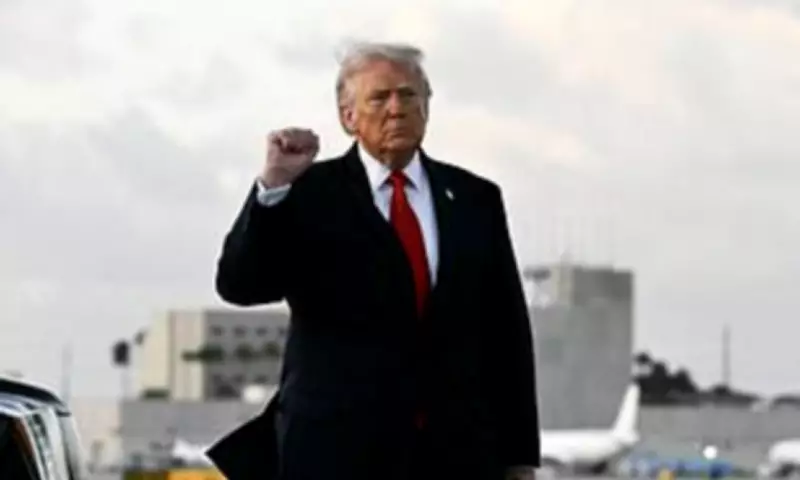
President Donald Trump has deployed United States Navy vessels to establish a blockade in the strategically vital Strait of Hormuz, a move that military analysts caution could endanger American military personnel. The announcement was made by Trump via his Truth Social platform on Sunday, where he declared naval assets would commence blockading all ships attempting to enter or exit the strait.
Trump's Declaration and Iranian Threat Assessment
In his social media statement, Trump asserted that the Iranian naval threat has been eliminated from the crucial waterway following sustained US military operations against Iran since February 28. "Effective immediately, the United States Navy, the Finest in the World, will begin the process of BLOCKADING any and all Ships trying to enter, or leave, the Strait of Hormuz," Trump proclaimed. He added a stark warning: "Any Iranian who fires at us, or at peaceful vessels, will be BLOWN TO HELL!"
However, defense experts immediately challenged the president's assessment of Iranian capabilities. While acknowledging that US operations have destroyed much of Iran's larger naval vessels, specialists note that the Islamic Revolutionary Guard Corps maintains a formidable fleet of smaller, more agile boats specifically designed for operations in the narrow strait.

Expert Warnings About Asymmetrical Warfare
Farzin Nadimi, a senior fellow at the Washington Institute specializing in Iranian affairs, revealed to the Wall Street Journal that more than sixty percent of the IRGC's fast-attack craft and speedboat fleet remains operational. This presents a serious threat to US forces in a waterway that measures only about thirty-five kilometers wide at its narrowest point.
David Des Roches, former director for Persian Gulf policy at the US Defense Department, emphasized that Iran's "asymmetrical strategy is working." These smaller vessels are highly proficient at controlling the strategic chokepoint through various tactics including missile deployment, mine-laying operations, and harassment of commercial shipping.
Ceasefire Breakdown and Diplomatic Context
The blockade announcement follows the collapse of peace negotiations between the United States and Iran. Vice President JD Vance returned empty-handed from twenty-one hours of talks in Pakistan after Iranian representatives proved unwilling to abandon their nuclear ambitions, according to Trump administration officials.
A US official familiar with the deliberations told The Daily Mail that Iranian negotiators initially failed to comprehend America's fundamental requirement that any potential agreement must center on preventing Iran from obtaining nuclear weapons. While Vice President Vance corrected this misunderstanding during discussions, the Iranians reportedly need to adjust their assumptions about the current military situation before serious negotiations can resume.
International Reactions and NATO Support
Trump revealed during an appearance on Fox News Sunday Morning Futures that NATO would provide "begrudging" support for US efforts to secure the Strait of Hormuz, though he characterized the alliance as "shameful" for what he perceived as insufficient backing. The president expressed particular disappointment with the United Kingdom, comparing Prime Minister Sir Keir Starmer to notorious Adolf Hitler appeaser Neville Chamberlain.
A UK government spokesperson promptly rejected Trump's characterization, clarifying that Britain would not participate in the Hormuz blockade. "We continue to support freedom of navigation and the opening of the Strait of Hormuz, which is urgently needed to support the global economy and the cost of living back home," the spokesperson stated.
Current Military Presence and Iranian Countermeasures
The USS Franklin Petersen and USS Michael Murphy, both American destroyers, are currently positioned in the Strait of Hormuz to enforce the blockade. This development occurs against the backdrop of a fragile two-week ceasefire agreement between Washington and Tehran, which had temporarily opened the strait in exchange for Iran halting hostilities.

Iran has responded to the blockade announcement with its own warnings broadcast via marine radio, threatening destruction of any unauthorized vessels attempting to traverse the waterway. Tehran has also alerted shipping interests to possible antiship mines and advised following new coastal routes with Revolutionary Guard guidance.
White House spokeswoman Anna Kelly defended the administration's actions, telling the Journal that the US military had accomplished "the largest elimination of a navy over a three-week period since World War II." She further noted that American operations have destroyed Iran's ballistic missile capabilities and production facilities, which she claimed would help secure long-term energy flow through the region.
Commercial Shipping Impact
The blockade has already dramatically reduced maritime traffic through one of the world's most crucial oil transit routes. On the first day of implementation, only four vessels passed through the strait, compared to the normal daily average exceeding one hundred ships. Iranian authorities plan to limit daily traffic to approximately twelve vessels under the new restrictions.
Trump expanded on his blockade directive Sunday morning, instructing the US Navy "to seek and interdict every vessel in International Waters that has paid a toll to Iran." He declared that "No one who pays an illegal toll will have safe passage on the high seas," reinforcing his administration's hardline stance against what it considers Iranian extortion in the vital waterway.