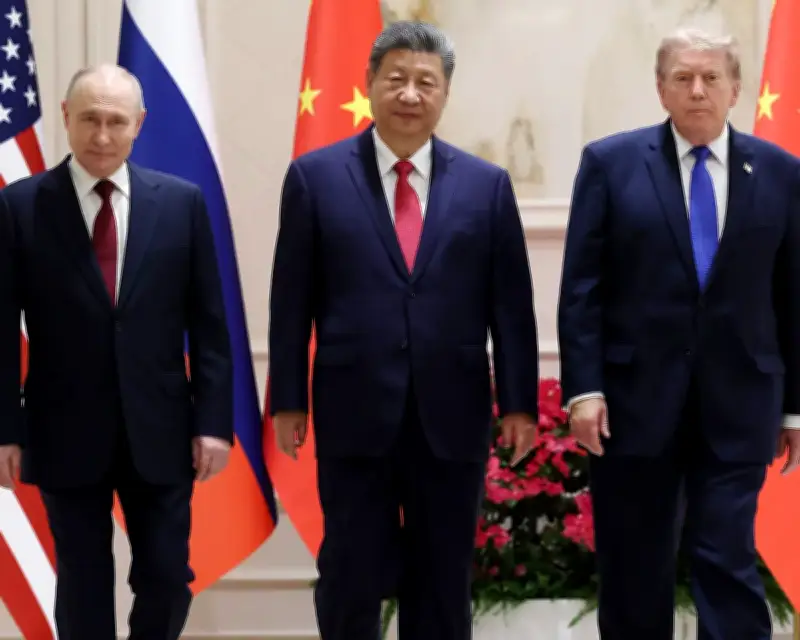
Senator Edward Markey has called on Donald Trump to take immediate action to prevent a three-way nuclear arms race between the United States, Russia and China, following the president's meeting with Vladimir Putin and Xi Jinping in southern China.
During the meeting, Trump said the leaders would “talk about nuclear weapons and denuclearization”. It was the first time the leaders of the world’s three largest nuclear powers had come together to discuss the future of nuclear weapons, a discussion that was long overdue.
Markey argued that the meeting was “all pomp and little pop”, and that if Trump wants to make the world safer, he needs to do more than talk. The US needs to lead, he said.
Arms control architecture under threat
Nuclear weapons remain the greatest immediate threat to the security of the US, Russia, China and the entire world, according to Markey. He noted that as the risks of artificial intelligence, climate emergency and geopolitical instability grow, the danger of nuclear catastrophe has not diminished. The erosion of arms control agreements and the modernization and expansion of nuclear arsenals are bringing the world closer to a dangerous new arms race.
The first priority must be rebuilding the arms control architecture that the United States and Russia spent half a century constructing. During and after the cold war, Washington and Moscow negotiated a series of treaties that helped prevent nuclear confrontation and reduced their nuclear arsenals by roughly 88%.
Those agreements demonstrated that even adversaries can find common ground when the stakes are existential, but that progress is now in jeopardy. The New Start Treaty, the last remaining agreement limiting the strategic nuclear arsenals of the United States and Russia, expired earlier this year without a replacement. Today, there are no legally binding limits on the size of their nuclear arsenals, and China has never been subject to comparable restrictions.
China’s smaller arsenal
Markey noted that there were plenty of reasons to be skeptical that the meeting could produce meaningful results. During his first administration, Trump tried to bring China into bilateral nuclear arms control negotiations between Washington and Moscow. That effort failed because Beijing correctly pointed out that it had a much smaller arsenal than the others.
China is expanding its nuclear arsenal, but it possesses roughly 600 nuclear weapons, compared with approximately 4,000 in the arsenals of both the US and Russia. Expecting Beijing to negotiate reductions on the same terms as Washington and Moscow is unrealistic, Markey argued. Progress cannot be made by demanding that China reduce its arsenal while the US and Russia retain arsenals many times larger.
Nor should Trump wait for Putin to make the first move. Putin has increasingly relied on nuclear threats to discourage other countries from supporting Ukraine and to advance his broader strategic objectives. But even though he may resist reductions, that does not mean Russia wants to spend the next decade locked in another costly nuclear arms race.
Missed opportunity on New Start
Shortly before New Start expired, Moscow proposed that the United States and Russia voluntarily maintain their existing limits on strategic nuclear weapons while negotiating a successor agreement. Trump rejected that proposal, which Markey described as a missed opportunity. He urged Trump to reverse course and put that proposal back on the table.
Markey said Trump should immediately agree with Putin to freeze their nuclear arsenals while negotiating a new arms control agreement to replace New Start. A new agreement should reduce American and Russian nuclear arsenals to 1,000 weapons each, counting both strategic (long-range) weapons and tactical (shorter-range) weapons. Such reductions would lower the risk of nuclear war, rebuild a measure of trust between Washington and Moscow, and save taxpayers billions of dollars.
Just as importantly, a serious American-Russian agreement would create the conditions for China to join the process. Beijing should commit to refraining from further significant increases in its nuclear arsenal as long as Washington and Moscow are making real progress toward substantial reductions.
The objective should be straightforward: bring American and Russian arsenals down toward China’s level, not drive China to build up toward ours. That is how a three-way arms race can be prevented before it gets started.
Nuclear superiority vs nuclear security
Some will argue that the United States must maintain nuclear superiority over China and should never reduce its arsenal unless Beijing agrees to comparable reductions. But that approach mistakes nuclear superiority for nuclear security, Markey said. History demonstrates that arms control works when countries negotiate from a position of mutual security and seek stability, rather than endlessly pursuing an advantage over one another.
A new nuclear arms race among the US, Russia and China would serve nobody’s interests. It would waste enormous sums of public money, accelerate environmental damage, undermine international security and increase the possibility that a crisis or miscalculation could end in nuclear catastrophe.
The world does not need another nuclear arms race. It needs leadership, diplomacy, and a clear commitment to a safer future. “If Trump is serious about denuclearization, moving forward, he now has his chance to prove it,” Markey wrote.