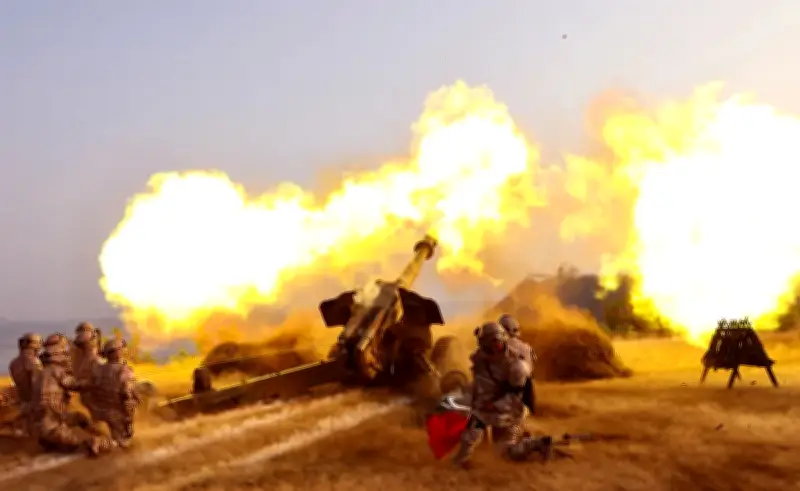
Donald Trump has ordered a substantial reduction in joint US military drills with South Korea, citing his "very good relationship" with Kim Jong-un, even as US military officials warn that North Korea is gaining new battlefield experience from the war in Ukraine.
The Ulchi Freedom Shield exercise, one of two major annual drills, begins Monday and runs until 27 August. It was expected to involve about 18,000 South Korean troops, alongside US forces and personnel from 11 of the 18 member states of the United Nations Command (UNC).
Trump's decision
On Sunday evening, the US president said he was "not happy" with US participation "based on my very good relationship with Kim Jong-un". He added that the drills were costly and "send a signal that is totally inappropriate and hostile, to a country that, as long as Donald J Trump has been president, has been unthreatening and respectful".
Trump said it was too late to cancel the drills, so he ordered Defence Secretary Pete Hegseth to "substantially reduce" them. He also said South Korea had refused to help in the "denuclearisation of the Islamic republic of Iran".
On Saturday, Trump shared an old photo of himself with Kim on Truth Social, repeating his claim that the two "get along great", leading to speculation he might renew efforts for a summit.
Ukraine lessons
Last week, South Korean and US military officials said they would incorporate lessons from North Korean troops' battlefield experience in Ukraine, including new drone tactics, into the drills. North Korea has deepened military ties with Russia since signing a comprehensive strategic partnership pact in June 2024, providing troops, artillery ammunition and ballistic missiles to support Moscow's war effort.
At a joint briefing, Col Ryan Donald, public affairs director for the US-led commands in South Korea, said this year's scenario would reflect "drones, GPS disruption [and] cyber attacks", threats he linked directly to North Korean soldiers who have fought in Ukraine. "They've taken those lessons they learned there and brought them back to North Korea, that changes the DPRK capability," he said. "Our training accounts for that threat, that is why the exercise looks different [from previous exercises], and over the last five years it's continually evolved."
Lt Gen Scott Winter, deputy commander of the UNC, said the threats being countered "reflect the increased use of these technologies and the understanding that North Korea has contemporary battlefield experience". He noted that North Korea has used the war to test ballistic missile systems, and said this year's drills would be "bigger and better than ever".
Reactions and context
South Korea's defence ministry said the drills would "proceed as previously notified and scheduled". The Guardian has reached out to South Korea's defence and foreign ministries for further comment.
More than 14,000 North Korean troops have fought alongside Russian forces in the Kursk region, and Ukraine's president, Volodymyr Zelenskyy, has warned that Russia is preparing to receive 30,000 more. The two countries are also close to completing the first road bridge over the Tumen river, which one open-source investigation concluded functions more as a military logistics corridor than a trade route. Russian state media says it is expected to open in September.
In the days before the exercise, North Korea test-fired ballistic missiles, in what analysts read partly as a protest. On Friday, North Korea's foreign ministry called the exercise "a rehearsal for an aggressive war", warning it would "respond to a new level of a threat with a new level of a deterrent". Officials have repeatedly described the exercise as "defensive" in nature.
Chun In-bum, a retired lieutenant general who commanded South Korea's special forces, highlighted the importance of preparing for new challenges. "This is a very serious improvement in North Korean capabilities. And we should not take lightly this threat environment."