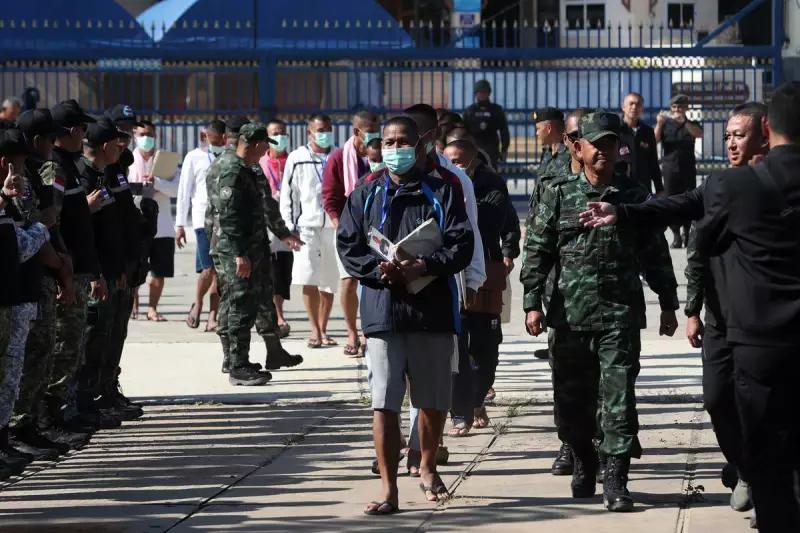
In a significant move towards de-escalation, Thailand has released and repatriated 18 Cambodian prisoners of war, fulfilling a central condition of a freshly inked ceasefire agreement designed to halt prolonged fighting along the contentious shared border.
A Gesture of Goodwill and Adherence to Protocol
The handover took place on Wednesday 31 December 2025 at a border checkpoint between Thailand’s Chanthaburi province and Cambodia’s Pailin province. This was the very location where the defence ministers of both nations had formalised the ceasefire agreement just days earlier, on Saturday.
Thailand’s Foreign Ministry stated the repatriation was conducted as a "demonstration of goodwill and confidence-building, as well as in adherence to international humanitarian principles." The soldiers had been detained for five months following their capture in late July.

Cambodia’s Defence Ministry welcomed the move, asserting it "creates an environment conducive to peace, stability, and the full normalization of relations for the benefit of both nations and their people in the near future."
From Detention to Diplomatic Leverage
The prisoners' status had been a persistent point of friction. Thailand maintained its right to hold the men under the Geneva Conventions, which permit detention until the cessation of hostilities. Thai authorities noted the detainees had received visits from the International Committee of the Red Cross and their rights under international law were respected.
Conversely, the Cambodian government effectively leveraged the continued captivity to galvanise nationalist sentiment back home. In its Wednesday statement, it emphasised the government had "remained steadfast in the promise made to the families of the 18 soldiers and the Cambodian people: that no soldier would be left behind."
The circumstances of the capture remain disputed. Cambodian officials claim their soldiers approached a Thai position with friendly post-fighting greetings, while Thai officials insisted the group had hostile intent and entered territory Thailand considers its own. Originally, 20 soldiers were taken captive, but two were repatriated shortly after for medical reasons.
A Fragile Path to Peace
The ceasefire pact stipulated the soldiers would be freed if combat ceased for 72 hours after the agreement took effect at noon on Saturday. Although the 72-hour period lapsed on Tuesday, Thai authorities delayed the release, citing a need to evaluate the situation after reporting 250 Cambodian drones were active along the border.
This release aims to remove a major obstacle to peace after two rounds of destructive combat and ongoing minor clashes, which escalated into widespread heavy fighting in early December. Official Thai figures report the loss of 26 soldiers and one civilian since 7 December, with an additional 44 civilian deaths.
The current agreement builds on an initial July ceasefire, brokered by Malaysia and pushed by pressure from then-U.S. President Donald Trump, who threatened trade privilege sanctions. It was later formalised in more detail at an October regional meeting in Malaysia attended by Trump. Despite these deals, a bitter propaganda war and sporadic violence continued until the recent escalation.