
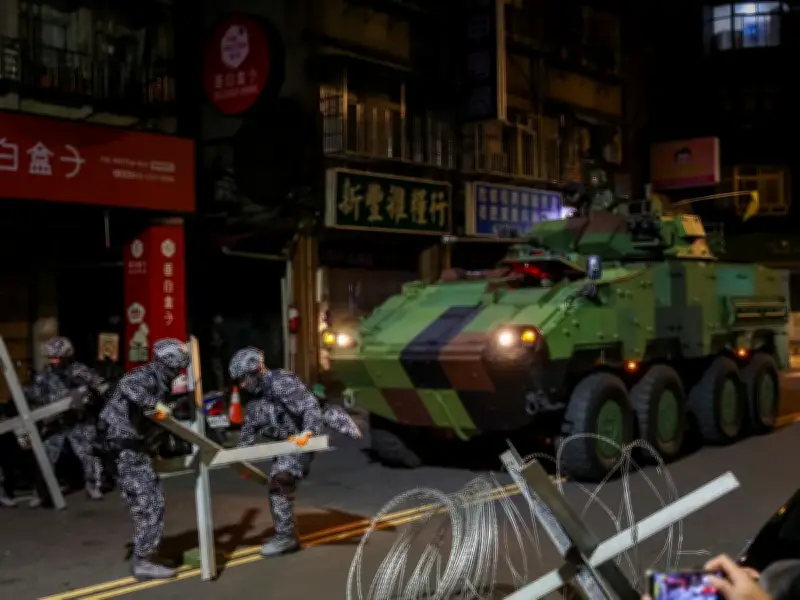
World War 3 fears are reaching a boiling point after Taiwan locked down its cities and plunged its population into massive, unscripted live-fire military exercises. Known as the Han Kuang drills, the nationwide operation tested the island's defence capabilities and combat readiness against a potential invasion, sparking widespread fears of a looming World War 3 scenario.
Blockade of Danjiang Bridge
As part of the intensive simulations, the Taiwanese military blockaded the newly opened Danjiang Bridge, deploying heavy anti-tank barriers and razor wire to halt any simulated enemy advance towards the capital. The drills being held this week are running alongside the Wan An civil defence exercises, bringing normal life to a grinding halt.
Sirens wailed across major metropolitan areas, signalling the start of simulated air raids that force residents to scramble for cover. It has been claimed that the “anti-invasion” drills were done as a show of strength to China, who constantly makes threats against the country.
Civil Defence and Public Response
Mobile internet speeds were deliberately reduced to simulate enemy attacks on communications infrastructure, throwing cities into offline simulations and testing the public's resilience in a wartime environment. During the daytime alerts, civilians and young children were seen rushing along pavements as police officers in high-visibility vests urgently guide them towards designated safe zones.
The immediate impact of the Wan An civil defence drills is visible underground as well. Safety officials direct large groups of commuters and families to crouch against rows of lockers inside transport concourses, ensuring everyone is kept away from windows and open areas. Locals were seen cowering in subterranean parking garages, sitting against the walls with their hands firmly covering their heads as they wait for the all-clear signal.
Urban Combat Simulations
Then, the military operations intensified as armed forces conducted decentralised, US-style combat simulations on urban streets, local news outlets reported. Infantrymen in digital camouflage stood guard in the dead of night, weapons drawn as they watched over barricades of razor wire constructed right in the middle of commercial districts.
The heavy military presence transformed normal neighbourhoods into active war zones. Squads of soldiers hastily erected steel anti-tank obstacles and spools of barbed wire on dark roads, protecting the perimetre around massive, multi-wheeled armoured tanks. Local businesses served as surreal backdrops for the high-stakes urban warfare drills. Heavily armed troops moved tactically along pavements, passing directly in front of closed restaurants and shopfronts as they patrol the darkened city blocks – as if the enemy was right there in front of them.
Engineering Challenges and Strategic Implications
According to locals news outlet streamlinefeed: "Military officials emphasized that the exercise provided crucial logistical data. Historically, blockade drills were conducted on flat, open roadways. Deploying heavy concrete and Hesco barriers within the confined, weight-sensitive parameters of a suspended bridge presented unique engineering challenges. The parameters gathered during the nighttime closure will directly inform future tactical doctrines."
"As daylight broke and the concrete blocks were rapidly cleared for the morning commuter rush, the strategic reality lingered: Taiwan is preparing its pristine civilian infrastructure to serve as the brutal frontline of a potential existential conflict." During the drill, elements of the Army's 53rd Engineering Group utilized requisitioned civilian dump trucks and flatbed trailers to transport heavy interdiction materials onto the bridge's southbound lanes. Within hours, the combat engineers constructed a formidable 200-meter-long, 13-meter-wide blockade zone.




