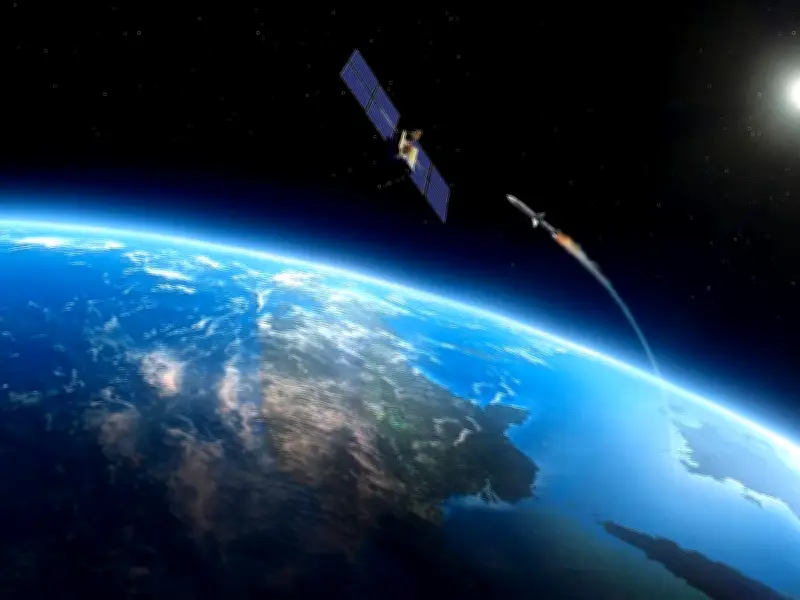
Real-life Star Wars could break out within five years, experts have warned, as civilian space companies pivot to defence in preparation for potential conflict in orbit.
Civilian firms shift to military roles
UK-based Astroscale, founded to remove space debris from Earth's orbit, is now involved in classified military programmes which could repurpose its technology to monitor or deter threatening enemy spacecraft. Space refuelling company Orbit Fab is also working with the Ministry of Defence on 'defensive' and 'offensive capabilities in space'.
Last month the US Space Force admitted it had deployed a weapon in orbit for the first time. Chinese satellites have been spotted dogfighting, and it is feared Russia has a nuclear device in orbit.
Daily targeting in space
Dr Julia Balm, of the Freeman Air and Space Institute at King's College London, said allied nations were now finding themselves 'targeted' in space by adversaries 'on a daily basis'.
"We are looking at conflict emerging not only in the domain, but in the next five years," she said. "If an adversary believes that it can disrupt satellites and potentially cripple not only our military operations but also critical national infrastructure we have to see that as space being an attractive means of coercion in the eyes of our adversaries and prepare as such."
"It's a question really about resilience at an operational level - about organising ourselves in space as a war-fighting domain."
Consequences of satellite destruction
Modern life largely relies on satellites and their destruction would have catastrophic consequences for the West, including information blackouts and financial sector collapse. Air traffic control services would go 'blind' and essential services such as the internet, TV, and weather forecasting would cease to function. Life would be pushed back to the 19th Century, experts have warned.
Detonating a nuclear weapon in space would release huge amounts of radiation and high energy particles which could destroy a vast array of satellites in orbit around Earth. The Foreign Policy Research Institute said Russia appears to be considering a 'mass kill' of satellites in orbit.
In 2025 it launched Cosmos spacecraft which have conducted suspicious synchronised manoeuvres, and its Luch/Olymp intelligence satellites have stalked European spacecraft which provide critical data and communications to Earth. This week, a Russian military satellite moved close to ICEYE X36 - an Earth-observation satellite that has been supporting Ukraine.
China's Shenlong space plane has been seen practising capturing objects in orbit, while Chinese satellites have become the first to demonstrate off-planet re-fuelling - practising close proximity operations with other orbital objects coming within a few feet.
Industry response and UK defence shift
Nick Shave, managing director of Astroscale, said the company never intended to have a military arm when it was founded in 2013 for in-space servicing. It changed direction following the UK's strategic defence review in 2024 which warned of war in space.
He said: "For the last 20 or 30 years we've been able to just put objects in orbit and be fairly happy that they're not going to get attacked. But I think that's changing now.
"We need to really develop the capability to show we are strong and that we will protect our assets. The strategic defence review was the first time that space as a war-fighting domain from a UK government perspective was really recognised. So that was a wake-up call."
Mr Shave said it may be possible to send payloads to deter aggressive spacecraft in a similar way to how chaff is deployed to disrupt guided missile systems.
"There could be different ways of stopping an aggressor coming towards you or interfering with your satellite and deterring that," he said. "I would hope that we wouldn't end up in a sort of missile war-zone Armageddon-type scenario."
In September the Royal Air Force announced its first space squadron dedicated to defending Britain's satellites. Defence Secretary Wes Streeting warned the threat in space was 'growing in speed, scale and sophistication' - often mirroring geopolitics on Earth.
Across the globe, countries have been developing space weapons including electromagnetic pulses, lasers, dazzlers to blind optical sensors, and grapplers to latch on to satellites and drag them out of orbit. Anti-satellite missiles have also been tested.
Jacob Geer, Orbit Fab's managing director, said: "When I started the debris removal programme we didn't talk to the Ministry of Defence. But trying to change and adapt an uncooperative satellite could be useful to the UK and other militaries around the world. The world changed and now that pivot to defence has happened."
The European Space Agency has also started making its projects dual-use to include military and security elements.