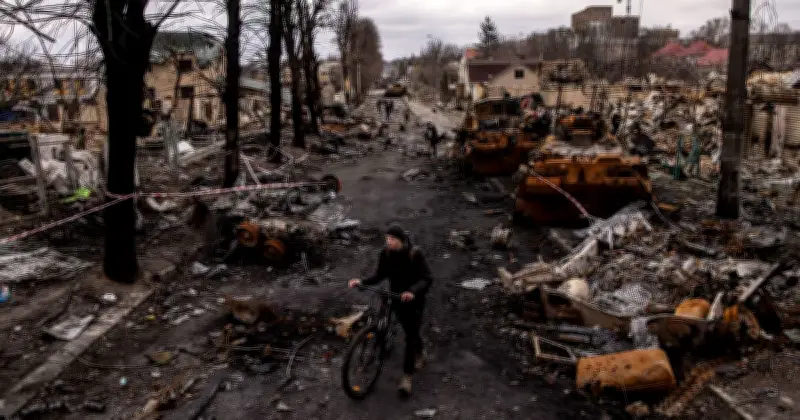
A major data leak has revealed the devastating toll the war in Ukraine has taken on Russian forces, with more than 460,000 deaths linked to the conflict between February 2022 and September 2026. The leak, orchestrated by the hacking group Cyber Partisans and the Ukrainian hacker collective Silent Crow, exposes an unexpectedly deadly war on Russia's side.
In just one week last year, 5,000 Russian soldiers died fighting Ukrainian forces. Since the outbreak of the war in 2022, more than 1,000 soldiers have died by suicide, according to the leaked data.
Massive daily losses and cover-up
The Guardian reported that Russia scrambled to cover up the staggering loss of 720 men every day during this period, the highest rate during the entire war. Russia's defence ministry has not updated its official death toll since September 2022, when it said 5,937 soldiers had been killed.
For comparison, this figure is far more than anything suffered since World War 2. About 15,000 Soviet soldiers were killed over the nine years in Afghanistan between 1979 and 1987 according to official figures; in the worst year, 1984, the toll was about 2,300. In Ukraine in 2025, Russia was losing that many men roughly every four days.
Pokrovsk and the human cost
At least a third of this number were killed around the Eastern Ukrainian city of Pokrovsk, a key focus of Putin's. Moscow had tens of thousands of troops in its spring offensive in 2025.
Alexander Korepanov was one of the casualties. He signed up to fight in August 2023. He was wounded twice and twice sent back to the front lines before dying in the deadly May week last year, after 20 months at war. Korepanov was killed in the village of Uspenovka, near Pokrovsk, aged 52.
Korepanov is one of 11 million death certificates obtained by the hacking group. War became the leading cause of death for Russian men under 65 last year.
Experts weigh in on the data
"There was always sort of an unknown X factor: how many Russian deaths are we missing? And that turned out to be much much more," said Janis Kluge, a Russia expert at the German Institute for International and Security Affairs, told the Guardian. Kluge said the data suggested Russia could have more soldiers killed in action than severely wounded, which is different to the expected number.
The even more disturbing suicide data may be a result of the intense pressure from fellow soldiers and commanders, as well as a fear of being sent on dangerous missions.
"There's clearly a lot of coercion used by the Russian military to force people to go forward. In some cases, they will abuse them, torture them, use different types of physical abuse," Rob Lee, a senior fellow at the Foreign Policy Research Institute, told The Guardian. "This tells you something about this war and the way that it's fought," Kluge said.
Territorial gains and rising death toll
Since the start of 2023, Russia has gained about 8,000 sq km (3,000 sq miles), less than 1.5% of Ukraine's territory, according to data from the Ukrainian monitoring group DeepState.
Almost 20,000 deaths were recorded during the first year of the invasion and 50,000 in 2023. In 2024 the toll more than doubled, to more than 134,000, and it rose a further 52% a year later, to close to 200,000, the deadliest year of the war: about 548 men a day, against an average of about 277 since the invasion began.
"We've been predicting demographic doom for Russia for a few decades, and somehow the catastrophe never materialised," said Judyth Twigg, a professor of global health at Virginia Commonwealth University in the US. "But the current situation really does look qualitatively different. Today's losses are a direct consequence of regime policy: combat deaths, political emigration, foregone births, healthcare budgets raided to fund [military] signing bonuses and death payouts."
Almost 116,000 of the deaths - more than a quarter of the total with a known recorded location - occurred in Pokrovsk. The coalmining town of 60,000 people before the war covers less than 30 sq km, but more Russian soldiers have died in the district around it than Ukrainians lived in the city itself.
"If we compare the death data with Russia's official recruitment rates, it becomes clear that Russia's military has a manpower problem," said Kluge. "The absolutely horrible losses combined with slower recruitment rates apparently forced Russia to slow down its attacks in 2026 already," he added.
In 2018, Putin spoke of Russians looking forward to a "well-deserved retirement", when they could devote more time to their families, children and grandchildren. Eight years later, more and more older Russian men are dying on the battlefields of Ukraine.