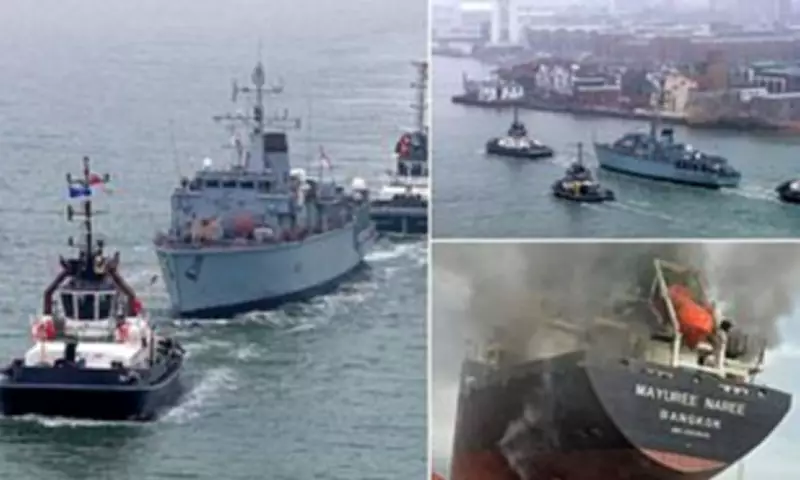
Royal Navy's Minehunter Return Marks End of 50-Year Gulf Presence
In a stark symbol of diminishing naval capabilities, the battered and unseaworthy HMS Middleton was unceremoniously dragged by tugs into Portsmouth naval base on Sunday, March 8. The Hunt class mine countermeasures vessel (MCMV) completed its ignominious journey back from the Gulf aboard a heavy-lift ship, having been deemed unfit to make the 6,200-mile voyage from Bahrain under its own power.
Strategic Withdrawal Amid Rising Tensions
This return marks the definitive end of the Royal Navy's anti-mine vessel presence in the Middle East after nearly five decades of continuous deployment. According to naval statements, only unmanned drone systems now remain in the region to handle mine countermeasures duties. The timing of this withdrawal appears particularly ill-judged given the escalating geopolitical situation.
By the time HMS Middleton reached British shores, the United States had already launched attacks against Iran, and global oil prices were hovering around $100 per barrel. This price surge reflects mounting fears that Tehran has either already deployed or plans to deploy mines in the strategically critical Strait of Hormuz - the narrow bottleneck entrance to the Persian Gulf through which approximately 20% of the world's oil passes.

Growing Threats in Vital Waterway
The situation has deteriorated rapidly in recent days. Former US President Donald Trump claimed last night that Iran had positioned about a dozen mines within the channel, further complicating what has become an effective blockade. The strait is already closed to through traffic from some of the world's most productive oil fields following attacks on multiple commercial vessels.
If these mining allegations are confirmed, the Strait of Hormuz could remain closed or severely restricted for a considerable period, making the Royal Navy's withdrawal from the region appear even more poorly timed. The strategic implications are significant, with Iran's Revolutionary Guards claiming responsibility for at least one attack on a Thai bulk carrier that was set ablaze after allegedly disobeying orders.
Diminished Naval Capabilities
The Royal Navy's current predicament reveals serious capability gaps. Of Britain's seven mine countermeasures vessels, four are now out of commission, while the remaining three are based in UK waters performing essential duties including protecting nuclear submarine bases. Even if one vessel could be redeployed to the Gulf immediately, it would require approximately five weeks to reach the region.
Defence analyst Francis Tusa highlighted this deterioration in capability, telling The Times: 'When the Iran-Iraq tanker war broke out in the late 1980s, the USA turned to the UK for our mine countermeasures expertise. From that time on, there have normally been four advanced MCMVs deployed in Bahrain.' He added pointedly: 'As a country, the UK is being found sadly wanting as regards naval capabilities.'
Conflicting Narratives and Regional Impact
Just before the current conflict erupted, senior naval officers presented a different perspective on the drawdown. RN fleet commander Vice-Admiral Steve Moorhouse told The Telegraph that regional partners had requested this shift in capability, stating: 'When you ask allies in the Gulf what they actually want from us, they now want boarding teams to help build up their own capabilities, autonomous systems, and some leadership in the maritime environment.'
Meanwhile, the regional situation continues to deteriorate. Two fuel tankers in Iraqi waters were reportedly struck by explosive-laden Iranian boats early today, prompting Iraqi officials to announce that oil ports have 'completely stopped operations.' Another container vessel reported being struck by an unknown projectile near the United Arab Emirates, while Oman has evacuated all vessels from its key oil export terminal at Mina Al Fahal as a precautionary measure.
Iran has significantly escalated attacks on merchant shipping in the Strait of Hormuz, with at least 16 vessels struck since fighting began. Tehran has issued stark warnings that the world should prepare for oil prices reaching $200 per barrel if tensions continue to mount.

Royal Navy's Modernisation Defence
A Royal Navy spokesman defended the strategic shift, stating: 'HMS Middleton was returned to the UK to undergo a planned upkeep period. Once regenerated, it will rejoin the fleet. Meanwhile, we have an autonomous minehunting capability deployed in the region. This is part of our transition towards a hybrid Navy, where uncrewed vessels and autonomous systems are increasingly taking on these roles.'
This transition comes at a critical moment when traditional mine countermeasures capabilities are suddenly in high demand. The withdrawal of HMS Middleton and the end of Britain's 50-year minehunter presence in the Gulf represents both a symbolic and practical reduction in Royal Navy influence in a region where maritime security directly impacts global energy markets and economic stability.